


Montessori in the Rocky Mountains
Rural. Remote.
That’s the remotest of the U.S. Census Bureau’s 12 categories of “locale,” defined as “more than 25 miles from an Urbanized Area and also more than 10 miles from an Urban Cluster.” And that’s where you’ll find North Fork Montessori at Crawford, a district school serving 124 children in Crawford, CO. It’s one of just five public Montessori schools in that category.
To put that in perspective, Crawford itself had a population of 403 in 2020. The nearest town is Hotchkiss, 11 miles away, and hardly an Urban Cluster at 875. That honor goes to Montrose, home to 20,291 Coloradans, 51 miles by road. It’s only 21 miles as the crow flies, but that crow flies over the rugged and breathtaking Gunison Gorge Wilderness, so the road is a better bet. The closest Urbanized Area nod goes to Grand Junction, 65,000 souls 71 miles up Highway 50.
So yes, rural. Remote.
But North Fork Montessori has been providing free public Montessori education to the families of Delta
country for 25 years. MontessoriPublic sat down with Crawford Principal Denise Regelman and Lower Elementary teacher Cami Bair (25 years with the school) to learn more about the program. Regelman and Bear are so in sync that they finish each other’s sentences, so we’ll just call them the Crawford team in this edited conversation.
MontessoriPublic: Tell me about your school, and what it’s like doing Montessori out where you are?
Crawford Team: We have 121 students, primary through upper elementary, with two sections of each. So
two classrooms of primary, two lower elementary, and two upper elementary.
MP: Does your primary have three- and four-year-olds, or do you have to start with Kindergarten? How
does that work in the funding model for Colorado?
CT: We do have a full age range in primary. We have a universal preschool program where the state
covers about 80% of the cost. We also have grants through Colorado-based organizations Anschutz
and Temple Buell, which help with tuition. Before the universal pre-K program, we relied heavily on grant
money because preschool can be cost-prohibitive for many families.
MP: So there’s tuition for three- and four-year-olds?
CT: Yes, it’s a sliding scale.
MP: So 80% of the cost is covered by state funding, and the remaining 20% is covered by tuition, and
families can also get grant support?
CT: Yes.
MP: And you’re in what the US Census describes as a “rural, remote” area.
CT: Yes, very rural. Delta County is one of the lower socioeconomic counties in Colorado. [Ed.: 51st out of 64 counties in median household income at $56,349, well below the U.S. median of $75,149 and further below the Colorado median of $87,598.]
We are in a little community called Crawford, at the very edge of Delta County. If you drive a few miles
you’re in Montrose County, and our demographic is definitely rural. We’re talking “real America,” you know—we have kids that have had all kinds of stuff go on in their lives. Kids that are from solid ranching
families. Kids whose parents moved here for the school. A normal American can still afford a few acres
here. Lots of the kids get up and irrigate or go get eggs from the chicken coop before they get on the bus.
It’s just a very cute and, I would say, a kind of a normal demographic that we serve for rural America.
MP: How is it that there’s a Montessori school in Crawford in the 1st place?
CT: It’s a little miracle. Here’s what happened. The district, Delta County School District, 50J, is a very
lovely district. They were open to a group of interested parents. About 25 years ago the district had had a Montessori classroom or two in one of their schools, and it had been sweet, and they had really liked it. So when this group of parents approached them and said, “Can we actually start a school?”, believe it or not, they said, “Sure, let’s try it.”
And almost right away it got a very good reputation. We’ve had tons of awards and the district loves us.
[Ed.: Crawford has been a Colorado School of Distinction twice in the last three years among other
awards.] As a public school, of course, we take all comers, and the success rate at the school is high. We
do really well on standardized testing. And when we send out parent surveys and student surveys, we get really high scores on those.
The school used to be in Hotchkiss, but we were outgrowing our tiny building there, and we had a
waiting list. There was a beautiful building here in Crawford whose numbers had gone down a bit, so they
moved us up here.
CT: And one thing that’s really wonderful about this school and this district is that there’s busing provided throughout Delta County. So we have families coming from Paonia and Hotchkiss, and all of our little surrounding towns which make up our school district. And sometimes there are families that travel, as far as 35 miles one way just to be a part of our school.
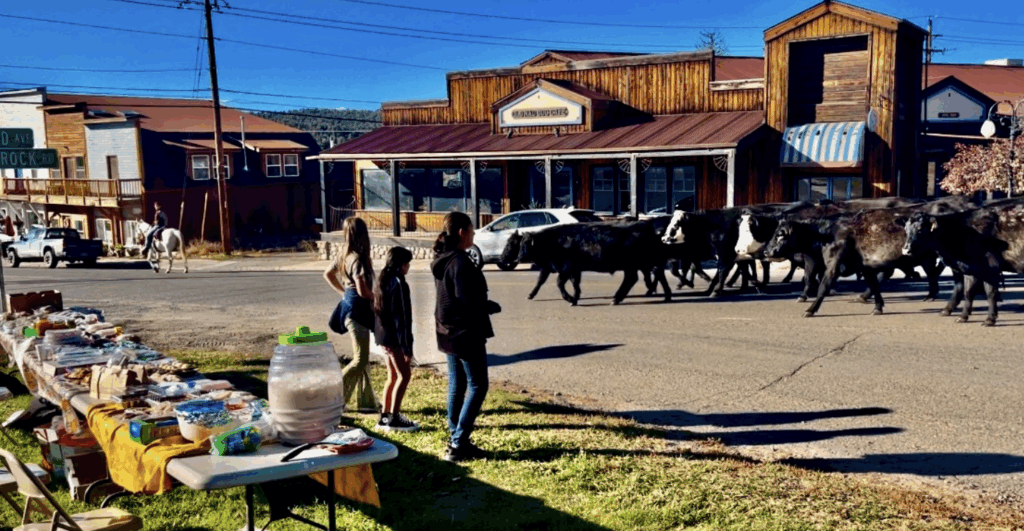
And it’s definitely a rural community. There are times when kids will be late to school because of a cattle
drive, or a sheep drive.
CT: This October the kids did a “Hunter’s Bake Sale” for a fundraiser. We get quite a few hunters that
come through the area. So the kids were doing the bake sale, and then the whole town of Crawford fills up with cattle, everyone watching 150 cows go by. Then the streets open back up, and they just go on with the bake sale. These are just parts of life here.
MP: What’s the newer facility like?
CT: We have a gym. We have a library which was added with grant funding. And in the library we put a
STEAM lab, and the kids can go and do engineering, 3D printing, robotics. They do all this absolutely
incredible project-based stuff. We also offer Spanish, Latin and band starting in 4th grade.
And then the play area is bigger, too. We have a separate, beautiful play area for the primary program.
They play soccer out there. We got grant money and put beautiful new play structures in and—this is kind of funny—we have this big hill behind the school, but it faces south. So we got grant money to rearrange it, to move some dirt and make a little sledding hill.
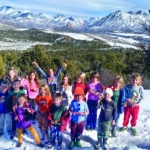
We spend a lot of time outside, and on those snow days that are coming, students are allowed to even
bring a sled, and they go sledding. You can even hike up the hill and find fossils, believe it or not, right
here in Colorado.
The town elevation is almost 7,000 feet. It’s not really a hill: we’re on the side of a mountain. You climb
up, you get to the top. It’s the most extraordinarily beautiful view you’ve ever seen. You see mountains to
the north and to the east, and then rolling farmland and a river, and it’s just unbelievable to the south and
the west, and then about two-thirds of the way up, there’s a bank full of marine fossils, brachiopods, and
little beautiful fossils like that, and the kids go crazy, as you can imagine.
And then we go hike into town. We go to the library. This wonderful couple rented the Town Hall for us
once a month, and we go there and do square dancing and other kinds of folk dancing.
And then we go to businesses. Our little town of Crawford really supports our school. So we work
together, we have food drives, and we support our library by having, instead of a Scholastic book fair, our
students donate books, and then they purchase them back, and then all the money goes to our little
Crawford library.
MP: So the community is very connected to the school?
CT: Yes, and once or twice a year, we have an open house—a “Montessori showcase night.” Parents
come, and you wouldn’t believe how cute it is. These kids are showing mom and their grandpa, and so
forth, the Montessori approach. And you’ll have a first grader or a second grader showing long
multiplication. You should see the parents. Our students are the teachers, and they have their planners all ready to go for their parents. And then the student has to sign off after they do their works. The parents really enjoy that night. And the teachers are just observing. It’s really beautiful.
MP: What kind of school are you in the Colorado system—district, magnet, charter, or something else?
CT: We’re a Colorado School of Innovation [Ed.: This is a Colorado category that allows schools some
flexibility in “educational programming, personnel selection and evaluation, calendars and scheduling, and budgeting.”] So we have a contract with the district where we still have to follow all the Colorado standards but, for example, we are allowed to use our Montessori curriculum, and have a teacher and an assistant in the classroom. We update that plan every three years.
The district supports our school and our curriculum one hundred percent. Because they know that it works!
We just had a school board meeting last week, and we were honored to receive the Colorado School of
Distinction award [Ed.: Again!], and for three of the past four years we have been voted the best school in
Delta County.
In fact, typically, in Colorado, the proficiency and advanced rates are between 40 and 50%. We’re at
90%. And that’s with half of our student population qualifying for free and reduced lunch—yet they are
excelling academically. [Ed.: Crawford is a Title I school.] Keeping them in this Montessori, safe
community environment allows them to thrive regardless of their home life.
MP: You’re kind of the best kept secret.
CB: Right! So many people think we’re this little prestige private school. It’s just amazing. The first
question people usually ask when they call is “How much does it cost?” As you can imagine. Even though we publicize that we are free and public. Because it’s unusual—like you said, “Hey, how is this existing in a town of 400 people, in very, very rural Western Colorado?” So we do have a little bit of a barrier to that understanding of public Montessori, as compared to Denver where they have 18 or 20.
MP: Are there other elementary schools in your town of 400?
CT: Not in this town. There are five communities within the Delta County School district: Cedar Ridge,
Delta, Paonia, Hotchkiss and Crawford, and they each have an elementary school.
MP: Do most of the families in Crawford come to your school? Or if they don’t, where do they go?
CB: We only go to 6th grade. As kids age out, there is busing down to Hotchkiss, some take their kids to
Paonia, and there is a homeschooling element, as you can imagine. But we get a lot of people in
Crawford, and then we also draw from all around Delta County.
MP: What are some challenges you face?
CT: Transportation. Some students live 15 miles away and have to take early buses. We also have a lot of
mesas in the area, so snow can make transportation difficult. Another challenge is marketing our school.
The town has only 400 people, so we need to draw from a wider area. At the same time, we want to
maintain good relationships with the district and other schools.
MP: Right, other small towns want their kids to attend their own schools.
CT: Exactly. And the other schools in our district are great. We don’t want to step on anyone’s toes.
MP: How do things look going forward? What’s the growth trajectory?
CT: Well, we’ve been pushing towards building it up. We have at times filled it up completely. It’s wonderful to have the bigger space for the primary classrooms. But right now, they are so full it’s
ridiculous. We’re having to brainstorm—what do we even do next year?
MP: Because, as that big primary class moves through, you may have bigger numbers in the lower and
upper levels.
CT: Yeah, exactly. That’s what we’re thinking. And we’re considering opening up another section of
primary. We’re working with a marketing team to attract more families. A lot of people don’t know we’re
here, and they don’t realize what a joy it is to live here. It’s really like going back in time, a very slow
lifestyle. When you go to the grocery store, expect to be there an extra fifteen minutes because people
just want to visit. It’s wonderful.
That’s why I came here. We were living on the Front Range and wanted a smaller school for our
children, a strong sense of community. There are so many opportunities here—farming, ranching, arts,
and music. It feels very safe.
MP: It sounds wonderful. Thanks for sharing your school with us!

David worked in private Montessori for more than twenty years as a parent, three-to-six year-old and adolescent teacher, administrator, writer, speaker, and advocate. In 2016 he began working with the National Center for Montessori in the Public Sector. David lives in Portland, Oregon.

Cami Bear
Cami Bear is the Lower Elementary teacher at North Fork Montessori at Crawford in Crawford, CO.

Denise Regelman
Denise Regelman is the Principal at North Fork Montessori at Crawford in Crawford, CO.
You may also like