

Swiss researcher looks at Montessori brains
MontessoriPublic sat down with Swiss neuroscientist and Montessori researcher Solange Denervaud (virtually) to talk about her work.
MontessoriPublic: For as long as I’ve been in Montessori, I’ve heard people within and outside of Montessori saying, “Where is (or why isn’t there) research proving that Montessori works?” And once you start digging into that, you realize that there’s a lot riding on what is meant by “research”, what counts as “Montessori”, and what we mean by “works”.
Solange Denervaud: I have the same questions!
I entered this research convinced that Montessori was “better”, but what is better? The beauty of science—what I love about it—is that you can go beyond this binary perspective. You can learn about the processes and the biology behind who human beings are and why we grow the way we do. There are so many different ways of growing up! One experience gives you something, and another form of experience gives you something else. Can we balance these perspectives and gain granularity, and make something more unified? So it’s not one against the other, but more like, if we have all these possibilities, why and how should we use them while the child is growing up?
For example, the reward system. Is it really bad to provide rewards, or not? And if it’s bad, why would biology have kept that system?
MP: Great question! So how did your interest in this come about? Did you go to Montessori school?
SD: My schooling was in the traditional Swiss system. My mother was a kindergarten teacher and I kind of grew up in her classroom. She was highly creative and had a Montessori approach in a very natural way. I used to observe and help her and always knew that my life would be dedicated to children. Later, she switched to Montessori. When I was 16, she went to Paris to get training, and I went with her. She was working with Patricia Spinelli in Paris, coming home every evening, doing her albums, drawing, and explaining. I was helping her, and as she explained Montessori, I thought, “Yes, that’s so logical, that’s so obvious!” I was 16 and for me it was just extremely obvious— I think I was still in a young mindset.
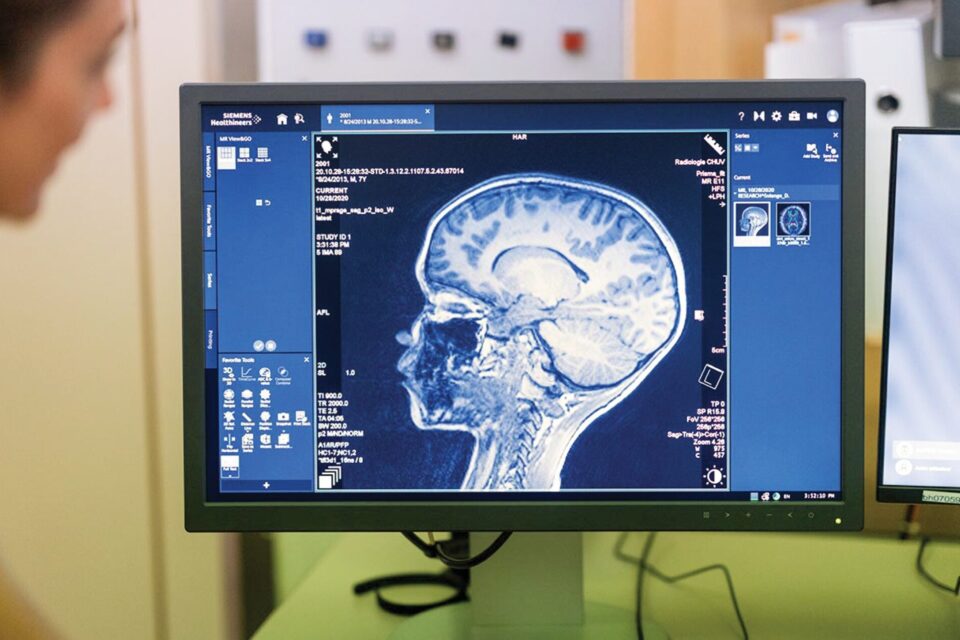
When I finished high school, I went to the school where she was working to help, and I fell in love with all these children working and evolving, being creative and coordinating themselves. So, I did the AMI training and got my diploma while working there. And you know it’s magical—you teach the first child to read, and it works; you teach the second one, and again, the same magic. After some time, I thought, “OK, I want to understand this magic; what is happening in the brain and why?” I went to a university in bioengineering, and then I went for a PhD in cognitive neuroscience to investigate the difference between children in Montessori and the Swiss traditional schooling system.
MP: What’s that system like?
SD: It’s very homogeneous. You have strict policies for what teachers do in the classroom. You don’t have a lot of creativity, and the more the children grow, the more constrained they are. It’s a teacher-directed curriculum. They must sit still, and it’s a 45-minute class, followed by a break, and then 45 minutes again. They have homework, they must memorize content, and then they have tests and grades.
MP: So go back to our question—does it work? For whatever we mean by work. But I think Americans’ perception of Swiss culture is that things work very well! So it must be getting the outcomes they want.
SD: Yes, if you look at PISA outcomes, they’re consistently scoring relatively high, so nothing to worry about, great. But very strangely, they’re starting to have children as young as eight years old, being highly stressed by school, feeling school anxiety and depression, and quitting school. Teacher burnout is increasing—40% of teachers leave after five years. So, you start having signs that it’s not about performance. We have the performance, that’s great we score high—every Swiss child knows how to read and how to do math. But is it just about learning or growing human beings with an OK mental state? And teachers who don’t want to quit their jobs after five years.
That’s the timeliest question we must ask ourselves now. It’s not about children learning how to read, do math, or solve problems faster. AI is growing in knowledge, so we need human skills such as creative thinking, critical thinking, the ability to work in teams and cooperate, and the pleasure of learning! This is not the same as just scoring high on tests.
There’s a lot of talk here about how unnatural it is to make children sit still for long periods of time and how that works OK for some children, but it’s not good for them! And for some, maybe many children, it’s damaging.
MP: I wonder if Montessori is a hard sell in Switzerland because the education establishment might say, “Well, yes—but the PISA scores.” So yes, Solange wants these things, creativity and all that, but it’s not broken so why fix it ?
SD: Yes! I think it was when I started. Everyone said, “Oh, you want to study education with neuroscience; that’s so cute.” But over the last ten years, the landscape has completely changed. Now, school directors are highly worried about students and teachers. That’s relatively new, and it’s as if we know there is a problem, but we either try to hide it, undermine it, or address it with minimal intervention—band-aid solutions. You see, we just put a band-aid there, but then there is another issue, but we put another band-aid without seeing the root of that problem.
MP: It sounds like Swiss culture has changed to recognize qualities and objectives in education beyond PISA scores.
SD: We have a long tradition of education in Switzerland having a very good reputation, and it’s based on excellence. It’s like when you are proud of something you’re good at, but then you must remember to train yourself. We are dealing with this issue—we are thinking of our accomplishments instead of being aware that maybe we should adjust ourselves to maintain or improve.
MP: So back to your work. You did your undergraduate studies in bioengineering—what is that?
SD: It’s life science in engineering school. I was in a polytechnical school, and they introduced a life science curriculum called bioengineering—biology from an engineering perspective.
MP: I don’t know if we have that here.
SD: We have biology and human biology in universities. At some point, they realized we should also have engineers who know about human beings, and that’s how I was trained to think. In universities in the Western tradition, such as in Switzerland, we have theories such as about child development in psychology. But engineers have no theories but laws—they have questions and test them with their actions. Just go and get information and observe. And that’s precisely how I work. I’m not interested in theories of how the child should develop according to someone. It’s more like, let’s look at what we have and do reverse engineering. We build, and we look inside, and we ask why.
MP: That sounds like Montessori: she was an observer. She didn’t start with theories of development—she observed. She said, what are they doing, and what can I figure out about how it works by observing.
But then she went on to become quite a theoretician, didn’t she, with planes of development and human tendencies and sensitive periods and all that. The Swiss scientist Piaget had developmental stages as well but they’re a bit out of fashion now.
SD: I’m not so in love with theory because it’s limiting. But I think there can be something true in theory because that’s what we do as human beings: we try to understand and then fix knowledge somehow because that’s how we can transfer knowledge and build on it. But we should be careful. I had a great cell biology teacher at university, and he started the class saying, “50% of what I will tell you this year is wrong. But the problem is that I cannot tell you which 50%.” So, we should always keep that in mind, keep the possibility that what we believe is incorrect, and let ourselves be surprised by facts and data.
Technically, you can see that there are stages where children change and have more abstract thinking. It’s coherent with how the brain grows, and it’s first about specialization in the brain and then coordination between networks. Then, it’s about adjusting ourselves with other human beings, synchronizing human beings together. So it’s coherent with these developmental stages, but there are more variabilities than you think. We cannot just say at six, it’s the next step. We used to think, “OK, it’s a critical period; when it’s over, it’s over,” but now we know it’s not the case. If you want to change something, then everything can change. It’s just a matter of training and effort you put in, and that’s what we have to keep in mind because otherwise, it’s very deterministic. Ah, your child is seven, sorry, forget it!
MP: So after that?
SD: When I started my PhD—you know, we have fashions also in science, and at that time, Adele Diamond’s work on executive functions was very much in fashion. I was sure that all Montessori children would outperform in executive function—that was my starting point. I decided to include some other measures, just in case, like academic outcomes, well-being at school, and creativity measures. I thought we had to see where and how they differed, but I’m sure they would outperform in executive function.
But I was really upset! In the cohort I built—wealthy Swiss children, quite wealthy—I played with the data for more than one year. I was so upset because they would not differ in executive function, whatever analysis I would do. I was a bad scientist! Because I had an assumption, and I just wanted to prove my assumption. I didn’t have an open question. It took me a year to acknowledge that they would not differ in that.
MP: The null hypothesis!
SD: Yes, exactly. They scored higher in academic content, and the idea is that if you have high executive functions, you are better at school. However, in my data, it was not the case. They had similar executive functions, but the Montessori children would score higher. So where does it come from?
Then, I saw that it was closely related to creative thinking, meaning that Montessori students used their creative thinking abilities to solve math problems and do language tasks. Then I thought, “Oh, they are using different ways of thinking.” I used the task that measured executive functions to study error monitoring instead—how mistakes are seen and addressed and how long you take to correct yourself and bounce back after being wrong. And I thought, “Maybe they differ in how they perceive errors.” They have self-correcting material—no adult saying, “You’re wrong,” and no bad grades—maybe they differ there. I started studying that, and it was such a gift. I saw significant differences, and that’s where I started doing research. Because then I started not knowing but wondering.
They differ in how they perceive error, how they are capable of correcting themselves, and in the strategies they build. Instead of learning the correct answer by heart, in Montessori schools they learn to correct errors. You could see that the brain was wired differently, affecting their reactions and behaviors. When you’re wrong, you don’t like to be wrong, but this was different in Montessori children, where being wrong or right was not attached to judgment. It was just an information in the process. Traditional schoolchildren have a strong association that being correct is good. However, if it’s very good to be correct, then you have a strategy of targeting just the correct answer, and you dismiss part of the information because it’s irrelevant or even dangerous. That was closely related to brain networks related to creativity and flexibility and how they would use social cues. And that was the story of my PhD.
MP: What’s the essence of your findings?
SD: It sounds simple to say out loud, but: The way children are trained at school is mirrored in their brain activity, connectivity, and in their behavior. If you train children to the correct answer, that’s what the brain will do. But if you train children to solve their problems without judgments, they will keep this process-oriented mindset and ability to self-discover and overcome challenges, and this has an impact on creativity. If you target the correct answers only, you cannot innovate, but if you target to solve problems, then you can also create mistakes, meaning new ideas that are not expected, as you’re not scared of that process.
And the academic outcomes were better and not related to the ability to execute, but to think.
MP: Were there any ways in which the Montessori children did not perform
as well?
SD: Not in the measures we got. We targeted measures based on previous studies like well-being at school or emotional recognition abilities. If we used metrics of task processing speed where you must be very fast only, we might observe differences in favor of conventional schoolchildren.
MP: Maybe it’s Swiss children. Dr. Angeline Lillard has found Montessori strengthens executive function in American children. So maybe affluent, well-educated Swiss children are already strong there.
SD: Right; the control group was other wealthy Swiss children in public schools, so I guess those children’s executive functions are well-trained. They all have external activities like aikido or ballet or whatever.
But executive function isn’t the only thing. You can even have, for example, too strong selective attention and be less creative. You also need this capacity to let yourself out of control because that’s when you have spontaneous ideas, and you can have stimuli that you did not expect that enter your mind and consciousness.
And that’s what happens with Montessori children. Their freedom to make errors gives them the freedom to re-act, rewire their brains, and learn new things. That happened to me in my PhD: I expected one outcome, was wrong, and learned to adapt.
MP: We’ll have to leave it there. We’ll be back in the spring issue of MontessoriPublic to continue this conversation with Solange Denervaud.

Solange Denervaud
Solange Denervaud is a neuroscientist working at the CIBM Center for Biomedical Imaging, Swiss Federal Institute of Technology in Lausanne (EPFL).

David worked in private Montessori for more than twenty years as a parent, three-to-six year-old and adolescent teacher, administrator, writer, speaker, and advocate. In 2016 he began working with the National Center for Montessori in the Public Sector. David lives in Portland, Oregon.
You may also like