


Two creative innovators in Colorado share updates
MontessoriPublic has been keeping up with public Montessori activists Tatenda Blessing-Muchiriri and
Emily Madison since the fall of 2021.
Madison is a Montessori child turned conventional teacher who helped get a Montessori Pre-K program started at Stedman Elementary in Denver, with Blessing-Muchiriri coming on board as the teacher. (Adding Montessori primary to a District K-5, MontessoriPublic November 2021)
Sadly, the classroom closed in 2023. But that didn’t slow them down. Madison went on to found the Montessori Collective to help Denver-area schools with existing Early Childhood Education (ECE) classrooms convert them to Montessori by removing barriers such as funding for training, materials, and
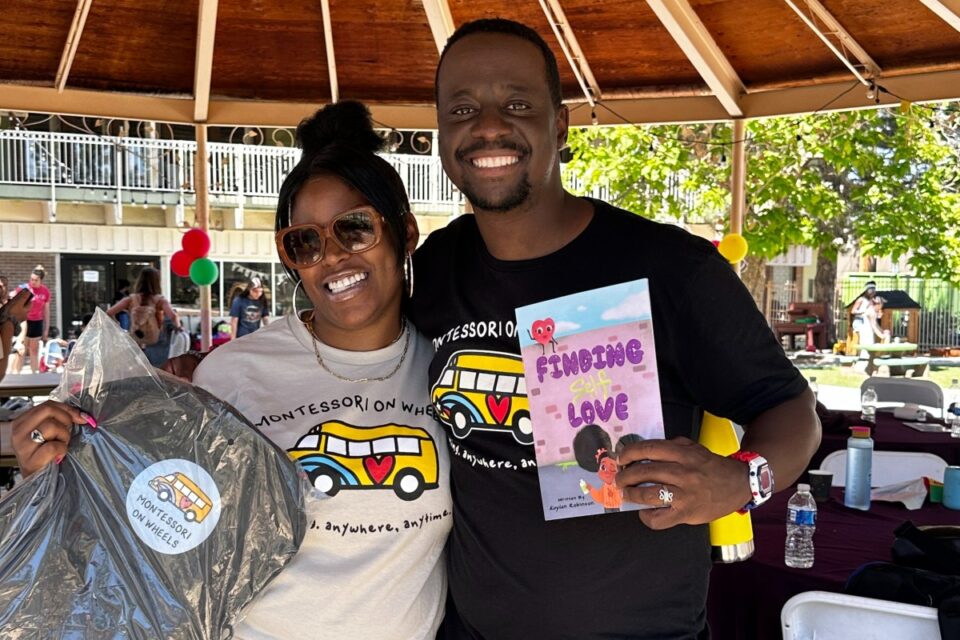
ongoing professional development. Blessing-Muchiriri launched Montessori on Wheels, a mobile
classroom in a converted school bus to introduce Montessori to children and families in a friendly,
accessible way. (Montessori on the move in Denver, MontessoriPublic, May 2022)
We caught up with them again this spring to hear the latest.
MP: What’s happening with the Montessori Collective and Montessori on Wheels?
EM: Montessori Collective will be opening our 6th partner classroom next year at a school that Montessori on Wheels has been working with. Montessori on Wheels introduces the idea of Montessori to a community, and then we follow up with establishing a classroom. This is the first organic opportunity we’ve seen for that to happen. The teacher is very much in love with Montessori after working with Montessori on Wheels, and the school and community have been exposed to it.
So it’s really laid that foundation for Montessori Collective to come in and start a classroom. We’re not
starting from scratch; there’s already a lot of knowledge about Montessori. All of the Montessori Collective partner classrooms are doing really well.
We’ve started three classrooms at schools that did not have any Montessori previously, and then we
supported two classrooms at an existing Montessori program that had both traditional and Montessori
strands within the same school. The Montessori program had a long waitlist, so they wanted to expand.
We’ve got solid data showing that students are outperforming their Colorado State averages by about
20 percentage points in kindergarten readiness—small sample right now, three classrooms, but promising.
MP: That’s a big number. I imagine that’s kind of attention-getting.
EM: Yeah, it is. It’s not totally apples-to-apples because the State numbers include kids who didn’t attend preschool, but it’s still showing that Montessori and early education produce strong outcomes.
MP: Early education works, and Montessori is a kind of early education that works. So people can’t say,
“Well, we know early education works, but we don’t know about Montessori.” No— it works.
EM: Yes, and even when it’s just a classroom within a traditional school, Montessori still works.
MP: Tell me about the most recent partnership. What’s the school? How did the bus come first and then
you came?
EM: How did you start your partnership with Val Verde, Tatenda?
TBM: They got funding from the Denver Public Schools Foundation. They were our first partner back in
2022, and we’ve been going to Val Verde for three years now. Initially, it was just exposure visits—parking the bus outside on early release days. Later, they invited us into classrooms to do blocks of Montessori in
science, literacy, or practical life. For the past two years, we’ve been doing that with ECE classes, plus
offering Montessori through Spanish with our Spanish teacher.
MP: Where does Montessori Collective fit in?
EM: Towards the end of last school year, they reached out. They had a teacher particularly passionate
about Montessori and excited after working with Montessori on Wheels. We brainstormed, secured
funding for one classroom for 2025–26, and we’re sending a teacher to training this summer.
MP: What age group?
EM: Currently just 4-year-olds. We’re hoping to get more 3-year-olds in. The classroom is designated for
4-year-olds, but some 3-year-olds have been placed there because of low enrollment.
MP: Is that how Denver typically structures it?
EM: Some places have moved to mixed 3–4 classrooms, but this school stayed with separate classes.
They have two 4-year-old classrooms, one in Spanish and one in English. We’ll be working with the
English-speaking classroom. It takes some mindset shifts to get people on board with mixed age groups.
MP: You got funding for her training? How does it work?
EM: Our training program is a full six weeks intensive over the summer, followed by a practicum year with
weekend seminars. She’ll do a self-directed practicum through Montessori Education Center of the
Rockies.
MP: So there will be six classrooms now?
EM: This will be the sixth.
MP: Do they usually become 3–4 classrooms? What’s the thinking about including kindergarten?
EM: We’re starting those conversations—to figure out what’s a real barrier and what’s just mindset. From
a funding perspective, early childhood and K–5 streams are different, which complicates it.
MP: But existing DPS Montessori schools have figured that out.
EM: Right. It’s possible—it’s about getting the right people to coordinate. DPS made a decision to
prioritize early childhood, offering programs for 3–4-year-olds, and the bus provided additional Montessori exposure. Over time, that exposure led to deeper collaboration.
MP: Meanwhile, what has the bus been up to?
TBM: We’ve been evangelizing Montessori around Denver and Aurora. Three big accomplishments: At
the Village Institute, working with refugee families, we transitioned a traditional preschool into a
Montessori-inspired classroom by training refugee women in 2023. We’re working with newly arrived
immigrants from Venezuela within DPS, running a language program. And we were invited to expand into
Paris Elementary in Aurora, working with YAASPA (Young Aspiring Americans for Social & Political
Activism). We’re setting up a new Montessori classroom there for next school year.
We’re also thinking about how to develop BIPOC teachers too, just like we did with Village Institute, and
we’re taking a strategic pause this spring to assess and plan our next three years. Our current
partnerships include Denison, Sandoval, Val Verde, and Vega, where we do literacy, Montessori, and
science programming.
We’ve had interest from Monarch Montessori and Stedman wanting to onboard with us, so we’re
carefully thinking about capacity and future direction.
MP: So from mobile bus visits to actually running programs—and possibly a full school.
TBM: Exactly. Families have loved it so much they’re asking, “What’s next?” We want to create a lab
classroom at Paris Elementary and continue mobile services. Funding will be key, through CCAP and
grant writing.
MP: You’re stimulating demand—families want more Montessori!
EM: Yes, but principals often see kindergarten as a separate thing. Kindergarten brings new accountability and academic expectations. There’s some hesitancy. However, trust is building. At first principals were skeptical of Montessori, but now that they see kids entering kindergarten already reading, they’re more open. We’ve started talking about creating standalone kindergartens, merging 3–4–K classrooms, and expanding into elementary. Some students have even left to attend Denison Montessori to continue their Montessori education, which principals are noticing.
MP: Tiny little pieces adding up. If you had your own Montessori elementary, you wouldn’t lose them. How is your relationship with the public Montessori program in DPSA?
EM: I work closely with the director overseeing Montessori in DPS. She’s supportive. And the broader
Montessori community in Denver is very supportive
MP: Is it still the same bus?
TBM: No, now we have two buses. The new one is smaller, designed for working with small intervention
groups. The larger bus is becoming a neighborhood station in East Colfax.
MP: When you say interventions, that’s literacy for lower elementary?
TBM: Yes. For example, at Denison, we run literacy interventions using Montessori and OG (Orton-
Gillingham) methods. We support kids needing interventions before formal services are prescribed. Schools contract with us after an initial free trial period.
MP: Do you need to be certified in some way to do this work?
TBM: Well, it’s not formally “intervention.” We bring Montessori-based offerings—literacy, math, science—into the schools before kids are officially placed in intervention tiers.
MP: And principals must like that.
TBM: Yes, and we have evidence that kids return to their classrooms at grade level. For example, at
Denison, kids we worked with last year didn’t need further interventions this year.
MP: That sounds like a compelling model.
TBM: It is. We’re proving impact. We aim to be proactive—help kids before they fall behind.
EM: It’s also budget-friendly. Principals often can’t hire full interventionists, but they can afford to contract with us without all the costs of a full-time hire.
MP: What are your biggest pain points?
EM: Funding. Demand is higher than what we can supply.
TBM: We’re also thinking about sustainability. Building frameworks others can replicate. Opening a school to create a revenue base. Funding threatens our existence, so we have to diversify. And we’re thinking about strategic planning as well: How to build a framework of what we do, so that we can share with others to enable them to do in their own space. So that the demand is not overwhelming for us.
MP: Well, it’s exciting to hear about your progress. Best of luck going forward!

Emily Madison
Emily Madison is a Montessori educator and founder of the Montessori Collective.

Tatenda Blessing-Muchiriri
Tatenda Blessing-Muchiri is a Montessori educator and founder of Montessori on Wheels.

David worked in private Montessori for more than twenty years as a parent, three-to-six year-old and adolescent teacher, administrator, writer, speaker, and advocate. In 2016 he began working with the National Center for Montessori in the Public Sector. David lives in Portland, Oregon.
You may also like