

Two Arlington public Montessori grads speak out
Adriana and Joseph Sparks are products of Arlington, Virginia’s 50+ year-old public Montessori program. MontessoriPublic sat down with these two recent high school grads to talk about their time in the program and their plans for the future.
MontessoriPublic: Tell us about your experience in public Montessori.
Joseph Sparks: I started in preschool for one year and then moved to Drew Model Elementary. Then I went to Gunston Middle School for 6th through 8th grade. At Gunston, gradually over time you take fewer Montessori classes. But my homerooms were structured like Montessori classrooms so I still had that experience in middle school.
MP: What did Montessori structure mean?
JS: The big thing was all sitting together. We didn’t have mats on the floor anymore, but we would sit on benches in a circle and talk about topics we wanted to cover in class. For example, my home teacher was also my science teacher in 7th and 8th grade so we talked about the lessons we would be doing in science that week, or what we’re looking forward to for the upcoming week, or our goals for the class—things like that. It was a good mix of balancing academic Montessori and also the classic community experience.
MP: How about you, Adriana?
Adriana Sparks: I had a similar experience. I’m a year older than Joseph so I did Montessori preschool and kindergarten at a different school, 1st through 5th at Drew, and then middle school at Gunston. In 8th grade, I had two Montessori classes and the Montessori-style homeroom. And Montessori did block scheduling before that was really a thing.
MP: So longer periods, 90 minutes in one room for one subject? Like Tuesdays and Thursdays for math?
AS: Yes, like that. Instead of doing every class every day for 45 minutes, it would be 90 minutes for two subjects and then the next day you flip.
MP: In the lower grades, did it feel different to be in Montessori?
AS: I had no idea that it was not a normal experience—I can’t even imagine what preschool or kindergarten looks like in a traditional environment. I find it hard to believe that it’s little kids at desks and teachers just talk at them. But I don’t know what that actually looks like.
JS: My friends that went to traditional school would be receiving letter grades from third grade onwards. I think I got my first letter grade in 6th grade.
At Drew, in upper elementary, Montessori and traditional were on the same floor but on opposite ends of the hall, so you would see them on your way to the gym or music class. But there wasn’t a lot of mixing because the programs were different. You would see the traditional classes but there wasn’t too much exposure to the difference in curriculum.
MP: What do you remember from Montessori?
JS: Three-hour work blocks. Then two or three days a week I’d have a formal lesson. My teacher would pick a group of students, say by grade, or interest, or math level, and we would work with her. When we were done, we wouldn’t get a worksheet or anything like that. It was just, “You can go explore that now, or you can do something else.” I spent most of my time working on projects I was interested in. I might go for a quick science lesson on kinds of clouds or the phases of the moon, and then go continue to work on my animal slideshow or whatever I was working on. It was good because it didn’t disrupt your flow.
It reminds me of my internship last year. I’d get to work and have some assignments to do from various departments, and then I might have a meeting to join for a little bit, and take notes and learn something. But after that I consolidate that work and get back to my original task. It reflected the professional work structure where you might have to hop between places to talk to these people for a little bit, learn something, and then bring that back to whatever you’re working on. It was a good way to make sure that, even if you aren’t working continuously, there’s still that workflow of having the long work period and the flexibility to sit and get things done. That’s something I remember a lot and when I reflect now I think it was a really big help.
MP: Where was the internship?
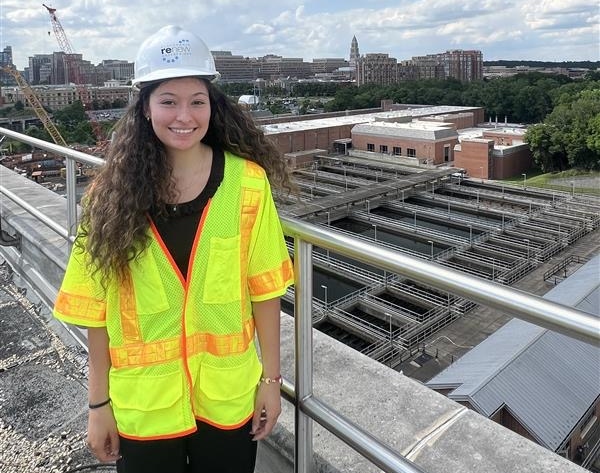
JS: At Alex Renew, the Alexandria city wastewater management plant. High school interns come in and do rotations between various departments like engineering, IT, and sustainability. You work at a bunch of different things, similar to Montessori, and then obviously you’re learning how to work in a professional environment and coordinate with supervisors and things like that.
MP: Do you remember what animals the slideshows were about?
JS: I did one on peacocks and—actually one was “guess that animal,” so I would reveal hints over a few slides and have my classmates guess. I would name the slideshow the animal’s name but reversed, like “Kcoceap.” I guess when you’re nine years old you think this is foolproof. I remember working on the Peacock and thinking, “This is going to be a good one!” But everybody got it after one hint so I was a little disappointed.
I did so many for marine animals as well. There were laptops which had a subscription to Pebble.go. I could just log on and say, “I’ll just read about animals now and write things down.” It was good practice for paraphrasing and making slides and learning to withdraw valuable information.
MP: And it wasn’t like you had a lesson on the peacock and then an assignment to make a slideshow. What was the inspiration?
JS: Probably Pokémon? Or maybe—we watched educational videos during lunch sometimes and then we had the flexibility to say, “I want to give a class presentation. Can I have 10 minutes during lunch?” And our teacher would say, “Yes—what are you working on?” You could just bring it forward and share your idea and your learning. That was really useful for me and the biggest thing I took advantage of: just presenting on a bunch of things I found interesting.
MP: How about you, Adriana—what do you remember from Montessori?
AS: Learning from the older kids. I would work with the grade above me and they would show me the next thing, or how to use the racks and tubes or the cloud chart or something. It was very mentor style. Not like you were assigned a mentor and they were told, “Do this, you teach them this, and I’ll show them that.” It mirrored more the actual workforce. The people above you and the people you’re working with who have more experience will just teach you things as you go. It definitely reminds me of Montessori.
We wrote novels which was maybe not my favorite, but definitely fun to get creative that way. And we learned fractions and chemistry through cooking or baking. My best friend and I would make bread, caramel, pickles—and we experimented with different ratios of ingredients and how changing the temperature or the length of time can affect the outcome. That was such a creative way of teaching ratios and fractions, and I had a really fun time, so it felt like I was just having fun and learning was secondary. For me, if I feel like I’m forced to do something I’m less inclined. It’s not as fun, it’s not as interesting, I’m just less motivated.
MP: What was the transition to middle or high school like?
AS: Definitely a transition! The first traditional class I took was Algebra I in 7th grade. Math was my favorite subject, but it was a big adjustment. We sat in desks, listening to lectures, and it was a silent room which was not the norm in Montessori. At the first exam in the second week of school I was shaking because I had never taken an exam before. I struggled with testing and anxiety. That was my second year getting a letter grade, so that felt like the biggest deal in the world. Over time I definitely adjusted to it, and the skills I learned in Montessori of independence and researching on your own transferred into learning how to study and helping me be motivated. But it was definitely hard at first.
MP: Did you have test practice in Montessori?
AS: We did have some version of practice but I don’t think much of anything would have helped. Your first time actually sitting down for a proper exam and getting a grade—practice could never quite be the real thing.
MP: And for you, Joseph?
JS: Similar. I remember my first test in 7th grade Algebra I. I hadn’t really taken a sit-down exam before and I did not score well at all. I would do fine on homework and quizzes but when it came to the exams I was bad, up until sophomore year of high school.
MP: Were tests a fair way of evaluating what you were learning but you didn’t have the skill?
JS: I used to think that you can be just not good at testing and that’s just how it is. But I think you can learn. You can make sure you understand the material 100%, or try to be less nervous, or learn to prepare.
In grade school, we did take our Standards of Learning for Virginia tests but those tests didn’t really feel real. You get your score back four months later and you only need 2/3 correct to pass so it’s not like you’re going to get held back unless you score very low.
MP: How was testing for you, Adriana?
AS: The low stakes standardized testing was one of those things where you just have to do it. Even the teachers said, “We know you guys know this stuff, this is just required, don’t even worry about it.”
As for exams in subjects, I think tests aren’t necessarily the best way of measuring your understanding. Obviously you can work on getting better at testing. For me, when I did poorly on a test it wasn’t because of the material but because of the environment of the test: high stakes, high pressure, your mind is foggy, you’re not even like thinking of the material. Obviously there’s things that you can do to work on that. But I don’t think we were made for a testing environment. Having an open-ended conversation or working through a problem with the teacher is a much better indication as to whether or not you understand the material. I think ideally you would just do Montessori and not test, and not have the transition.
MP: Some would say that standardization reduces bias.
AS: Well in education land that’s sort of the argument. No matter what system, there’s always bias. I agree that no system is perfect—obviously teachers don’t have 24/7 to talk with a student about or work through a problem. But no student is the same. No student tests the same, no student recalls information the same way, so while on paper it’s supposed to be the same experience for every student, that’s not how it’s going to shake out. Some people know how to test, some people aren’t as good at it, and while you can work on it, not everyone can get to the same level. Every person is different and they all have different experiences and ways they process things.
MP: What would you say to that, Joseph?
JS: Definitely everybody’s different and testing might not be the best way, but I think the most important thing is the objectivity.
You can definitely get better at testing and it doesn’t require necessarily a massive change in approach. I just know I got better at testing. We had to get up to speed quick on testing in middle school but I think that’s just how learning is. I think if you put in the effort, you can get better at it.
MP: So you just graduated. Where are you heading in the fall?
JS: Princeton. I’m thinking mechanical engineering.
MP: How did Montessori influence that path?
JS: My love for math and science. Math and science are about discovery and exploring topics that you’re interested in and challenging the status quo, and Montessori helps you do that. Obviously I wasn’t going to discover something new about peacocks, but I could take the time to sit down and learn about them. If you have an interest then you have the desire and hunger to pursue it further, and then you’ll develop skills in those areas and you’ll be willing to reach more complex topics. So not only did that give me analytical and quantitative skills, but it gave me the desire to strive for further things, whether it was advanced math in high school or challenging myself, signing up for that extra physics class. I credit Montessori for giving me the skills but also “I want to challenge myself to do this.” You aren’t turned off to learning in science and math—it wasn’t like, “Oh, we’ve got to do this boring thing again.” If you’re interested, go ahead and work on the peacocks, go ahead and follow that interest.
MP: How about you, Adriana?
AS: Mechanical engineering at Columbia.
MP: So, same question: how has Montessori influenced you?
AS: The collaborative and hands-on aspects of Montessori opened me up to engineering.
The transition to traditional school showed me what it means to be in a collaborative environment and to be able to explore your own curiosities and avenues yourself. That was something I definitely wanted to pursue, so I went into engineering, specifically mechanical engineering, because the projects involve many different people and it’s a group effort—and also the hands-on aspect. It’s not like there’s a set of instructions. Every day is different. There’s trial and error and you go back and forth between the problem—here’s a solution —come back again. It’s the entire engineering design process which mirrors Montessori really well.
MP: So Montessori is the perfect preparation for engineers?
AS: Montessori leaves you more open to trying new things, meeting new people, collaborating, and being able to work as a team, whether that’s professionally or academically or just with your friends. I’m prepared and willing to explore the unknown and meet new people. It’s easy to work within a team because you work with your classmates so much in lessons and open work time—it’s a skill you pick up very early. There’s a willingness to try new things and talk to new people and see what they have to teach you. It’s a big Montessori lesson that I’ve learned.
JS: I agree. Being young in Montessori, all you do is share. You share classroom equipment, and you learn how to keep it nice and how to not only think about the fact that you need to use it yourself but also that other people need to use it. That contributes to a better worldview where you’re thinking more broadly not only just about yourself but about the community. You’re interested in the environment and not only how your actions impact yourself but society in general.
Time management, too. You don’t realize it but as a little kid you’re learning how to balance exploring all the different avenues without someone looking over your shoulder saying, “It’s 2:00, it’s English time now.” You learn how to explore different avenues and follow where your curiosity takes you and broaden your horizons. But you also balance your different interests and the time that you put into them, making sure that you’re a well-rounded student and still learning all the things you need to learn. Also adaptability: there’s always so many different things going on in the classroom and there’s always something new you’re learning or something new that piques your interest. It could be as simple as, “Oh, you wanted to do math but someone else is using the equipment right now,” so you learn to shake things off and go with the flow.
MP: Well said, both of you. Thanks so much for this inspiring conversation, and best of luck!

Adriana and Joseph Sparks
Adriana and Joseph Sparks are graduates of Arlington, Virginia’s public Montessori program.

David worked in private Montessori for more than twenty years as a parent, three-to-six year-old and adolescent teacher, administrator, writer, speaker, and advocate. In 2016 he began working with the National Center for Montessori in the Public Sector. David lives in Portland, Oregon.
You may also like