


What the data tell us about how Montessori is done
Before I started working at the National Center for Montessori in the Public Sector, I put together and maintained a little “hobby” Montessori blog. In fact, it’s partly how I got this job. I was already writing news and information about Montessori for the internet in my spare time when NCMPS co-founder the late Jackie Cossentino asked me to come on board to revive Public School Montessorian, which you can read about elsewhere in this issue. (The lesson here: if the job you really want doesn’t exist, will it into being by just starting to do it and maybe someone will come along and start paying you.)
The blog was called The Montessori Observer. It’s offline right now but I’m hanging on to the domain name for a while longer in case I want to pick it back up. There was also a newsletter of the same name for a while, but that’s someone else, not me.
I picked that name partly because it was too good to pass up, and partly because it seemed like something the Montessori community could use: objective observation and reporting, so people who wanted to know something factual about Montessori would have a place to go, where they could follow the links and draw their own conclusions.
In 2016 I came on board with NCMPS and took on MontessoriPublic, which is a story for another article on page 1 of this issue. But NCMPS had another project on its hands at the time: the Montessori Census.
The Census goes back to 2012 and a group called the Montessori Leaders Collaborative, a community of leaders from national Montessori organizations convened by the Trust for Learning to help Montessori organizations find common ground and work towards common goals. Teach Montessori, a Montessori jobs board maintained by NCMPS; and the Montessori Public Policy Initiative (MPPI), the joint policy arm of the Association Montessori International/USA and the American Montessori Society, also emerged from this work.
The early data for the Census came in from mailing lists generously shared by Montessori organizations, dogged research, and painstaking googling. It took a while to build up a credible list of schools, where they were, their funding model, and maybe, just maybe, a rough estimate of enrollment and ages served. It was much harder than we expected to get schools to update their own profiles.
But over time the list got better. We focused more narrowly on public Montessori schools, because of who we are and what we care about. We do still collect and share data about the private sector, and that adds important context to our work.
We weeded out closed schools and duplicates, and did our best to distinguish the legions of “Community Montessori School” and “Montessori Children’s House” listings. We partnered with more organizations, including the International Montessori Council, Wildflower Schools, and Y Montessori. We’ve been able to share data with research projects from the local to the national, and our numbers have been cited in Forbes, EducationWeek, and the Washington Post.
This year, we’ve just about cracked the code on getting schools to update their own profiles—60% of public schools have updated in the last six months, and we’re hard at work chasing down the holdouts. Look your school up on montessoricensus.org—if it doesn’t look right, click that email link and we can send a simple form and get the school on a yearly schedule.
What does this have to do with observation? Well, what is the Census but an observation of the Montessori community?
What do you do when you want to know what’s going on in your classroom? You sit back and observe. And good observation means data. When you notice who’s choosing what work when and with whom—and what they’re doing when they’re not working— you start to see things. And when you start making a tally—how much practical life, how many minutes with the Stamp Game, how many trips to the snack table—now you’re gathering data.
What happens when you observe and gather data? Of course, it depends on what you’re looking at, but you might find things you hadn’t thought about, or didn’t expect, or that challenge your preconceived ideas. With this higher rate of Census participation, we have more schools than ever telling us how many children and staff they have at each level, and even how they group their mixed-age classes—information not reflected in government data. That lets us look at how Montessori is actually practiced in the public sector.
Age groups
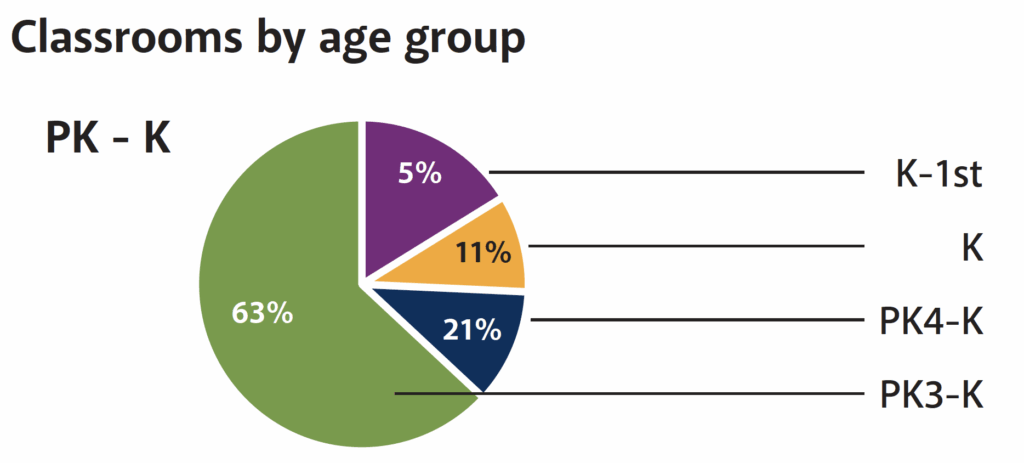
Montessori calls for three-year age groupings along developmental lines: ages three to six, six to nine, nine to twelve, and so on. But those age groups don’t line up with conventional education models or public funding streams. With public funding often starting at four or even five years old, how many schools can offer a true Children’s House? Under conventional grade groupings, how many schools provide full 1st-3rd or 4th-6th grade elementary classrooms? Now we’re in position to begin answering these questions.
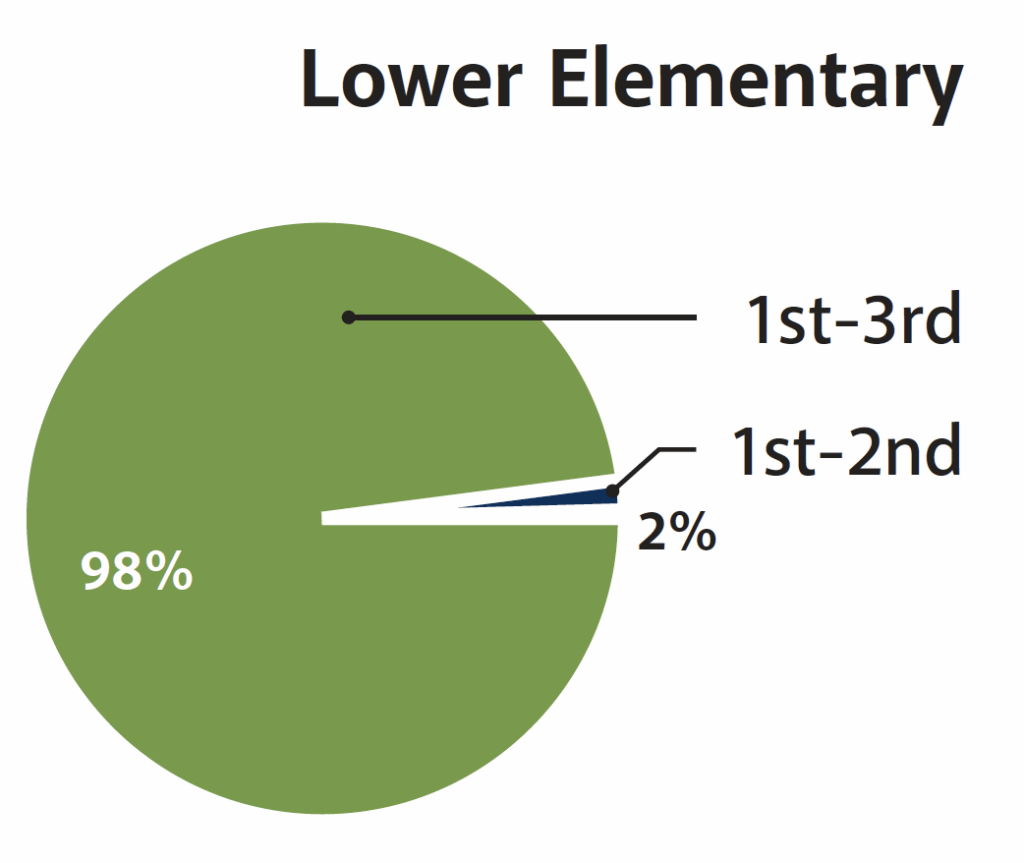
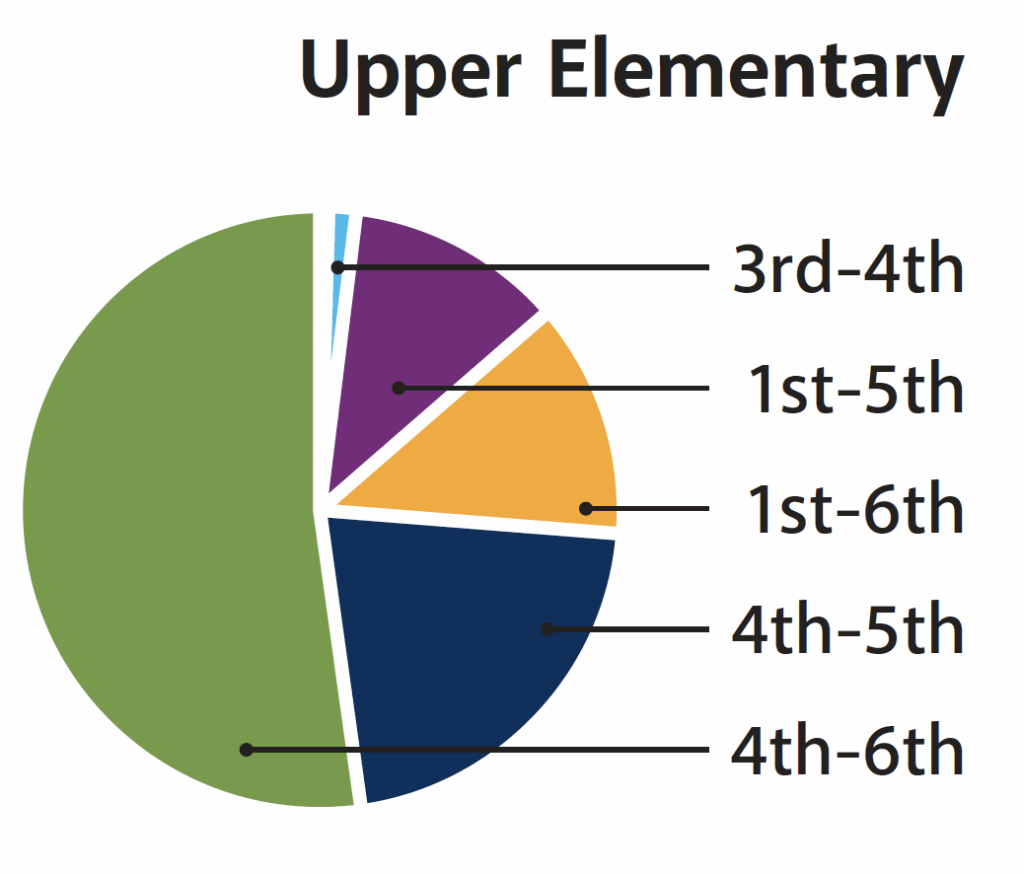
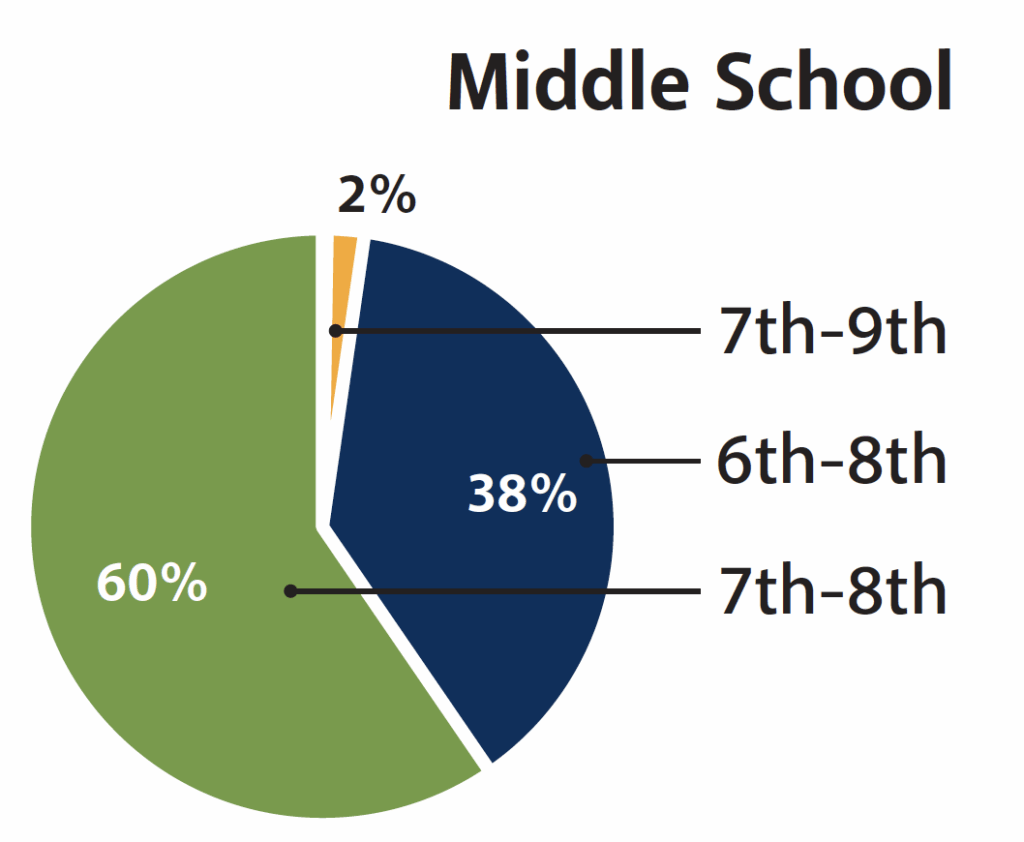
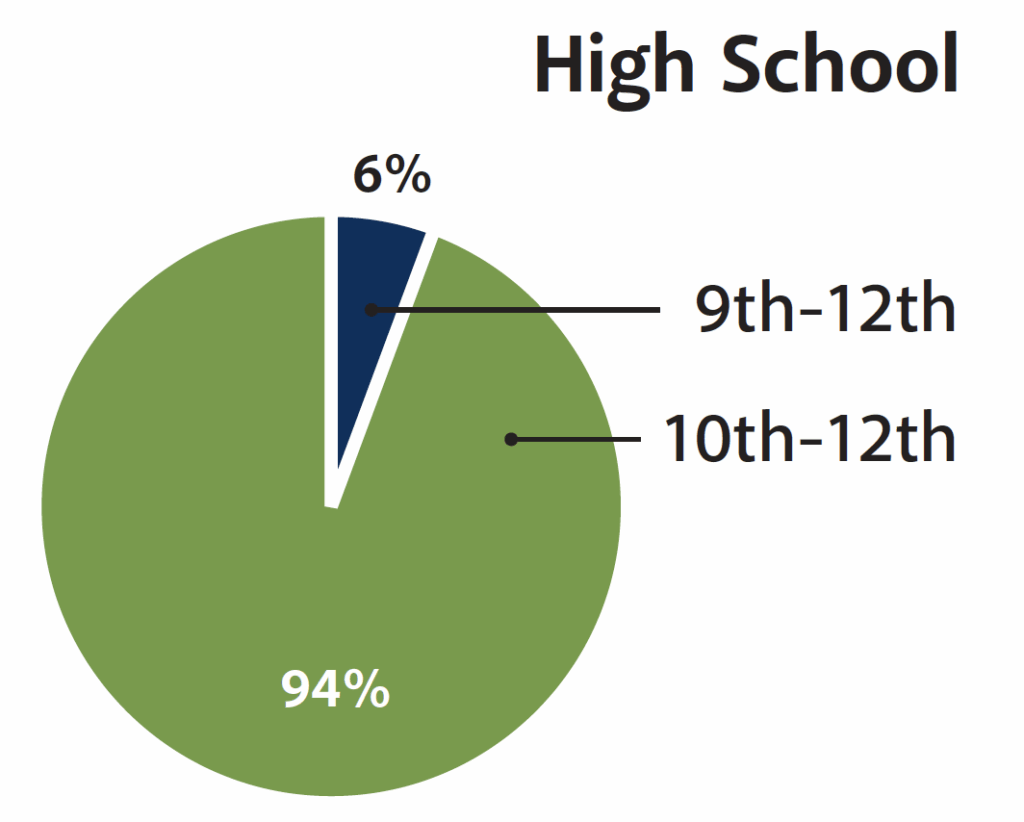
The charts here show the percentage of classrooms using each configuration. Encouragingly, for PK–K, 63% of classrooms manage to enroll a full three-year age span, and another 21% start at four years old. Lower Elementary classrooms are almost exclusively 1st-3rd. The model breaks up more at Upper Elementary: just over half of classrooms serve the full 4th-6th grade age span. 22% of Upper Elementaries use a 4th–5th model, presumably transitioning to middle school at 6th grade.
At middle school, more than half of programs serve two years in 7th–8th grade. Another 38% serve three years but begin at 6th and extend through 8th grades. Only eight classrooms in our sample reported a 7th–9th grade program. Unsurprisingly given this structure, just three schools group high school as 10th-12th, with the remaining 60 programs following a traditional 9th-12th grade model. All of these findings suggest opportunities for further research on the character and effectiveness of various structures.
Staffing
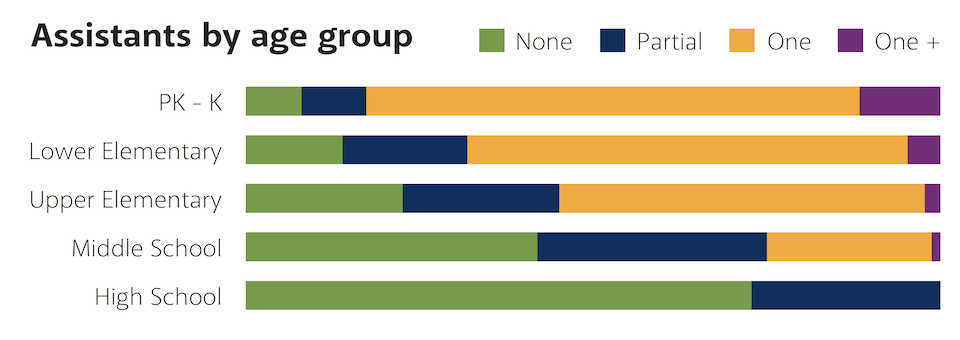
The base staffing model for Montessori classrooms through 6th grade is one teacher supported by one (or more) assistants or paraprofessionals. The base model in conventional school is one teacher, period. How many schools are able to staff classrooms with an additional adult to support full implementation?
We ask schools to report staffing by grade level, giving the number of classrooms, teachers, assistants, and children at each level. Then, we can caculate ratios for those levels. We can see that most schools (70%) that offer PK–K provide an assistant. This drops off predictably in the higher grades, with nearly half of upper elementary classrooms getting by with partial support or none at all. Middle and high school continue the trend, although at these levels a team teaching approach is more prevalent and assistants may represent teachers for special subjects.
What’s next?
We would love to get to 100% of schools filling in their profiles, so we don’t have to guess and extrapolate. And we’re excited to dig deeper into how schools operate. Who is using supplemental curriculum? How do outcomes correlate with staffing and enrollment models? In the big picture, how can we use data to improve practice, just as we should in classrooms and schools? You can help. Visit the Census at montessoricensus.org and let us know what we’re missing.
David Ayer is the Director of Communications at the National Center for Montessori in the Public Sector

David worked in private Montessori for more than twenty years as a parent, three-to-six year-old and adolescent teacher, administrator, writer, speaker, and advocate. In 2016 he began working with the National Center for Montessori in the Public Sector. David lives in Portland, Oregon.
You may also like