


Looking back on a decade in the movement
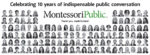
Nine years ago, the late Jackie Cossentino invited me to join the National Center for Montessori in the Public Sector, to revive Denny Schapiro’s much-loved newspaper Public School Montessorian. You can read more about Schapiro and his passionate dedication to journalism and public Montessori in Public School Montessorian is Now MontessoriPublic, reprinted from the first number of the new paper on page 19 of this issue.
As you can read in that article, we weren’t even sure we would print a paper—“Does anyone read print anymore?” I asked. Surely a website, a Facebook page, an email newsletter, and even a Twitter feed were more appropriate for a 21st century publication. But it turned out that Montessorians do love something they can get their hands on!
Since then, we’ve put out an incredible 21 issues of the paper, through political changes and a pandemic, covering the issues and sharing the stories that the public Montessori community—and the wider Montessori community—care deeply about. We mail one copy per teacher to every public Montessori program, one copy per school to every private Montessori school, plus copies to Montessori organizations, training centers, and individual subscribers, building our circulation from 8,200 to 12,650 as our movement and audience have grown. I offer my deepest gratitude to everyone who has contributed work and supported us along the way. Let’s take a look at some of the stops along the way. All of these stories are posted at MontessoriPublic.org, so you can catch up on them there if you missed an issue along the way.
Research
Perhaps the biggest trend we’ve tracked over the past ten years is the explosion of Montessori research. In 2016, there was just one substantial piece of published Montessori research: Dr. Angeline Lillard’s 2005 Montessori: The Science Behind the Genius (now in its third edition, published in 2017) and a handful of small studies, many of them hampered by selection bias, small sample sizes, and questions of model fidelity.
In 2016, we covered the launch of the Journal of Montessori Research, the first U.S. peer-reviewed scholarly journal on the subject, later housed at the University of Kansas Center for Montessori Research (which we reported on in 2018).
In 2017 we broke news of a $3M initiative by the Brady Education Foundation to study public Montessori specifically (and in 2020 the Foundation’s pivot to focus the initiative specifically on access). Later that year we covered Lillard’s groundbreaking and influential (and Brady-funded) Hartford study, using a lottery-based design to mitigate selection bias, which showed that Montessori had the power to raise achievement and reduce so-called “achievement gaps” in two Connecticut public programs.
2018 saw the publication of the largest yet Montessori study, the Riley-Furman report, which surveyed South Carolina’s 45-school public Montessori program and again found positive outcomes. Later that year we covered the announcement of a $3.3M federally-funded study under Lillard’s direction, made possible because of the results in Hartford. That study, planned for a three-year span and interrupted by the COVID-19 pandemic, is now in press and you can be sure MontessoriPublic will cover it in detail in the next issue.
Research coverage continued well into the next decade, with new results from Lillard on standardized test scores, play, and well-being, findings on equity and cultural responsiveness, a global meta-analysis reporting that “Montessori education outperformed traditional education on a wide variety of academic and nonacademic outcomes,” brain imaging from a laboratory in Switzerland, and much more. When someone asks, “Where’s the research” we no longer have to hedge and explain—and MontessoriPublic is a great place to find straightforward, non-technical explanations of the latest work.
Social Justice
Another broad trend in Montessori over the last ten years has been the rise of social justice as a fundamental issue with the movement. We covered Montessori for Social Justice (MSJ) in May of 2016, months before our first printed paper came out in December that year, and we attended, and reported on the 2016 MSJ Conference in Cambridge that June as well as the 2013 origins of the group and the 1st UnConference in 2014.
Since then, we’ve tracked the growth of the movement up through the transcript of a “looking back” webinar in our most recent issue with the current Executive Director, Regina Dyson, and founding board member Daisy Han. Along the way, nearly every issue of the paper has featured articles on equity in Montessori.
Wildflower and Bezos
In August of 2016, we covered the development of a new model for Montessori schools: Wildflower microschools, the brainchild of former Google engineer Sep Kamvar. That same month, we reported on Teach for America co-CEO Matt Kramer’s move to Wildflower, and we’ve covered their expansion and development over the years, including their expansion into the public charter world. As of 2024, Wildflower had 11 public charters in its network.
In 2018, we shared the news of Amazon CEO Jeff Bezos’ billion-dollar pledge to create “a network of new, non-profit, tier-one preschools in low-income communities,” and “launch and operate a network of high-quality, full-scholarship, Montessori-inspired preschools in underserved communities.” Since then we’ve tracked the success of these Day One Acadanies as they have grown to at least 41 schools in six states.
Puerto Rico
Puerto Rico is home to at least 41 public Montessori schools, fourth in the nation after South Carolina, Texas, and California and the highest concentration per capita of any U.S. state or territory. MontessoriPublic has been covering the movement there since 2018, through hurricanes, pandemic adaptations, establishment of a Secretariat of Montessori Education, threats to charterize the entire system, and a bilingual update in 2024 from the Director Educación Secundaria Montessori at the Secretriat.
Science of Reading
Most recently, MontessoriPublic has tracked the revolution in public education around the Science of Reading and its impact on public Montessori schools, raising the topic in 2018 before it was national news, and continuing with beginning with two issues devoted to the topic in 2022 and 2023, featuring work from authors Susan Zoll, Laura Saylor, and Natasha Feinberg, researchers Corey Borgman and Angeline Lillard, and reports from public Montessorians in the field.
And more…
Along the way, we’ve reported on the growth of public programs (just under 500 in 2016 to nearly 600 today) as well as the longer history of public Montessori going back to the 1960s; the expansion of credential recognition for Montessori training (from eight states in 2016 to twelve today); pandemic adaptations in schools across the country; Indigenous Montessori connections, publications such as the Montessori Bibliography Online, the Bloomsbury Handbook of Montessori education, and the Campbell Systematic Reviews global evaluation of Montessori; and so much more of interest to the public Montessori community and anyone interested in this model.
Where you come in
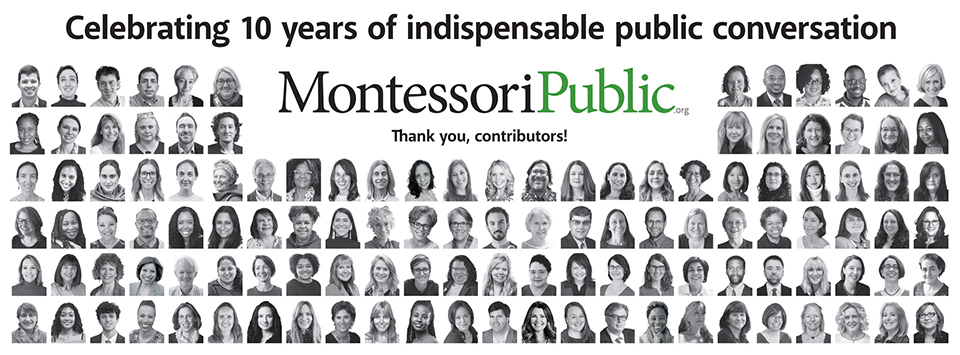
As always, we rely on you, the reader, to make this publication what it is. Elsewhere in this issue you’ll find an incredible compendium of the many people who have contributed to telling this story. If we haven’t heard from you, maybe now’s the time! If you’ve been in these pages before, you know you’re always welcome back. Together, let’s take MontessoriPublic into its next decade.
David Ayer is the Director of Communications at the National Center for Montessori in the Public Sector, and the Editorial Director for MontessoriPublic

David worked in private Montessori for more than twenty years as a parent, three-to-six year-old and adolescent teacher, administrator, writer, speaker, and advocate. In 2016 he began working with the National Center for Montessori in the Public Sector. David lives in Portland, Oregon.
You may also like