


Swiss researcher digs deeper into Montessori brains
In the fall issue of MontessoriPublic, we spoke with Swiss Montessori researcher Solange Denervaud about her PhD research (Beyond Executive Function, MontessoriPublic, November 2024). She spoke about her experience as a child in the somewhat rigid Swiss educational system, her discovery of Montessori, and her PhD work.
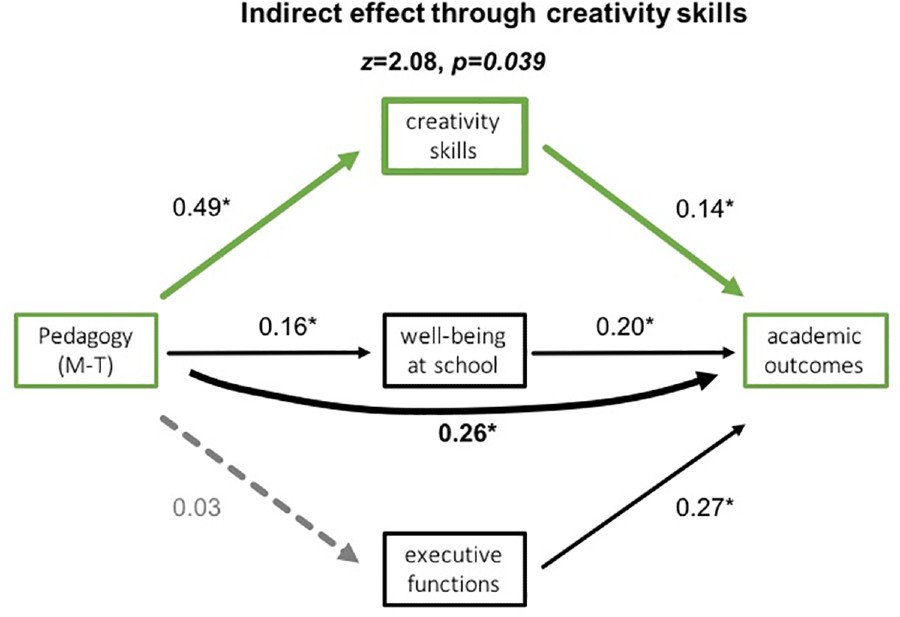
In her research comparing Montessori and conventional schools, she had expected Montessori children to show higher executive function, consistent with other research. But to her surprise, the Montessori children showed no difference in executive function. Yet academic achievement, which typically tracks with executive function, was higher, along with creativity and well-being at school. Brain imaging showed that the Montessori children perceived error and correction differently, without judgment, and this allowed them to be more flexible and creative thinkers. (Beyond executive functions, creativity skills benefit academic outcomes: Insights from Montessori education. PLoS ONE 14(11): e0225319.)
Our conversation was too long to get into one article, so we have picked it up here.
Solange Denervaud: The result—how we react to errors—was so interesting. If you are not afraid of
being wrong then you can create. But wait! When you enter in contact with other human beings, every
human being is a “mistake” to any other human being because you’re different from me, so to my brain
you’re an error, because you are different from me. To the brain, hearing “3 + 3 equals 5” or me meeting
you, it’s the same signal: it’s an error. It’s something different. But if I have been in school with children,
especially from different ages, and we have to work together and we are discussing the whole day around the work, instead of (in the conventional system), “Sit down at your place, don’t discuss with your neighbor otherwise, I will punish you,” and, “You do the same work that I will compare with your neighbor,” it’s not the same mindset from a social perspective.
So I began to investigate this social dimension. Because this brain system that detects something that
is different, or an “error,” is also implied in social processes. I wondered if we were missing something
important! For children at that age, what if they have real social diversity in the classroom—not just having one neurodivergent child in the class or something, but really having to work with one another?Where I have to learn from your point of view and we have to come together over a common goal, then we are really training the error monitoring system but for social interaction. And there we saw big differences between Montessori and traditional school children in social skills and social diversity, and how they would engage and perceive others.
And then, where in the traditional Swiss system you see that boys and girls they start showing different
outcomes in social skills or social-related brain regions, Montessori boys and girls they are similar! And
with what society suffers nowadays with gender differences, I thought, “this is important!”
MP: How are the non-Montessori children differentiated by gender in their social interactions? What do
you see in Swiss schools?
SD: The study is about how the complexity of social interaction is so high that we rely on several
brain regions that have to coordinate to work together. And in these brain regions we observe that
traditional school boys had lower smaller brain regions in areas related to meaning making and regulating
social context. That’s often an issue reported by school teacher —”These boys are aggressive, and they
don’t care about the classroom.”
You might wonder, is it just a matter of biology or is it a matter of experience? We have preliminary data
showing that it might not just be a matter of experience—it might be a matter of training and experience.
Then of course you want to know, “Why do adults act this way with boys? Because they’re acculturated
to, or is there something about boys that drives them?” Because, even if, subconsciously, you don’t want to make gender differences, we are in a cultural environment, we have some information, and even if we
don’t want to we convey some information. And just by the simple process of organizing brain activities,
I’m transferring information about myself that I’m not saying loud but because we synchronize brain
activity it comes across.
And it might be that in Montessori schools where there is one teacher for a large group of children, and
they interact and work with peers more than with an adult, the adult might be transferring less of this kind of bias than in traditional school system.
MP: So why are boys even like this, if they are? What do they get for being so thick-headed and
unemotionally responsive and all that? If boys have a deficit here, do they do better in some other area—
or is it just pretty much just a disadvantage, and we’d be better off if Montessori could make the boys be
more like girls?
SD: No, it’s not a matter of what’s better. It’s just that we observe some differences and some problems in society that we might not have if we understand better that children spontaneously want to
interact and work together. But in Swiss schooling it’s like, “Shut up and sit, don’t talk.” And for boys it
seems that society is also more sensitive to a competitive environment. And school is highly
competitive, so if boys react more strongly, they might be more individualized at that stage but it doesn’t
mean that outside school it’s helpful.
MP: There’s a train of thought in American education that says testosterone is real and has an effect.
That boys are naturally more competitive and less inclined to mediate differences with talking and with
emotions, and we should design school differently for boys and girls. We should have separate boy
classes with a lot more competition because that’s their natural inclination. And girls should have classes
and activities that respond to their more emotional, language-based ways of interaction and that’s OK! And we shouldn’t be trying to do things in schools that make the boys more like the girls.
SD: Well. I just hope that we have less misunderstanding between women and men later in life, and can
be more complementary than similar. The point is to understand each other’s strengths and modes. If
there is more testosterone, there must a good reason but if we can understand how to work together to be a better team, then I think that’s the point of humanity.
MP: Well, testosterone pathways evolved a long time ago as adaptations to very different circumstances.
Our lives are not mediated by nearly as much violence or aggression as they have been historically and
prehistorically. So maybe boys are just outdated! They’re really no longer a useful adaptation and the best we can do with the boys is try to socialize them a little bit.
SD: That’s not what I’m saying. It’s just that, observing societal problems, maybe the root is in how we
train children. When we got these results we thought, “How is it that possible?” So we went back to some schools and observed. Do teachers perpetuate gender differences, like saying to the girls, “You do
drawing” and to the boys, “You come with me and do math?”
So we counted! And actually it was less what teachers said than the number of interactions that was
drastically different. And we counted child interactions: each time one boy and one girl were talking we
made a mark. Then we looked at what they were interacting over—is it play or work? In the Montessori
schools they interact with work, so they have to adjust themselves because they have a project together.
They have to align themselves and share points of view, disagreeing and commenting. They have very
spontaneous interactions, sometime lasting for two seconds, sometimes for two hours, so there is no rule—just let them interact. Which is good because between ages six and ten they don’t want to stop talking—they have to talk. (And this is a problem now in Switzerland—people have communication issues and we have to take a class at work to communicate better!)
But I remember from my school years, you sit down and shut up, you don’t disturb, you stop talking. I
was punished so many times because I was always talking. But the beauty of Montessori is this: You want
to talk, talk—but talk about your work. So children have to adjust over a common goal, which is harder
than when you want to play together. You have to achieve something concrete and sometimes it’s
something you haven’t completely decided, and that’s highly frustrating, and then you have to gently grow up that capacity. Naturally in the teenage years you start discussing about topics you share interests in, and you decide who you want to belong with, and why, and how. That’s the next level but if you impair that level then teenagers are harder and you know there are these cascading effects.
MP: OK, so we’ve been kind of all over the map here. This all comes back to how children process
unexpected events in their environments.
SD: All this work with children and the way they were talking led me to study memory semantic issues
(how understanding and the knowledge are stored in the brain). How it was different and how it was
flexible and interconnected—which part of the brain, on which side, would change more.
And that led me to think, “So when they work together, I wonder if they synchronize faster between
children than between a child and an adult. If their brains are sensitive to mistakes, meaning unexpected
events, intellectually or socially, it might be easier to get unexpected reactions from a peer than from an
adult. Because we do so many random actions within a day for a child, and their brains might be less
sensitive to understanding what the novelty is.
MP: So children find other children less predictable than adults—the adults are a little boring, which
doesn’t stimulate learning.
SD: Sort of. With children they experience novel actions, which triggers brain activity and they want to
learn. It’s easier for them to extract information from another child than from an adult. We have to be
explicit about what we want them to learn but spontaneously from another child they expect many of the
actions and reaction and sometimes there is something novel and then they are like, “Oops that’s
interesting.” So we created some studies to see if that was true or not and it seems that these brain
regions related to error monitoring are also related to social monitoring and it’s also more sensitive to
other children when they do something different.
MP: So going all the way back to whether Montessori “works” or Montessori is “better,” it’s not so much
about outcomes academic outcomes, but more about, “What is the character of the interactions among children, what are the subtleties of behavior differences among the Montessori children and the non-
Montessori children?” Kind of teasing out those the various differences there without necessarily imposing a value judgment. Although it does seem like all things being equal it’s better to be a good communicator and to be able to work things out in social interaction. And to manage a difference in expected outcome without a heavy affect hit.
And it seems like that’s a better way to have a richer life experience, more opportunities, and that sort of
thing.
SD: It makes me think of the quote attributed to Darwin “It’s not the more intelligent that survive, it’s the
ones that can adapt themselves.” That’s a great adaptation, when you can react well to an unexpected
event, which is real life right? We face so many different challenges and changes now and it’s just the
beginning.
So what do we wish for the future of our society? Do we wish for people that can adjust, create, come
up with novel aspects, communicate, and collaborate? Or do we want people that are scared and afraid of change, and freeze and panic, and are just aggressive because they don’t know how to embrace
diversity? I think that’s a societal question it’s beyond “is it good or bad?” It’s just, what do we wish for
ourselves in the future?
Because more and more teachers realize that they are less bounded than they think in what they have
to do. They just have to remember they are more free and creative than they think. They forget their own
powers of innovation and creation but I think that’s coming back. Science can never be capable of saying
what to do, but we’ll always be a good team member, to grow understanding and to go beyond methods or recipes.
MP: And once again we’ll have to leave it there. It’s always great to speak with you.

Solange Denervaud
Solange Denervaud is a neuroscientist working at the CIBM Center for Biomedical Imaging, Swiss Federal Institute of Technology in Lausanne (EPFL).

David worked in private Montessori for more than twenty years as a parent, three-to-six year-old and adolescent teacher, administrator, writer, speaker, and advocate. In 2016 he began working with the National Center for Montessori in the Public Sector. David lives in Portland, Oregon.
You may also like