
By David Ayer with Povi Mitchell
Using Montessori to advance indigenous education
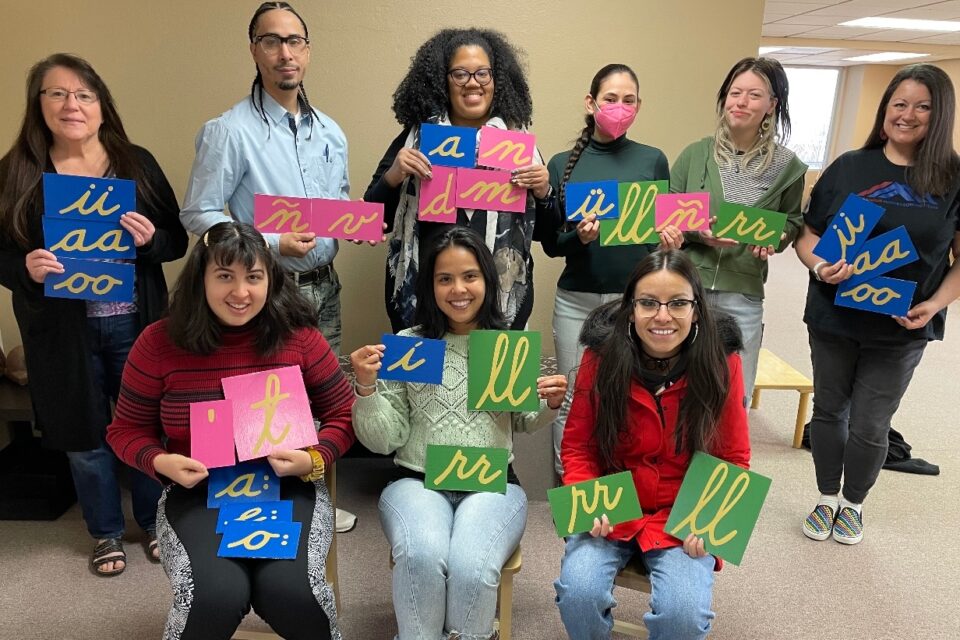
The Indigenous Montessori Institute (IMI) is an initiative of the Keres Children’s Learning Center (KCLC), which was founded in 2006 by Trisha Moquino and Olivia Coriz “with the purpose of reclaiming the education of our Pueblo children and educating them in a manner that maximizes their development and potential as Pueblo people,” per their website (kclcmontessori.org). KCLC launched with a Keres language immersion Montessori Primary (ages 3-6) program, and since that time has grown to offer immersion and dual-language Montessori programs for ages 0-3, 3-6, 6-12, and 12-18.
KCLC has gone on to launch several other initiatives to support Indigenous education, including an annual Native Language Symposium, a community Outdoor Classroom, a Mentor-Apprentice program, and the Indigenous Montessori Institute. MontessoriPublic sat down with Povi Mitchell, Director of the IMI, to learn more about the organization and its work.
Montessori Public: Thank you so much for getting together to speak with me. Can we start with the relationships among KCLC, the IMI, and the other initiatives?
Povi Mitchell: Of course. We have a graphic on our website that shows the connections, so if you’re looking at that, it will probably help.
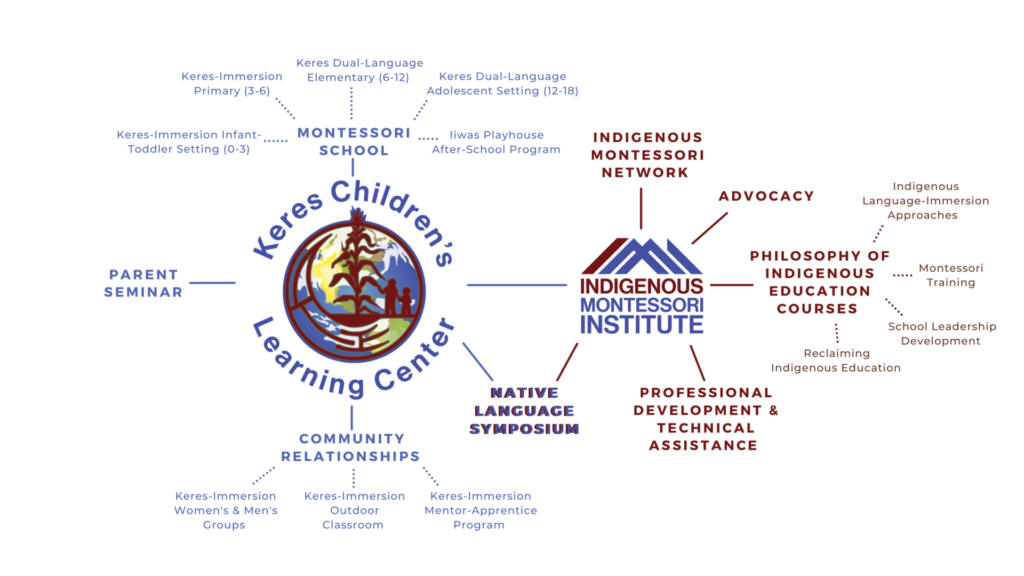
The Indigenous Montessori Institute is part of the Keres Children’s Learning Center. KCLC started with the Primary classroom, for ages three to six. Over the years we eventually opened the elementary because parents wanted to have their children stay in the Montessori environment and learn Keres at the same time. Then that also happened with the adolescent and toddler classrooms—these are new to KCLC and we were able to accept students two years ago, in 2022.
Now we’re able to serve children from birth through age 18, although our oldest student right now is 13. We’re just growing based off community needs, and parents’ needs and wants. Those needs also brought about the Iiwas Playhouse after school program, which is provided for working parents.
Another way we support the parents is through our Parent Seminar. Parents gather twice a month to grow their learning and understanding of Cochiti language and culture, the Montessori method, and leadership. We provide dinner and childcare so that parents are able to fully participate. In previous years we focused on language introducing Montessori. This year, again based on parents’ wants and needs, we’re focusing more on making the seminar language-immersion based. We noticed that while children are getting Keres here at school, when they return home there’s no Keres being spoken. So in order to develop more speakers of the language, parents are a key component of that as well. A lot of the parents are second language learners of the language, so they may be learning from their kids more than anything. Parent seminar provides that space for them to learn at their own pace. I think we’ll really see how much it benefits them this school year.
Along with these initiatives, we have community relationship building, including our women’s and men’s groups. In our communities we do have gender roles of what each gender is contributing to and able to do within the community and this carries on those teachings and traditions of our roles within the community.
In 2023, we implemented an outdoor classroom. We hired on outdoor educator who works in all of the classrooms and focuses on supporting children in the outdoor environment, and we also have a KCLC field where he’s been growing corn, squash, and watermelon throughout the summer. We’ll start getting into harvesting towards the end of summer and fall. We also have a mentor apprentice program for the community. We have five mentor “pods” made up of a mentor, a junior mentor, and an apprentice, separated by gender, for supporting language learning and culture.
MP: It’s called the Keres Children’s Learning Center but it sounds like it’s also for Keres Adults—it supports the whole community.
PM: You could say that, yes.
MP: And there’s more?
PM: In 2016, we launched our first Native Language Symposium, with the goal of building awareness and capacity around Indigenous language revitalization through education using an immersion, dual-language, and Montessori model rooted in community knowledge and values. We’ve kept that momentum going—last year we focused on reclaiming Indigenous curriculum and the importance of having an anti-bias, anti-racist (ABAR) lens in education. We’ll be having our 8th Symposium this November focusing on Indigenous Montessori and language in Santa Fe, and we’ll be doing a Zoom “glass classroom” based at the KCLC campus in Cochiti Pueblo. It will be just a normal school day at KCLC and everyone will get the chance to visit each of our four age groups. And then we also have panels, guest speakers and all that, to highlight other initiatives of language revitalization going on throughout the country.
MP: How big is the Symposium?
PM: We’ve typically had about 150 participants. Last year we had over 300 and we’re squeezed into our space. More people are starting to hear about us, we’re getting more and more requests to attend. It’s a two-day event, 8:00am to 5:00pm, with a lot of learning and networking. We really want to support everyone the best that we can. Sometimes it may not be directly from us—it can be from someone out of state that’s already doing this work as well, or another organization that’s just getting started or thinking of creating a language immersion school. Providing that network is really important.
MP: In person or virtual?
PM: It’s all in person, but they will be zooming into the classroom, as it’s in a separate location this year. People love to visit the school and we do get a lot of requests for visitors, but we also want to be mindful of the children’s learning. Sometimes we have to say no—this week we already had 20 people visit. We need to protect the children as they’re learning. And because we are language immersion, we’re also protecting the language and making sure that the only languages being spoken here are Keres or other Indigenous languages. English is kept outside the door—we try not to focus on English at all. We encourage folks to attend the Symposium to learn what we’re actually doing in this school.
MP: 300 is a big number for something like this! I don’t want to get you flooded with too many applications by printing this in the paper.
PM: It’s fine—they can come next year or the following year. And it’s open to Indigenous and non-Indigenous folk—very open. The main thing that we emphasize is that the Montessori method is in service to our language revitalization efforts. We don’t try to fit into this Montessori box—we pull out what we need and what is applicable for us to create speakers of the language.
MP: It’s the Keres Children’s Learning Center, not the Keres Montessori Children’s Learning Center.
PM: Right. So maybe some Montessorians don’t really agree with that. They might say, “Why aren’t you doing this,” or “How come you’re not using this material?” But if it’s something that’s pulling us away from using our language, we’re not going to spend time trying to figure out how to make it fit.
MP: Makes sense. So does this take us to IMI?
PM: Yes. In order to keep expanding and supporting the mission of KCLC, we created the Indigenous Montessori Institute to focus on the philosophy of Indigenous education. It supports an anti-racist, anti-biased approach to education using Indigenous knowledge systems and the Montessori philosophy to deliver teacher training, professional development, technical assistance, and advocacy.
We started with Reclaiming Indigenous Education, going over the history of federal Indian education policy and the effects of Bureau of Indian Education day schools on tribal land. Those policies and those schools play a role in taking us away from educating our own kids and creating native language speakers. And often that’s been tied to English-based standards and assessments. Montessori fits really well there because standardization and tests aren’t part of the model.
MP: So IMI was founded to do Montessori training that centered Indigenous education—do I understand that right? And it started with the Philosophy of Indigenous Education courses?
PM: That’s right. They were something you could take alongside of your Montessori training. That’s where you could see those parallels and connections between our traditional knowledge systems and Montessori. Then in each of our courses we partnered with Embracing Equity to do ABAR sessions. They provide the language and flow of how to give these trainings. Now we give these trainings, using their material in a way but through an Indigenous lens.
And then we partner with the Southwest Institute of Montessori Studies (SIMS) to deliver the Montessori training because we’re still in the process of being accredited through the Montessori Accreditation Council for Teacher Education (MACTE).
MP: Wait—you’re going to get MACTE accreditation? That’s also a big deal!
PM: Yes, that’s our goal!
MP: So when you do, someone could go to IMI and get the MACTE Primary or EL1 or 2 certification, and also have the option take the PIE courses? Or it might even be integrated so that if you took the IMI training that would just be part of it?
PM: Yes! So from there in 2023 we launched our Indigenous school leadership development and Indigenous immersion approaches courses. We have the reclaiming Indigenous education in the fall, school leadership development in the spring and then the language immersion approaches in the summer. And that’s all from community needs as well as language teachers needing that support.
All of our courses are available to non-Indigenous folks as well. It gives them a chance to go through culturally responsive or relevant sessions of how to better support Indigenous students as well as other students of the global majority. And we also do professional development and technical assistance, advocacy at the federal and state levels as well as community levels. Montessori is not well known in a lot of Indigenous communities, so there’s a lot of work there.
MP: I think I know of about six or seven but I’m sure there are more.
PM: Yes, they all came together during one of the language symposiums and created the Indigenous Montessori Network specifically to support each other in our work. When I came on as program assistant, one of my tasks was to gather them together, and we had specific funding to support them in any way that we could. One program we supported was a Montessori on Wheels for the Montessori American Indian childcare center in Minnesota—we provided as much funding as we could to them to get them started. And there’s a connection to KCLC because when language teachers are going through the Montessori training, of course they have their observation and practice teaching requirements which they can do at KCLC. Last year we had a woman from the Hopi tribes, so the kids were able to learn Hopi for a few weeks. Because it’s all immersion we asked her to only speak and give her lessons in Hopi as well—It was really awesome to see!
MP: What’s next for IMI—what are the plans and dreams?
PM: Our dream is to be our own training center where we’re not contracting out—where we can give diplomas to our own participants rather than having another organization’s name on there. And then because of how much we’re growing, we’re outgrowing our current spaces. So we’re in a capital campaign, raising money to build a school.
MP: That’s all really exciting, and I’m so thankful for the time. I hope I can come down and visit someday.
PM: We would love to have you.

Povi Mitchell
Povi Mitchell served as the Director of the Indigenous Montessori Institute in Cochiti Pueblo, New Mexico.

David worked in private Montessori for more than twenty years as a parent, three-to-six year-old and adolescent teacher, administrator, writer, speaker, and advocate. In 2016 he began working with the National Center for Montessori in the Public Sector. David lives in Portland, Oregon.
You may also like