

We combined a research-backed model with Montessori principles
When my state mandated that all public schools adopt an early literacy curriculum from a narrow, state-approved list, the Montessori community faced a familiar crossroads. How do we honor our pedagogical roots while navigating the rigid requirements of a public school system?
The four Montessori elementary schools in our large urban school district met this challenge head-on. In collaboration with my nonprofit, Montessori Collective, we facilitated this integration by blending three frameworks: Implementation Science, the Lippitt-Knoster Model for Managing Complex Change, and Montessori’s Human Tendencies.
This process can serve as a template for any complex, system-wide change, whether you are implementing a new System of Justness, aligning Montessori curriculum with district mandates, piloting a new coaching model, expanding to a new campus, or any other system-wide change.
Getting started with Implementation Science
Implementation Science originated in the medical field to close the “know-do gap”—the space between theoretical knowledge and practical application. Recently, it has become a vital tool in education.
Success begins with an Implemen-tation Team. This group makes key decisions and serves as a bridge to the larger community. It is essential that members possess both deep content knowledge and strong peer relationships. Our team included one representative from each school, with specific expertise in early literacy and biliteracy.
The team’s first task is to define the core philosophy and identify the necessity for change. In our case, the data was the catalyst. The number of students reading at or above grade level in our Montessori schools was well below the district goal.
We grounded our shift toward the Science of Reading in equity, asserting that we have a responsibility to provide every student with high-impact instruction. We concluded that these practices, using the Core Knowledge Language Arts (CKLA) Skills curriculum as a guide, could be integrated into Montessori environments without sacrificing our pedagogy or philosophy.
Identifying key ingredients
The team’s next task was to identify the Key Ingredients, the non-negotiable components of the new practice. For us, these included:
- Continued use of Montessori materials.
- Alignment with Montessori pedagogy (individualized and small-group instruction).
- Adherence to the CKLA Phonics Sequence and use of Decodable Readers
Clarity is the antidote to confusion. We established a common definition for each Key Ingredient. For example, using the “CKLA Phonics Sequence” meant children were explicitly taught sounds and spelling patterns in a specific order, but used Montessori materials for instruction and practice, and children progressed through the sequence at their own pace.
The Fidelity Assessment
To measure if we were doing what we said we would do, we developed a Fidelity Assessment. This included walkthrough tools and record-keeping systems to ensure the Key Ingredients were being implemented according to our shared definitions.
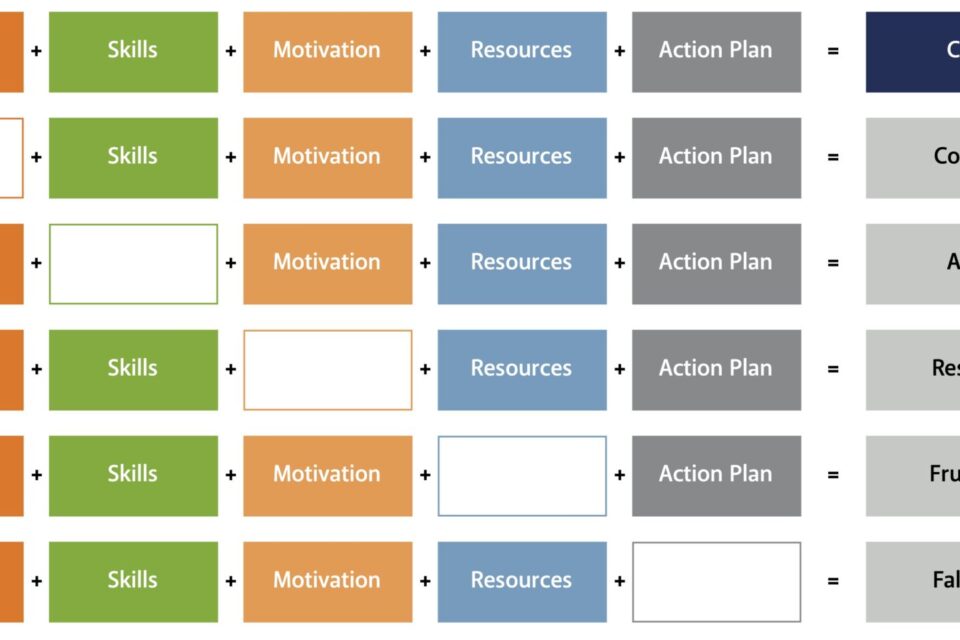
With the technical framework in place based on Implementation Science, we consulted the Lippitt-Knoster Model for Managing Complex Change for additional guidance. This model identifies five essential components required for successful change: Vision, Skills, Motivation, Resources, and an Action Plan. If even one element is missing, the change initiative risks failure:
- Missing vision leads to confusion: “Why are we doing this?”
- Missing skills results in anxiety: “I’m being asked to do this new thing, but I don’t know how. What happens if I can’t figure it out?”
- Missing motivation creates resistance: “This is a waste of time. The old way of doing things worked just fine.”
- Missing resources produces frustration: “I’m being asked to do this new thing, but I don’t have all the materials I need. How am I supposed to make it happen when I’m not provided with what I need?”
- Missing action plan leads to false starts: “We keep trying to make this change, but it never seems to stick.”
While Implementation Science helps us form the vision, we turned to Montessori’s Human Tendencies to fuel motivation. Because our work as Montessorians is deeply human, we prioritized these six tendencies during the transition:
- Orientation: Understanding one’s role in the bigger picture.
- Order: Making sense of the new physical and social environment.
- Exploration: Encouraging curiosity about the new curriculum.
- Communication: The need to understand and be understood.
- Exactness: Finding satisfaction in completing the new tasks well.
- Self-Perfection: Fostering self-determination in the new process.
We addressed the skills gap through responsive coaching and by using district professional development days for targeted learning. To provide the necessary resources, we designed a custom Scope and Sequence document that aligned CKLA skills to Montessori lessons, created record-keeping systems, and developed new Montessori works for every phonics skill in the curriculum.
Finally, we built a rigorous action plan detailing twice-monthly team meetings, principal check-ins, and a schedule for observations using our fidelity assessment.
Initial implementation
We moved from planning to action using PDSA cycles (Plan, Do, Study, Act). The Planning phase was complete, and we used our action plan to begin the Do phase. The “Study” phase is where many schools falter; they look at student outcome data too early. If the data hasn’t moved, is it because the method failed, or because it wasn’t actually implemented?
By using our fidelity assessment, we could see where the Key Ingredients were missing. If a classroom struggled, we asked: “Is this a skill gap? A resource gap?”
We then acted by providing the specific support needed.
Full implementation
Once the fidelity assessment data showed that the Science of Reading was being practiced widely and authentically, we turned our eyes to the student data.
The results were transformative. Thanks to the dedication of our teachers and leaders, the Montessori schools saw an increase of 21 percentage points in students reading at or above grade level on DIBELS. By integrating Implementation Science with Montessori principles, we found that systemic change can support, rather than compromise, our Montessori philosophy and pedagogy.
Explore more about active implementation at implementation.fpg.unc.edu.

Emily Madison
Emily Madison is a Montessori educator and founder of the Montessori Collective.
You may also like