

Public schools have a duty to make all children feel welcome
Public Montessori classrooms exist at a unique intersection: Grounded in a philosophy that centers the child, they operate within public systems shaped by standards, policies, and community expectations. In this space, educators are asked to hold both fidelity to Montessori principles and responsiveness to the diverse communities they serve.
In my work as a public Montessori educator, and in conversations with teachers across the country, one question continues to surface: What does it look like to truly honor the child in a classroom where children’s identities, histories, and lived realities are increasingly visible and complex? Montessori asks us to follow the child. Culturally responsive pedagogy asks us to see the child. Public Montessori requires us to do both.
As an educator whose own schooling experiences were shaped by culture, language, and socioeconomic difference, I am particularly attuned to the moments when children do, or do not, see themselves reflected in the classroom. This question is not theoretical. It lives in the daily work of teaching. It shows up in small, everyday moments, in what children notice, what they ask, and what they begin to make sense of about the world and their place in it.
When the curriculum meets the child
Montessori curriculum is often described as universal, grounded in developmental theory and informed by careful observation. At the same time, public Montessori classrooms are not abstract environments. They are filled with children whose lives reflect specific cultural, linguistic, and community contexts.
Children do not enter the classroom as neutral learners. They enter as meaning-makers whose experiences shape how they interpret and engage with the environment. They notice whose names are easy for them to pronounce and whose are not. They recognize which perspectives are emphasized, and which remain unexplored or underdeveloped within the curriculum. They ask questions that do not always live neatly within the scope of a lesson, but are deeply connected to it. These moments are not outside the curriculum. They are entry points into it.
Research on public Montessori highlights ongoing tensions around equity, access, and representation, particularly for students of color navigating systems not originally designed with them in mind. In this context, the work of the Montessori educator is not to add culture to the curriculum, but to recognize that culture is already present, and to respond through deliberate, instructional decision-making that shapes how children encounter and interpret content.
Expanding, not replacing
“Education should no longer be mostly imparting of knowledge, but must take a new path, seeking the release of human potentialities,” Montessori wrote. Culturally relevant pedagogy, as articulated by pedagogical theorist Gloria Ladson-Billings, emphasizes academic success, cultural competence, and critical consciousness. This framework has been further developed by Geneva Gay, Django Paris, and H. Samy Alim, who advocate for sustaining students’ cultural and linguistic identities. In Montessori spaces, this work is sometimes framed as something external to the method. In practice, it is an expansion of what has always been present.
Respect for the child has never meant attending only to developmental needs. It requires seeing the whole child, including identity, language, family, and community context. When children feel recognized, their engagement deepens and their sense of belonging strengthens.
In practice, this often begins with noticing. It requires a level of intentionality in how we respond, what we choose to extend, and what we allow to grow within the classroom. When children feel recognized, their engagement deepens and their sense of belonging strengthens.
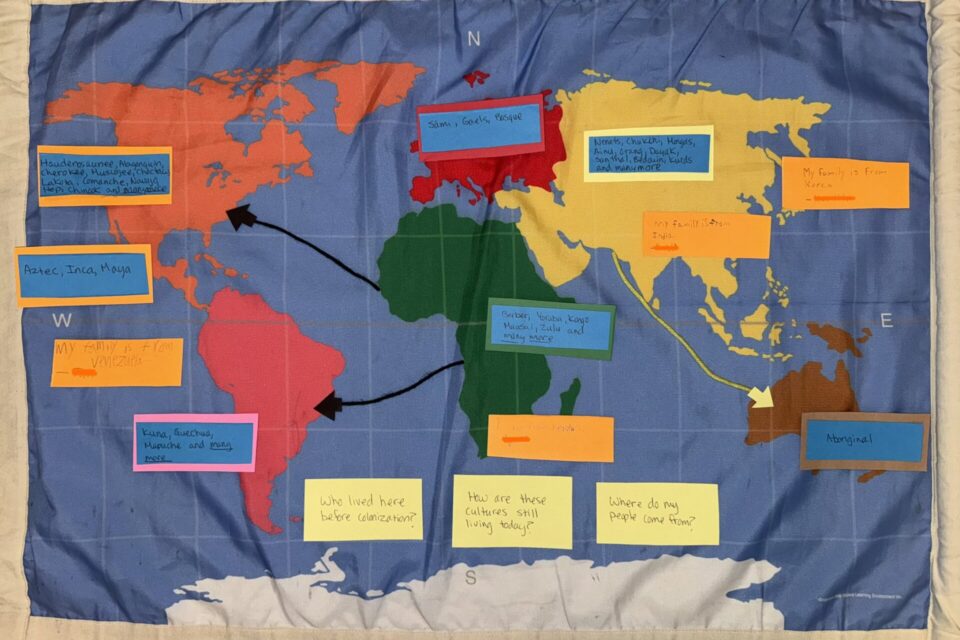
In my classroom, this has meant re-examining familiar materials through a broader lens. A continent study, for example, does not stop at landforms, biomes, animals, and climate. It includes layered understandings of Indigenous presence, forced migration, colonization, and the movement of people across time.
During this work, children often begin to make connections between the material and their lives, sharing stories about where their families come from or asking why certain histories are told more than others. Children are also invited to situate themselves within the human story by exploring their families’ migration histories.
In this way, they continue to learn geography while developing a more complete understanding of the world as lived and interconnected, as well as their place within the shared fabric of humanity. This is not a shift away from Montessori. It is a movement toward greater completeness.
Seeing the prepared environment more fully
In my work with educators, I have found that culturally responsive Montessori practice becomes clearer when we shift how we see the prepared environment itself. Instead of viewing it as something fixed, it becomes something we continuously interpret and refine based on the children in front of us, with attention to how meaning is constructed through materials, language, and interaction.
Building on a framework shared by Paul K. Chappell and Jacqui Miller at the 2026 NCMPS Public Montessori Conference and Retreat, and reinterpreting it through a culturally responsive lens, I began to reconsider familiar elements of the classroom not as fixed structures, but as opportunities for expansion.
What emerged was a way of thinking about the prepared environment as something that can be developmentally aligned and culturally responsive at the same time. A lesson can be accurate, but not yet expansive in its purpose. A classroom can feel peaceful, but not yet foster a deep sense of belonging. A material can be correct, but still limited in how it invites children to connect their own experiences and identities to the content.
This shift invites educators to look more closely at the underlying elements of their classrooms. It asks us to consider how purpose, relationships, explanations, and expression are experienced by children, and whose ways of knowing are centered and which perspectives are not yet fully represented or explored within those experiences. It extends further into questions of inspiration, belonging, and self-worth, ensuring that children not only access the curriculum, but see themselves as valued participants within it.
In practice, this can be as simple as rethinking how a lesson is introduced, what questions are invited, or how children are encouraged to respond and make meaning. These shifts are not accidental, they are the result of intentional decisions about whose knowledge is centered and how meaning is constructed.
In this way, rigor and challenge are not removed but deepened, becoming a form of intellectual and relational vigor, as children engage in meaningful, connected work that reflects the complexity of the world around them.
Ultimately, this perspective expands peace education beyond harmony and cooperation alone. It invites a broader understanding of peace, one that includes identity and responsibility, allowing children to develop not only as learners, but as participants in an interconnected and evolving world.
A site of belonging
In Montessori, the environment teaches. The books on the shelf, the images on the wall, and the materials on the tray communicate messages about whose experiences matter.
In public Montessori classrooms, where student populations are often diverse, the prepared environment becomes a critical site for belonging. When children see their culture, languages, and family structures reflected, they experience the classroom as a place where their identities are recognized as integral to the learning environment.
In contexts where teachers have limited control over materials, this work shifts from selection to pedagogy. Teachers guide children to notice patterns, ask questions, and consider multiple perspectives within what is available. In this way, representation is supported not only through materials, but through how children are taught to engage with them.
Montessori environments that foster emotional safety and belonging are especially important during times of uncertainty, as they provide stability and connection for children navigating complex realities.
Inquiry as the bridge
One of the most powerful tools Montessori educators have is inquiry. When children ask questions, particularly those connected to identity, fairness, or difference, the role of the teacher is not to provide conclusions, but to facilitate structured exploration grounded in observation, questioning, and evidence.
As Maria Montessori reminds us, “I feel that it is a difficult path that we are following … This ‘someone’ who can teach us is the child. The child can reveal to us the origin of society and can show us the way out of this intricate question. Our task is to give help to the child and watch for what he will reveal to us.”
Questions such as “What do you notice?” “What are you wondering?” and “How might we learn more?” maintain a focus on learning rather than positioning and allow children to think critically while remaining grounded in observation and research. In practice, this can look like staying with a child’s question a little longer than planned, allowing space for multiple perspectives, or returning to a topic over time rather than closing it too quickly.
In public Montessori settings, where educators may feel pressure to avoid certain topics, inquiry offers a path forward. It honors the child’s curiosity while maintaining alignment with Montessori principles of self-directed learning and discovery.
Grace and courtesy
Grace and Courtesy lessons are often the first place where culturally responsive practice becomes visible. Traditionally focused on tone, movement, and social norms, these lessons can expand to include explicit practice in navigating difference, addressing harm, and engaging in repair within community contexts. These moments often arise naturally, in small conflicts, misunderstandings, or moments of curiosity between children.
Children naturally encounter moments that require them to listen across differences, respond to mistakes, and reconsider assumptions. Community meetings create space for this work, allowing children to practice listening, disagreement, and accountability in developmentally appropriate ways.
The realities of public Montessori
Public Montessori educators operate within systems that bring both opportunity and constraint. There are standards to meet, policies to follow, and communities with differing expectations. At times, this requires careful professional judgment as educators balance responsiveness with institutional expectations.
Culturally responsive Montessori practice does not require stepping outside of these systems. Inste ad, it asks educators to work within them with clarity and intention. This work includes ensuring that materials reflect a range of human experiences when possible, guiding children to think critically about what they observe, creating classroom structures that support dialogue and community, and responding to children’s questions with curiosity rather than avoidance.
This is not about introducing a new ideology. It is about maintaining fidelity to the child. In practice, this often looks like small, thoughtful shifts in how materials are used, how conversations are facilitated, and how children’s questions are honored, rather than large-scale changes to the curriculum itself.
Preparing children for the world they inhabit
Montessori education has always been oriented toward the future. Through cosmic education, children come to understand interdependence and their place within a larger human story.
For today’s children, that world is diverse, complex, and interconnected like never before. Preparing them requires more than academic knowledge. It requires the ability to see themselves as part of the human story, to understand perspectives beyond their own, to engage thoughtfully with difference, and to participate in community with responsibility and care.
Returning to the child
In conversations about curriculum, policy, and practice, it is easy to lose sight of the simplest truth: the child remains at the center. Culturally responsive Montessori practice is not about adding something new. It is about returning to what has always been essential, a commitment to understanding the child as both a developing learner and a situated human being.
It asks educators to observe more closely, listen more carefully, and prepare environments that reflect not only developmental needs, but lived realities. In public Montessori classrooms, this work ensures that all children experience school as a place where they belong. And when children feel that sense of belonging, their capacity to engage, question, and contribute to the learning community expands in meaningful ways.

Jazmin Corbell
Jazmin Corbell is a public Montessori educator and Montessori coach at Charles Ellis Montessori Academy in Savannah, Georgia.
You may also like