

Group work brings out the best in Montessorians of all ages
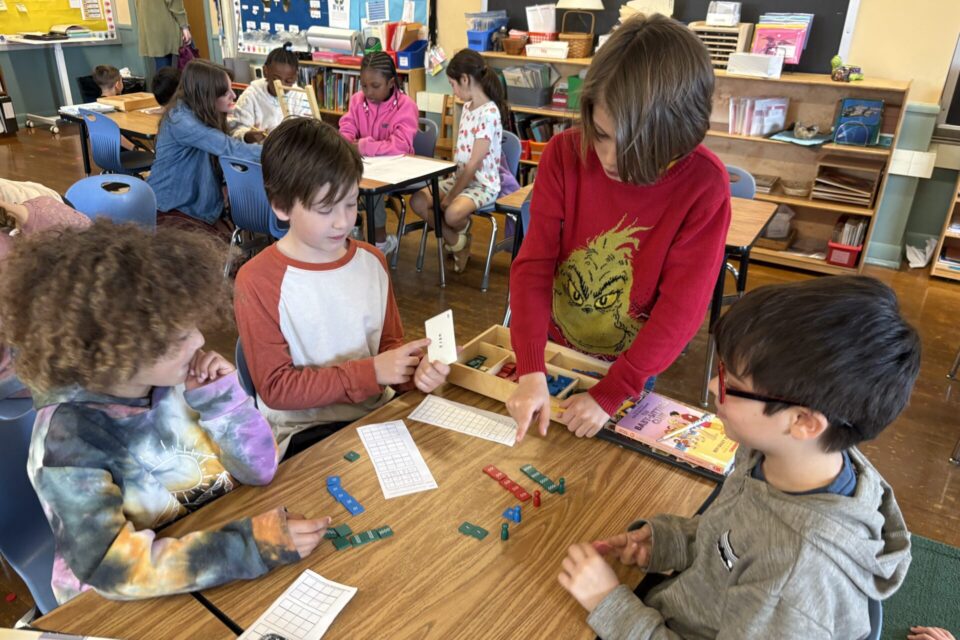
One of my favorite Montessori “A-ha moments”—those snapshots of pedagogical genius that immediately make sense when you see them, no Montessori background needed—is how right Montessori gets group work.
In non-Montessori education, we spend children’s early years (the first plane of development) trying to get them to work together when their natural tendencies are to work in parallel. Then, when they hit the elementary years (the second plane) and their social and intellectual needs drive them toward each other, we put them at desks and ask them to do their own work. Oh, the struggle—and no wonder!
As I reviewed this issue of MontessoriPublic, what caught my attention is that we at NCMPS and our colleagues across the education sector have been channeling our inner second-plane child to get work done that simply could not be done alone. Unlike the collaborations in our elementary classrooms where children are learning how to negotiate roles and share responsibility, these grown-up collaborations bring together organizations with distinct expertise, resources, and roles to play. The magic comes in figuring out how to combine these strengths to accomplish something we simply couldn’t do on our own.
From Washington state, we have a remarkable story of what sustained collective investment means for the long-term health of a quality program. A decades-long collaboration in Spokane Public Schools includes teachers and their union, administrators, parents, and the school district working together to build and maintain a strong public Montessori program that has attracted families and served children for more than forty years.
Three more stories tackle the ever-present challenge of sustainable teacher preparation, with different approaches taking shape in Washington, Iowa, and Louisiana.
To provide Washington’s public Montessori programs with a sustainable stream of well-prepared, credentialed teachers, Whitworth University has brought in NCMPS and Montessori Northwest (an AMI training center) to integrate Montessori teacher preparation into its state-approved teacher credentialing program.
In Des Moines, Iowa, NCMPS translated its teacher training curriculum into a master’s-level program, allowing Drake University to launch a Montessori preparation pathway targeting Des Moines Public Schools’ teachers. Teachers will be able to pursue a master’s degree and Montessori certification through an integrated program which Drake plans to open to other Iowa districts at a later date.
In Louisiana, NCMPS is working with the Tangipahoa, East Baton Rouge, and Rapides Parish school systems to train teachers for their Montessori programs through the National Center’s MACTE-accredited Montessori Teacher Residency, while simultaneously helping the parishes establish their own regionally-grounded teacher preparation program. The collaboration addresses both the immediate need for trained Montessori teachers and the long-term need for a sustainable teacher pipeline.
Finally, a collaboration with the National Association of Charter School Authorizers (NACSA) helps the broader education system understand and support Montessori.
NCMPS has been working with NACSA for several years, drawing on our experience and resources to help charter school authorizers better understand Montessori. Now, with funding from the U.S. Department of Education, NACSA has selected Montessori as the first model in a planned series of guides to help authorizers understand, support, and assess the unique educational models offered by the schools they oversee.
And these are just the collaborations featured in this issue. In our next issue, we hope to share some of the exciting work happening around curriculum. The common thread in all this work is that building something complex, building something that lasts, and building something that meets the varied needs of children, families, and teachers takes a village’s worth of expertise and commitment.
So, let’s keep channeling our inner second-plane child and get this big work done!

Sara Suchman
Sara leads and directs the National Center for Montessori in the Public Sector.
You may also like