
A new partnership serving Montessori teachers in Des Moines public schools
Joining a partnership between a public school district and a local university to provide Montessori teacher training? That’s just the kind of sector-building work the National Center for Montessori in the Public Sector was created to do, especially when that training turns into a master’s degree for the teachers in question.
That’s exactly what’s happening between Des Moines Public Schools (DMPS) and nearby Drake University, which traces its School of Education all the way back to 1888.
The collaboration is unique within the educational world, and one well worth celebrating. So, Montessori Public sat down with some of the folks that put it together for an inside look at how the partnership works. As Jill Johnson, a professor and director of the graduate program at Drake University’s School of Education explained, the relationship’s roots run deep.
“Drake and Des Moines Public Schools has had a longstanding partnership, which in itself is unique,” Johnson said, noting that the partnership goes back 13 years. “It’s a high-need district, and [DMPS] were losing a lot of teachers every year. With every teacher in their system, they’ve invested time, and energy, and institutional knowledge with that teacher. So, they were looking at a way to encourage teachers to stay in the district.”
What the district settled on, with Drake’s help, was a master’s program where teachers could enroll at no cost—other than a commitment to stay in the district for a certain number of years.
The upshot has been a decade with multiple winners; teachers get a free master’s degree (not to mention the concordant pay bump), Drake gets students, and the district gets “help moving forward on their strategic vision and goals,” Johnson said.
More Montessori
One of those goals, she continued, is expanding public Montessori options within the district. For over thirty years, Cowles Montessori was the district’s only public Montessori school. In fact, it was the only public Montessori school in the state. That changed as a part of DMPS’ five-year “Reimagining Education” plan, which divided the district into three distinct regions, each with a pathway leading to a high school and with unique educational options on tap.
“Des Moines is doing a big reimagining,” said Laure Fleming, Director of Impact and Innovation at NCMPS. (At the time of this interview, she served as NCMPS’ Director of Teacher Residencies.)
“They’re trying to put specialty programs all over their city to try to hold on to enrollment, because the Iowa voucher system allows people to [explore other educational options]. So the district is really looking at reimagining what it’s offering to families in order to keep kids enrolled in the district, and Montessori…is a big part of that.”
But if you want to deliver more Montessori to more students, you’ve got to have more Montessori-trained educators on deck.
“[DMPS] recognized a need and a desire and reached out. And then we were able to bring in NCMPS as the expert in Montessori and help us really design a program that would fill the needs of DMPS, the rigor that Montessori requires, and also be within our guidelines at Drake,” Johnson said. “So, it took a coordination of people with different expertise and different desires to come together for this to be a pathway for Des Moines teachers.”
For Fleming—who, as director of teacher residencies, was passionate about equity issues in Montessori training—such a pathway is all too rare.
“There are other master’s degrees associated with Montessori training, such as Loyola University Maryland, where I got mine. But the masters is typically an add-on to an accredited Montessori training,” Fleming said. “In this case, the actual Montessori training program is the pathway to the master’s degree.”
“I don’t know many other programs that are doing that in the country right now that are working with a district and a university at the same time,” echoed Katie Mosquera, Coaching Specialist for NCMPS.
Job embedded
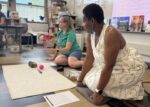
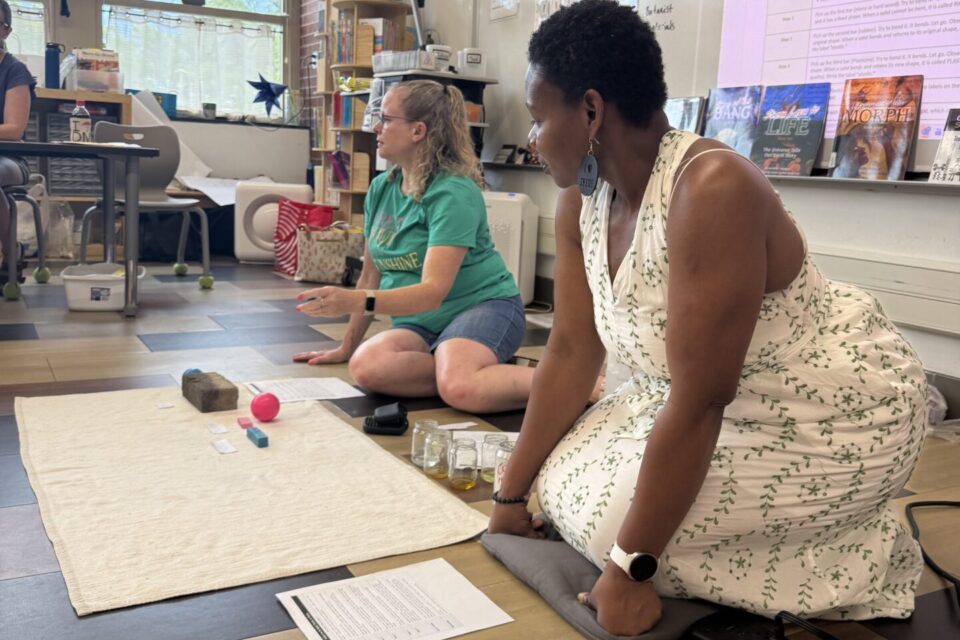
NCMPS’ contribution to the pot is just as unique as the other ingredients—its Montessori Teacher Residency program (MTR), around which Drake’s master’s degree is built, is “job embedded.” That means trainees learn Montessori pedagogy in the context in which that pedagogy will be implemented, i.e. their own communities, schools, and classrooms. No traveling, no paying for lodging, no leaving kith and kin at home every summer in pursuit of a certificate or degree.
Trainees work through the program in cohorts, leaning on already-developed colleague relationships for support. That’s an environment that leads to camaraderie and success, both Fleming and Mosquera said. Not to mention there’s flexibility built right into the training model, something that made it a good fit for modification into a Drake University master’s degree. In addition to holding accreditation by Higher Learning Commission for its Masters of Science in Montessori Education, Drake is also seeking MACTE accreditation for the course.
The first cohort began last year.
“My experience with this group of teachers has been they just really dig deep, and they have embraced the Montessori philosophy,” Mosquera said of the cohort, which comprises 18 teachers from within the district.
The make-up of this cohort is a combination of those seeking Montessori as an alternative pedagogy and those who are long-serving, experienced teachers in their buildings willing to take on the Montessori preparation in order to remain in service to their school communities undergoing the transition to Montessori.
That’s not easy, nor is the rigor demanded by Montessori training. Some students were taken off-guard by just how much intensity the program demands, Johnson said.
“But what we found, though, is after the summer intensive and they have a year behind them, our first cohort is really settling in and balancing their workload a little bit better. They are recognizing the rigor that needs to happen,” she said.
With that kind of Midwestern work ethic on tap, it’s no surprise that as the new school year begins, a second cohort, eighteen strong, is ramping up, with more in the pipeline.
And always worth remembering, Fleming said, is how it all came about to begin with—community buy-in and institutional partnerships, all in greater service to the child.

Andrew Marshall is an award-winning journalist and visual artist.
You may also like