

An ambitious program to revitalize public Montessori in Louisiana
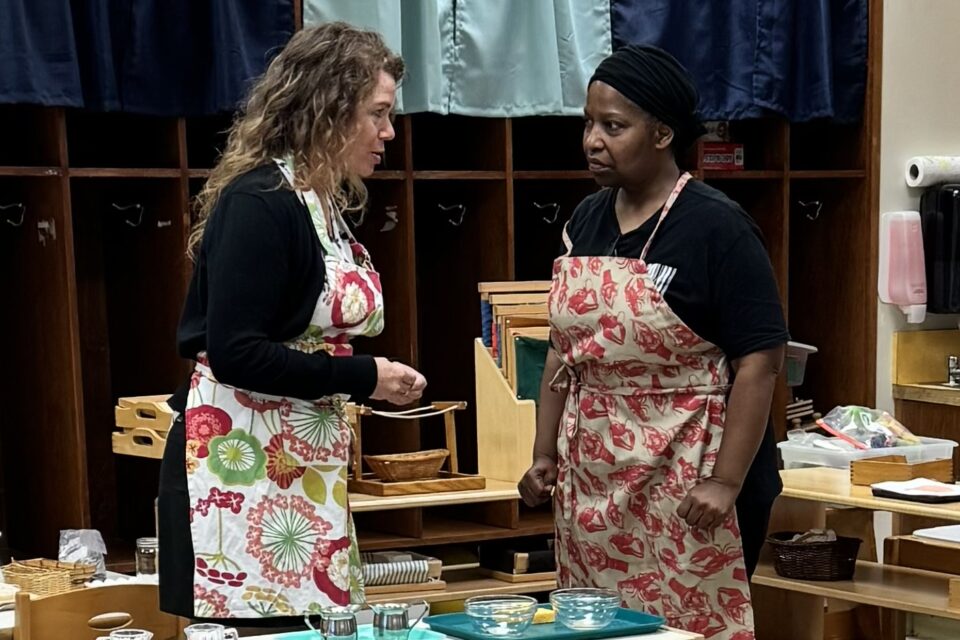
DeShea Johnson had only been at her job for about a month when she was handed a major project—figure out why the two public Montessori schools in her Louisiana school district had strayed from the model.
“One of our school board members had reached out to [the superintendent] and wanted to know how come they had gone back to [non-Montessori instruction] …, and why does it look similar to the traditional school sites,” said Johnson, the Magnet Coordinator for Tangipahoa Parish School System (TPSS).
Johnson started digging. What she eventually found was that a 2010 grant had paid for two years of Montessori teacher training, but was not enough to sustain the programs over time.
As the distance between the original training and the current moment increased, test scores started slipping. Many teachers who were trained in 2010 left their roles, and many of those hired since lacked Montessori training. Johnson set out to right the ship. But she wanted to right it in a sustainable way.
“We’ve already had training, we’ve already bought materials. What about this would be different, where we could sustain the program?,” she asked herself.
A conversation with Tangipahoa Parish School System superintendent Melissa Martin Stilley illuminated a possible way forward.
“She said, you know, DeShea, it’s always been a dream of mine to open a Montessori training program in our district … my grandchildren went to the Montessori schools. I really believe in Montessori,” Johnson said.
Meanwhile, Johnson had also discovered that two other districts in Louisiana were facing similar challenges. So Tangipahoa, East Baton Rouge, and Rapides Parish school systems teamed up to apply for a federal Magnet Schools Assistance Program grant—with only twenty days until the grant deadline. A tight squeeze for an extensive grant process, but they got it done. When they found out they’d secured the $15M grant in October 2024, they started looking for a Montessori teacher preparation partner who could meet their needs for sustainability—not only training their current teachers but also preparing the Parishes to open their own training center.
Accessible training
One of their needs was to bring the training to the Parishes so teachers didn’t need to travel.
“In most of the country, there’s not a training program available. It’s not like most places have [a MACTE-accredited] training center sitting next door,” said Laure Fleming, Director of Impact and Innovation at the National Center for Montessori in the Public Sector (NCMPS).
The travel challenge is just one of the reasons NCMPS entered the world of teacher training over a decade ago. The NCMPS Montessori Teacher Residency design also recognizes the importance of local context in public education. The training is “job embedded,”—learning to do the work in the context in which the work will be done. That’s exactly what’s happening now in Tangipahoa, East Baton Rouge, and Rapides Parish school systems. This kind of “Grow-Your-Own” teacher development strategy is “increasingly popular … for strengthening and diversifying the teacher workforce,” according to a 2024 report from New America, an education policy think tank.
Bringing high-quality Montessori training to educators instead of the other way around enables schools to hire staff from their local communities who might not be able to leave home for a summer of training. The upshot is that the Montessori teacher pipeline becomes more diverse and reflective of individual communities.
Coming onsite also means NCMPS’s training can be individually tailored to meet the needs of unique communities. Louisiana’s culture is no more homogeneous than that of any other state, and each of the three parishes has its own cultural assets and needs. The National Center’s MTR can flex and bend, scheduling coursework around the Wednesday night church services common in the Tangipahoa and Rapides parishes, or giving trainees a week off for Mardi Gras.
The point is that life goes on, even during Montessori training. Respecting that, rather than requiring teachers to put their life on hold, is a central theme of the National Center’s MTR.
“We’ll kind of do anything,” Fleming said. “We’ll do whatever it takes to the degree that we can.”
Seeing the light bulbs
Another of Louisiana’s needs was a program that prepared teachers for the demands of working in a public setting.
“What was lacking [in our schools] was a standards alignment, and that accountability piece,” Johnson said.
NCMPS’s Montessori Teacher Residency design recognizes the unique demands of a public Montessori school. That means offering training that is standards aligned from the very first day, plus a host of other skills needed to teach effectively in public settings.
“We’ve integrated … coursework on trauma and [the] brain, special education, culture, race and equity, engaging with diverse families, multilingual learners, so we have a surround of coursework that is appropriate for public school educators,” said Fleming.
Fleming also said her team at NCMPS has worked hard to come into communities with respect for cultural background and lived experience. Fleming wants the adult students in MTR cohorts to be independent thinkers capable of pivoting with the moment-by-moment needs of public education while holding true to Montessori principles.
“Interestingly enough, Montessori is constructivist, and Montessori teacher education has [not always been],” Fleming said. “And so we’ve done a lot of work around that.”
As flexible as the National Center’s MTR is, one thing never changes. And that’s how it feels when things start to click for a trainee. That’s something that never gets old for Angie Morris, the NCMPS instructor and coach spearheading the Louisiana program.
“You can see the light bulbs going off during a lecture, and that’s a beautiful thing,” Morris said. “That’s something that I really enjoy … building those relationships with [teachers] and being a part of their journey when they’re having those moments. It is really important to me. They’re my people, I’m invested in their success.”
“Grow Your Own” was an attractive model for Tangipahoa Parish. But just because training is happening locally and flexibly doesn’t mean it’s easy. Cohort members grind away on weekends, evenings, and summer break. The realities of people’s lives mean that some teachers move on or drop out before completing their training.
But the beauty of the Montessori method wins out, and for the most part, Johnson said, “My teachers are thirsty for this … I see a lot of excitement there, and a lot of eagerness.”
Andrew Marshall is a Communications Specialist for the National Center for Montessori in the Public Sector.

Andrew Marshall is an award-winning journalist and visual artist.
You may also like