


A quantitative research study in a Montessori classroom
Red words. Heart words. Puzzle words. Sight words. High frequency words. You might have learned how to teach these tricky words in your training. Are they all the same thing, and what is the evidence-based method to teach these words for reading and spelling mastery?
When asked in a Montessori social media group about educators’ experiences and training in teaching irregular words in the classroom, guides’ feedback was generally unanimous. Either they had received no explicit training in irregular word instruction, or they were taught to have students memorize the words as whole units on flashcards. Many commenters chimed in, sharing that they sought additional training in Orton-Gillingham, the Science of Reading, or structured literacy after completing their Montessori training to better equip themselves to teach reading and spelling, including the explicit instruction of irregular words. The shift from rote memorization to a more analytical approach reflects a broader understanding of how children learn to read and spell effectively.
Recently, there has been an increasing interest in the research and application of irregular word instruction. The rote memorization of hundreds of words does not align with reading research. This method overlooks the importance of storing letter and sound associations in memory. Even words regarded as highly irregular in English may have sufficient regularity to be successfully decoded and encoded. Instead of having students memorize long lists of irregular words, we can teach them to read and spell by finding the parts of the word that break the rules and the parts that do not. Words stick when their meanings, pronunciations (sounds), and spellings are combined. As high-frequency words lie along a spectrum of irregularity, with most following some regular sound-spelling correspondences, students can still use their phonics knowledge and skills to analyze high-frequency words. Therefore, educators need to discontinue the drill-and-kill method of rote memorization of all irregular words and move toward a more research-based method of analyzing the parts of words that remain phonetic and the parts that do not follow English phonetic rules.
Irregular words challenge students because they only partially follow standard English spelling rules and patterns. They contain unique spellings and pronunciations that are difficult to memorize. Irregular words often require more practice and repetition than regular (decodable) words because of the complexity and unpredictability of the sound-spelling associations. As one goal of reading is for every word to become a sight word, educators must implement teaching practices that enable students to read and spell irregular words instantly and effortlessly. This study explored if there was a functional relationship between the type of irregular word spelling instruction and irregular word spelling skills.
Frequently, educators use the terms sight words, high-frequency words, and irregular words synonymously, which can be confusing. Any word, whether decodable or irregular, read fluently and effortlessly is considered a sight word. Any word, whether decodable or irregular, appearing in print frequently is considered a high-frequency word. Irregular words are those that contain exceptions to the typical sound-spelling patterns in their grapho-phonemic correspondences, either temporarily (because the student has not yet learned the phonics pattern) or permanently (because the graphemes represented will never adhere to the rules and patterns of the English language). Orthography refers to the correct spelling of words. Orthographic mapping is the process by which readers connect the sounds of letters (phonemes) to their correct letter sequences (graphemes) for spelling. This connection assists with storing words in memory for instant and effortless retrieval so that they become sight words.
Importance of explicit irregular word instruction
Learning irregular words is important because it supports the formation of a robust sight word vocabulary, enhancing reading and spelling skills. While often perceived as highly irregular, the English language is characterized by a high degree of phonological consistency. Most letters in irregularly spelled words conform to grapheme- phoneme conventions. Researchers have suggested that only about 4% of English words are truly irregular. Therefore, explicit instruction in analyzing irregular words’ phonetic and irregular components should be manageable.
In a 2020 article, reading scholar Linnea Ehri proposed that it is vital for students to make a connection between the graphemes and the phonemes of all words to help bond the spellings and pronunciations. Even in words that do not follow typical sound-spelling patterns, some parts of the word can be decoded by readers. Knowledge of the components of words (irregular and decodable) can assist with orthographic mapping, therefore assisting with storing words in memory as sight words.
Integrating irregular word instruction emphasizing systematic phonics that specifically targets grapheme-phoneme correspondences and exceptions to typical sound-spelling patterns can improve reading skills, even among struggling readers. Irregular word spelling instruction can increase students’ sight word recognition, contributing to more fluent reading and more skilled spelling. By incorporating irregular word instruction into literacy practices, educators can help students develop a deeper understanding of the rules, patterns, and exceptions to the English language. Such instructional practices can increase students’ sight word knowledge), fluency reading, and encoding skills.
In a recent study, we examined a potential functional relationship between the type of irregular word spelling instructional approach and an increase in students’ irregular word spelling skills.
Seven first-grade students from a Montessori classroom were randomly assigned to two groups. One group received instruction utilizing techniques to analyze and understand irregular words’ phonetic and exception components (a grapho-phonemic approach). Another group received instruction utilizing techniques to memorize unanalyzed irregular words as whole units displayed on flashcards.
After four weeks of instruction in each intervention group, the students switched so that each group received instruction in each approach. The groups received instruction in the other approach for an additional four weeks. We collected data for 11 weeks using weekly cumulative irregular word spelling assessments. By collecting data for all participants receiving instruction in both methods, we measured how skills produced by these two approaches contributed to the spelling of whole irregular words and correct letter sequences within irregular words. These data helped determine which type of irregular word spelling instruction demonstrated a functional relationship to increased irregular word spelling skills.
The findings provided some initial support for the alternative hypothesis that a functional relationship does exist between irregular word spelling instruction and irregular word spelling skills of first-grade students. Overall, the pattern across students suggested a slight advantage of the grapho-phonemic intervention relative to the flashcard intervention, regardless of the order. The results of this study are generally consistent with previous research indicating that instruction for irregular words should emphasize a grapho-phonemic approach. Several studies support the process of active engagement with the spelling of irregular words, highlighting systematic phonics and grapho-phoneme relations in irregular words. These studies underscore the significance of these instructional strategies in enhancing students’ reading and spelling proficiencies. By focusing on the connection between letter-sound correspondences in irregular words, educators can better support learners in orthographic mapping these words to their permanent sight word storage.
Implications for irregular word instruction
The findings of this study and the data presented in other literature suggest that educators should incorporate evidence-based practices into their instruction for irregular word spelling support. These practices include emphasizing the grapho-phonemic components of irregular words by drawing attention to parts of the word that follow expected sound-symbol patterns and the parts of the words that do not. (See Grapho-Phonemic Mapping on the previous page.)
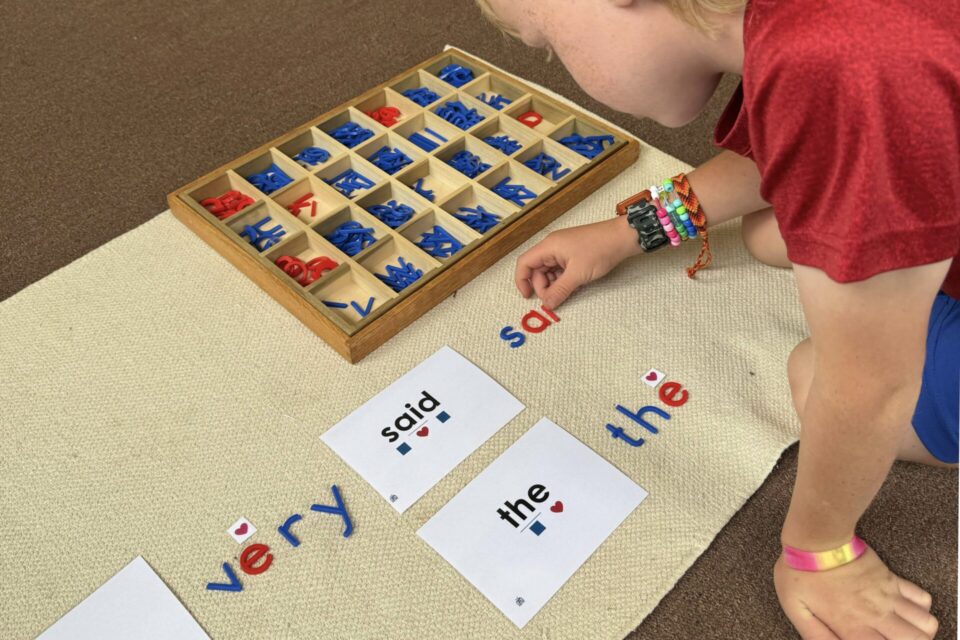
As follow-up work to aid in continuous exposure, students can use the movable alphabet to spell irregular words by placing a small, laminated heart above the part of the word that is an exception to the sound-spelling rule or pattern. This approach supports the theory of orthographic mapping in which the sound and symbol (and meaning) of a word are linked together to create a mental representation of words to be stored in long-term memory for effortless retrieval. This approach is particularly important for irregular words, as understanding their grapho-phonemic components helps contribute to the long-term storage of irregular words in readers’ sight word vocabulary memory.
References
- Arra, C. T., & Aaron, P. G. (2001). Effects of psycholinguistic instruction on spelling performance. Psychology in the Schools, 38(4), 357-363.
- Bhattacharya, A., & Ehri, L. C. (2004). Graphosyllabic analysis helps adolescent struggling readers read and spell words. Journal of Learning Disabilities, 37(4), 331-348.
- Brunsdon, R., Coltheart, M., & Nickels, L. (2005). Treatment of irregular word spelling in developmental surface dysgraphia. Cognitive Neuropsychology, 22(2), 213–251.
- Colenbrander, D., Wang, H. C., Arrow, T., & Castles, A. (2020). Teaching irregular words: What we know, what we don’t know, and where we can go from here. The Educational and Developmental Psychologist, 37(2), 97-104.
- Colenbrander, D., Kohnen, S., Beyersmann, E., Robidoux, S., Wegener, S., Arrow, T., & Castles, A. (2022). Teaching children to read irregular words: A comparison of three instructional methods. Scientific Studies of Reading, 26(6), 545-564.
- Cuvo, A. J., Ashley, K. M., Marso, K. J., Zhang, B. L., & Fry, T. A. (1995). Effect of response practice variables on learning spelling and sight vocabulary. Journal of Applied Behavior Analysis, 28(2), 155–173.
- Ehri, L. C. (2005). Learning to read words: Theory, findings, and issues. Scientific Studies of Reading, 9(2), 167-188.
- Ehri, L. C. (2014). Orthographic mapping in the acquisition of sight word reading, spelling memory, and vocabulary learning. Scientific Studies of Reading, 18(1), 5-21.
- Ehri, L. C. (2020). The science of learning to read words: A case for systematic phonics instruction. Reading Research Quarterly, 55, S45-S60.
- Ehri, L. C. (2024). Clarifying the role of orthographic mapping in sight word reading. The Reading League Journal, 5(1), 4-12.
- Harm, M. W., & Seidenberg, M. S. (2004). Computing the meanings of words in reading: Cooperative division of labor between visual and phonological processes. Psychological Review, 111(3), 662.
- Johnston, R., McGeown, S., & Moxon, G. E. (2014). Towards understanding how children read and spell irregular words: The role of nonword and orthographic processing skills. Journal of Research in Reading, 37(1), 51-64.
- Joshi, R. M., Treiman, R., Carreker, S., & Moats, L. C. (2008). How words cast their spell. American Educator, 32(4), 6-16.
- McArthur, G., Castles, A., Kohnen, S., Larsen, L., Jones, K., Anandakumar, T., & Banales, E. (2015). Sight word and phonics training in children with dyslexia. Journal of Learning Disabilities, 48(4), 391–407.
- Miles, K. P., Ehri, L. C., & Lauterbach, M. D. (2016). Mnemonic value of orthography for vocabulary learning in monolinguals and language minority English-speaking college students. Journal of College Reading and Learning, 46(2), 99–112.
- Miles, K. P., Rubin, G. B., & Gonzalez-Frey, S. (2018). Rethinking sight words. Reading Teacher, 71(6), 715–726.
- Miles, K. P., McFadden, K. E., & Ehri, L. C. (2019). Associations between language and literacy skills and sight word learning for native and nonnative English-speaking kindergarteners. Reading and Writing, 32(7), 1681–1704.
- Moats, L. C. (2005). How spelling supports reading. American Educator, 6(12-22), 42.
- Ouellette, G., & Sénéchal, M. (2008). Pathways to literacy: A study of invented spelling and its role in learning to read. Child development, 79(4), 899-913.
- Rawlins, A., & Invernizzi, M. (2019). Reconceptualizing sight words: Building an early reading vocabulary. The Reading Teacher, 72(6), 711–719.
- Savage, R., Georgiou, G., Parrila, R., & Maiorino, K. (2018). Preventative reading interventions teaching direct mapping of graphemes in texts and set-for-variability aid at-risk learners. Scientific Studies of Reading, 22(3), 225-247.
- Schlesinger, N. W., & Gray, S. (2017). The impact of multisensory instruction on learning letter names and sounds, word reading, and spelling. Annals of dyslexia, 67, 219-258.
- Share, D. L. (1995). Phonological recoding and self-teaching: Sine qua non of reading acquisition. Cognition, 55(2), 151-218.
- Simonsen, F., & Gunter, L. E. E. (2001). Best practices in spelling instruction: A research summary. Journal of Direct Instruction, 1(2), 97-105.
- Steacy, L. M., Wade-Woolley, L., Rueckl, J. G., Pugh, K. R., Elliott, J. D., & Compton, D. L. (2019). The role of set for variability in irregular word reading: Word and child predictors in typically developing readers and students at-risk for reading disabilities. Scientific Studies of Reading, 23(6), 523–532.
- Treiman, R. (2017). Learning to spell https://doi.org/10.1080/10888438.2017.1296449words: Findings, theories, and issues. Scientific Studies of Reading, 21(4), 265-276.
- Weiser, B., & Mathes, P. (2011). Using encoding instruction to improve the reading and spelling performances of elementary students at risk for literacy difficulties: A best-evidence synthesis. Review of Educational Research, 81(2), 170–200.

Jennifer Dempsey
Jennifer Dempsey is a lower elementary guide at the Montessori School of Maui and a doctoral student in the Reading Science program at Mount St. Joseph University.

Dr. Kelly A. Powell-Smith
Dr. Kelly A. Powell-Smith is a Professor of Reading Science at Mount St. Joseph University.

Dr. Laura Saylor
Dr. Laura Saylor is the Dean of the School of Education at Mount St. Joseph University.
You may also like