


Research suggests a new step in the lesson
In recent years, the Science of Reading (SoR) has gained much attention, and for good reason. It is not a buzzword or a fad. Like the term “Montessori,” it can be misleading because anyone can use it regardless of their fidelity to practice. The term SoR refers to the massive amount of research accumulated over the past 50 years about how the brain learns to read, what works, what doesn’t, and why.
As an AMI trainer-in-training, I began looking at this body of research to help me understand how the brain learns to read and how our practices for supporting emerging literacy in the Children’s House align. What I’ve learned has deeply affirmed our core principles and practices as Montessori practitioners and been informative about what we can do better.
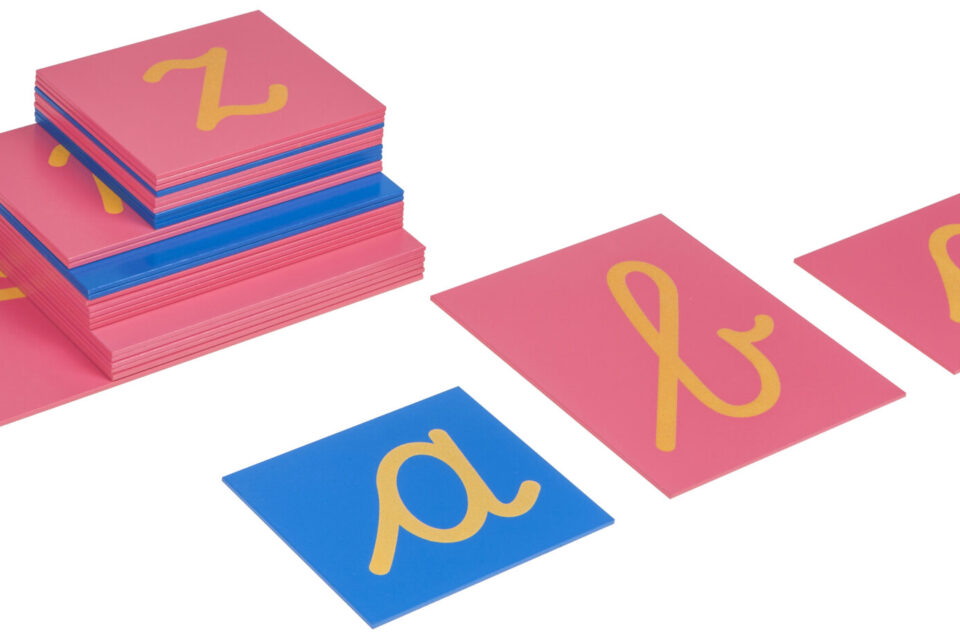
One of the first things I validated was using keyword picture cards with the Sandpaper Letters. When I added these cards to the classroom (fixed to the wall behind each letter, displayed on long, narrow wall shelves), I saw success manifest right before my eyes because it supplemented the work with the Sandpaper Letters; they helped forge the neural connection between meaning and an arbitrary symbol for a sound. I was pleased to find later that Maria Montessori wrote, “To every letter of the alphabet, there corresponded a picture…the name of which began with the letter in question,” describing precisely these alphabet picture cards. Current literature provided further affirmation, where mnemonics have been shown to aid the development of sound-symbol correspondence.
I also began to use little booklets for record-keeping of Sandpaper Letter lessons, which were placed on the shelf for the children’s free choice. I would write the child’s name on the booklet’s front cover. On the back cover, all the letters were printed in a font and color that matched the Sandpaper Letters to keep track of their lessons in the same way as a record-keeping card (underlining a letter each time a lesson was given, circling it when the sound-symbol correspondence was solidly demonstrated).
At the end of the lesson, I wrote each letter on a page of their booklet, along with some of the keywords we thought of at the beginning. This approach provided a model for handwriting and a rationale for letter learning. These little lists of words then became an excellent support for retaining sound-symbol correspondence over time. Letters would be reviewed frequently over the days following a lesson. If the child couldn’t remember the sound represented by a letter, I would read their words to see if that prompted their memory of the sound—it frequently did. Then, I would provide more command games and bring me games with that letter. If it didn’t, I knew I needed to give another three-period lesson.
I also introduced handwriting on a chalkboard much earlier, a tip from one of my trainers who visited my classroom as a consultant. When I saw that children could make intentional shapes in their drawings, I knew they could begin to practice letters with chalk, creating another opportunity to practice sound-symbol correspondence. As it turns out, this early exploration of letter forms is an important part of emerging sound-symbol correspondence.
It’s no wonder that early handwriting is significant to becoming literate—when we see a letter, groups of neurons work together to recognize and assemble letter features. The experience of repetition with the naturally occurring variation of letter forms in handwriting helps our brains to identify those letters more efficiently.
Another more recent technique I have been working on is intentionally incorporating letter names into Sandpaper Letter lessons while retaining the focus on sound. The 2008 “Developing Early Literacy” report published by the National Early Literacy Panel identified six variables with a large predictive relationship to later measures of literacy—alphabet knowledge (identifying and/or producing the name, sound, and form of letters), phonological awareness, rapid automatized naming of letters or numbers, rapid automatized naming of objects or colors, writing individual letters or one’s name, and phonological memory.
A 2019 study showed that lessons using paired-associative learning (incorporating letter names, sounds, and forms) provided the most significant gains in alphabet knowledge. Similarly, a 2010 study found that children receiving instruction on letter names and sounds were more successful at learning letter sounds than those receiving instruction on sound only. These findings suggest the importance of intentionally incorporating letter-name learning into early alphabet instruction, such as using the phrasing of “A spells /a/,” which leads nicely into phonogram work where sounds are spelled with two letters!
We know that when we give a lesson, it is an introduction to the material, and the learning happens through the child’s work with the material. So, we must consider what this looks like when a lesson is largely teacher-directed, especially for children who need many repetitions before the neural connections are solidified. What can we do to bring the learning alive? All of these techniques opened up additional opportunities for working with letters in the Children’s House spontaneously, joyfully, and playfully.
Jess Fraley is an AMI 3-6 Trainer and Community Events Coordinator at Montessori Northwest.
References
- Dehaene, S. (2010). Reading in the brain: the new science of how we read. Penguin Books.
- James, K. & Engelhardt, L. (2012). The effects of handwriting experience on functional brain development in pre-literate children. Trends in Neuroscience Education. 2012 December; 1(1): 32–42.
- Montessori, Maria. (1949). The discovery of the child. (Mary A. Johnstone, Trans.) Kalakshetra Press.
- Piasta, S., Purpura, D., & Wagner, R. (2010). Fostering alphabet knowledge development: a comparison of two instructional approaches. Reading and Writing. July 2010, 23(6), pp. 607-626.
- Piasta, S. (2023). The science of early alphabet instruction. Handbook on the Science of Early Literacy, pp 83-94. United Kingdom: Guilford Publications.
- Roberts, T., Vadasy, P., & Sanders, E. (2019). Preschoolers’ alphabet learning: cognitive, teaching sequence, and English proficiency influences. Reading Research Quarterly, 0(0) pp. 1-25.
- Wolf, M. (2018). Reader come home: the reading brain in a digital world. Harper Collins.

Jess Fraley
Jess Fraley is an AMI 3-6 Trainer and Community Events Coordinator at Montessori Northwest.
You may also like