


A new study asks district leaders what it will take
From 2021 to 2023, my colleagues Ian Parker and Annie Frazer and I conducted a study with leaders of districts with and without Montessori programs to learn more about what might make it difficult for them to launch Montessori programs. We presented this work at the Research Poster session at the 2023 American Montessori Society annual conference (Emerging Public Montessori Research, MontessoriPublic, May 2023). The study has now been published in the School Superintendents Association’s Journal of Scholarship and Practice: Re-envisioning School: Lessons on School Reform from Montessori District Schools. What follows is a summary of the study and our
findings.
If you’re a public Montessori educator, chances are good that you have looked at your school’s (often lengthy) waitlist and wondered: Why aren’t there more public Montessori schools? Why aren’t school districts more eager to open Montessori programs when they’re so overwhelmingly popular?
Multiple studies have shown Montessori students perform as well or better than their peers in traditional
schools—especially in literacy, math, and executive function. Research even suggests Montessori can
help close achievement gaps for low-income and minority students.
Still, Montessori is often absent from school reform discussions. According to this new study, that’s not
due to a lack of results. It’s because of something deeper: cultural norms, institutional habits, and systemic inertia. The data we collected sheds light on what keeps promising models like Montessori from becoming mainstream, and what could change that.
Study design
To answer this question, we conducted interviews and focus groups with 11 district-level leaders from
eight different school districts across the country. Some of these districts already had public Montessori
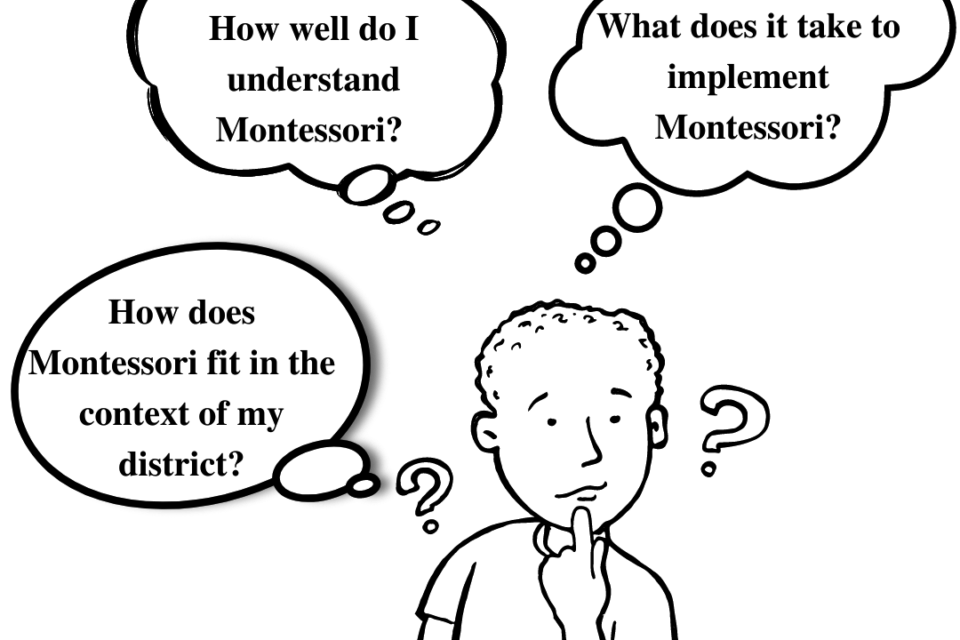
schools, while others didn’t. For the districts without an existing Montessori program, the leaders had two interviews. In the first interview, we asked district leaders about their impressions and knowledge of
Montessori and how they typically make decisions about educational programs and curricula. After the first interview, they were given a literature review to orient them to the empirical evidence about outcomes from Montessori programs. In the second interview, we asked them if the literature review had changed their thinking on Montessori, and what it would take for them to implement Montessori in the district.
For the leaders who already had Montessori in their districts, we asked them how their Montessori
program came to be, what factors have limited its expansion, and how it fits within the larger context of
their district’s programming. We then looked closely at what the leaders said in the interviews, identifying common ideas and themes in their responses.
Recognition of Montessori’s potential
District leaders generally acknowledged the potential benefits of Montessori education; many of them
had firsthand experience with Montessori, either as a parent of a Montessori child or through exposure to
private Montessori schools. They saw it as a promising approach to address current educational needs, particularly in early childhood education. They recognized its capacity to support students’ social-
emotional learning and strengthen academic foundations, which were seen as crucial in the context of post-pandemic recovery. By emphasizing hands-on learning, independence, and emotional development, Montessori classrooms can help rebuild what was lost—not just test scores, but confidence, self-regulation, and a love of learning.
Our conversations revealed that district leaders didn’t need to be “sold” on Montessori, and they didn’t
necessarily need to be oriented to the research behind it. Many of them are already believers.
Inside the decision-making process
So if all these district leaders are so pro-Montessori, why aren’t there more district Montessori
programs? What we found was not simple resistance, but a complex web of considerations: political,
financial, logistical, and philosophical.
School leaders asked questions like:
- Will this fit with our current curriculum and standards?
- Can we afford the materials and training?
- Will our teachers and parents support it?
- How do we ensure equitable access, especially if transportation is a barrier?
In short, introducing Montessori isn’t just a curriculum switch—it’s a paradigm shift. And that’s a heavy lift in a system designed for conformity, not innovation.
The psychology of institutions
To make sense of this, we framed our study using institutional theory, which helps explain why even
good ideas struggle to gain traction in large systems like public education.
Institutional theory tells us there are three types of obstacles:
- Regulative: Rules, funding, and laws. These are the logistical hurdles.
- Normative: Shared values about what education “should” look like.
- Cultural-Cognitive: Deep-seated beliefs and habits that guide behavior, often unconsciously.
While funding challenges are real—Montessori does require special training and materials—this study
shows that the bigger barriers are often invisible. For example, many teachers are skeptical because
Montessori looks so different from traditional classrooms. Parents may be confused or unsure if it’s
rigorous enough. And administrators worry it won’t align with testing requirements or district priorities.
When Montessori does work
In districts where Montessori has been adopted successfully, leaders got creative. Some repurposed
under-enrolled schools into Montessori campuses. Others applied for grants or used magnet school funds to support the launch. In one case, a district created its own in-house Montessori teacher training program to avoid costly external certification.
Most importantly, these leaders built trust. They held community nights to explain the Montessori
approach. They found teacher-champions and offered them extra support. They made sure families knew what to expect, and why it mattered.
A superintendent in the Midwest explained how his district introduced Montessori not as an elite option,
but as a solution to a struggling school. “We weren’t trying to be trendy,” he said. “We were trying to save a school from closure and give our families something better. And the response was overwhelmingly positive.”
Whose voices matter?
One of the more surprising findings from the study was this: while teachers and administrators were
heavily involved in the decision-making process, parents were mostly left out. Yet once programs
launched, parental enthusiasm often surged—if the district had taken time to communicate.
This points to an opportunity. If districts are serious about school reform, they may need to rethink who
gets a seat at the table. Teachers, families, and even students should be part of shaping what education
looks like moving forward. Montessori grows best when it’s rooted in the needs and dreams of the
community.
Key takeaways
Montessori is seen as a promising model: District leaders recognize the potential of Montessori to
address critical educational needs, particularly in early childhood and in supporting holistic child
development.
Knowledge gaps exist: A significant barrier to wider adoption is the limited understanding of the
Montessori method among district-level leaders. This lack of in-depth knowledge can lead to
misconceptions or hesitation in considering it as a viable reform model.
Context matters: Decisions about implementing Montessori are heavily influenced by the unique context
of each school district, including its existing resources, priorities, and community dynamics.
Implementation challenges are significant: Practical concerns around teacher training, curriculum
alignment, and financial sustainability are major considerations for district leaders.
Family influence is not a primary driver: While leaders acknowledge the importance of community
support, families are not typically seen as the primary force behind curriculum adoption decisions.
Recommendations:
Increase awareness and education about Montessori: We recommend proactive efforts to educate
district leaders about the core principles, research-backed outcomes, and practical implementation of
Montessori education. This could involve workshops, site visits to successful public Montessori
programs, and accessible resources that clearly articulate the model’s benefits.
Highlight successful public Montessori models: Sharing information and case studies of successful
public Montessori programs can help to alleviate concerns about feasibility and demonstrate how the
model can be effectively integrated within a public school setting.
Address implementation challenges: We suggest developing resources and support systems to help
districts navigate the practicalities of implementing Montessori, particularly in areas like teacher training
pathways, curriculum development aligned with state standards, and budget considerations.
Engage families and communities: While not identified as primary drivers in this study, the authors
implicitly suggest that engaging families and the broader community in understanding the benefits of
Montessori could build stronger support for its adoption.
While we found an openness to Montessori’s potential, bridging the knowledge gap and addressing
specific local implementation concerns are crucial steps towards its wider consideration and adoption as a valuable option within public education.

Katie Brown
Katie Brown is the Director of Professional Learning at NCMPS.
You may also like