

This article is in the
Spring 2018 print issue
of MontessoriPublic

A new spin on traditional models for greater impact and service

by Kathryn Picanco
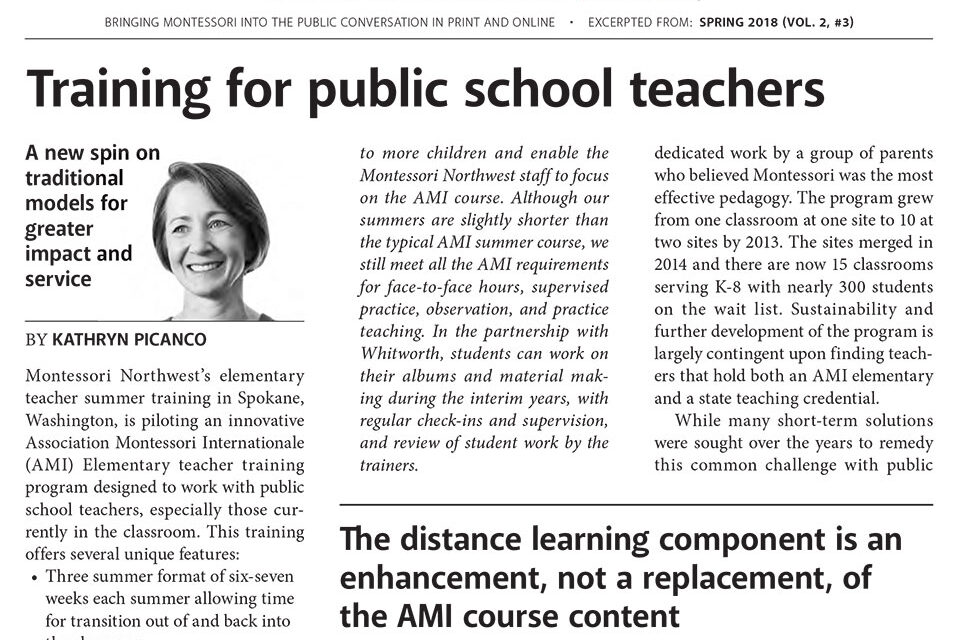
Montessori Northwest’s elementary teacher summer training in Spokane, Washington, is piloting an innovative Association Montessori Internationale (AMI) Elementary teacher training program designed to work with public school teachers, especially those currently in the classroom. This training offers several unique features:
- Three summer format of six-seven weeks each summer allowing time for transition out of and back into the classroom
- Supplemental lectures and support provided online during the academic year
- Master’s in Education from Whitworth University in conjunction with the training with specially designed classes for Montessori practitioners developed and taught by the National Center for Montessori in the Public Sector (NCMPS)
- One semester of extended practice teaching to earn Washington State teacher certification
Elise Huneke-Stone, Director of Elementary Training, writes enthusiastically about the prospect of this new training model.
Partnering with Whitworth and NCMPS enables our students to access the services and support of two institutions with qualified, gifted staff who share our vision of bringing more Montessori education to more children and enable the Montessori Northwest staff to focus on the AMI course. Although our summers are slightly shorter than the typical AMI summer course, we still meet all the AMI requirements for face-to-face hours, supervised practice, observation, and practice teaching. In the partnership with Whitworth, students can work on their albums and material making during the interim years, with regular check-ins and supervision, and review of student work by the trainers.
The distance learning component of the course is an enhancement, not a replacement, of the AMI course content. These partnerships will result in a more coherent, positive experience for the course students, and in a training that is much more integrated into their professional lives.
The development of the new training center and model evolved from continual efforts of and relationships between the local, regional and national AMI community to sustain and grow Montessori programs across the country.
Spokane public Montessori and the development of a training center
Spokane Public Montessori started thirty years ago after years of dedicated work by a group of parents who believed Montessori was the most effective pedagogy. The program grew from one classroom at one site to 10 at two sites by 2013. The sites merged in 2014 and there are now 15 classrooms serving K-8 with nearly 300 students on the wait list. Sustainability and further development of the program is largely contingent upon finding teachers that hold both an AMI elementary and a state teaching credential.
While many short-term solutions were sought over the years to remedy this common challenge with public Montessori schools, a long term solution emerged from the Community of Montessori Parents (CoMP) to create a training center in Spokane to develop their own teachers. Sending one teacher, Paula Gibson-Smith, to the training of trainers program through AMI led to influential relationships and work resulting in the creation of the training center. My involvement on the CoMP board led to the eventual Whitworth University connection to provide customized academic program development and support.
The first draft of the Master of Education in Montessori program was created and approved by Whitworth’s School of Education and CoMP board during the 2010-2011 academic year. CoMP collected the names of prospects interested in seeking elementary AMI training with a master’s degree and/or state certification. With the academic program in place and need established, CoMP and Whitworth sought to find the most viable way to run the program. This led us to seek partnership with Montessori Northwest, a flagship AMI training center in the west. The partnership was finalized in fall of 2014 for a summer 2015 launch.
The beginning of something great
Collaborative efforts between Whitworth, Montessori Northwest, and Spokane Public Montessori teacher, Paula Gibson-Smith, created the proposal for a Master of Education, Emphasis in Montessori program. Elise Huneke-Stone designed the schedule and break-down of the courses for each term. Gibson-Smith’s careful analysis helped determine the alignment of the courses to the state of Washington’s elementary education endorsement competencies. This assisted Whitworth’s teacher preparation programs in developing completion plans for students seeking both the AMI diploma and Washington teacher certification. Whitworth, Montessori Northwest, Spokane Public Montessori and Woodland Montessori worked together the first summer to transform one classroom into a model prepared environment for students to do practice lessons. The program was ready for the students.
Twenty-four students from nine states and two countries participated in the diploma program. Ten of these also sought their master’s degree, and two used coursework towards state teaching credentials. Four of the students were employed at Spokane Public Montessori at the start of the program with two additional students hired mid-program. The first cohort finished in August of 2017 with great success.
Students provided valuable feedback regarding what worked and desired program changes. Elementary director of training Huneke-Stone also saw the need for modifications, noting,
The demand for high fidelity, rigorous Montessori training has never been greater, especially in the public sector and for underserved populations. Although AMI has a long tradition of successful summer trainings, we have felt the tension between upholding our standards and supporting those teachers-in-training who are already working professionals.
Our summer elementary trainings attract Montessori assistants, educators with non-Montessori training or preparation, and primary and adolescent practitioners who want to know more about (or work with) elementary children. Despite our recommendations, it’s not uncommon, due to high demand, for people to start working in elementary classrooms after the second or even the first summer of the course. Some of these people have been successful in their Montessori aspirations, but others have been discouraged by their incomplete preparation, and by lack of support in the early years of teaching.
This feedback and insight led to innovative changes to the next training program set to start summer of 2018 including:
- Shorten the summer sessions to ensure students have a break between the start and end of their own classroom’s year
- Create a way for ongoing support and contact during the year
- Change the non-diploma coursework in the M.Ed. program so it is more applicable to Montessori application
- Create a way to more seamlessly integrate the additional elementary endorsement requirements into the M.Ed. program
Montessori Northwest’s Whitworth campus program version 2.0
Whitworth, Montessori Northwest and NCMPS worked together to devise responsive ways to address the recommended changes.
Shorter summers and more cohort contact: The Spokane program will pilot three online courses of supplemental Montessori lectures based on the coursework started in the summer during the academic year. All of the required AMI coursework will be completed face-to-face during the summer session. The online sessions are designed to support students in their practice. Modifications will also be made to the on-campus component to lengthen each instructional day and ensure required content is covered sufficiently. The net result will be six to seven week summer sessions. The format also allows for students to have consistent support and contact with trainer Huneke-Stone, lecturer Ellen Lebitz, and their cohort throughout the year.
Coursework that is more applicable to Montessori for the non-diploma portion of the M.Ed.: Three exciting new courses (learn more and register here) created by instructor Dr. Katie Brown and NCMPS will be offered as a part of the master’s program, replacing other previous requirements. Neurobiological Perspectives on Developmental Education; Early Intervention, Special Education and Family Engagement; and Advanced Seminar on Language and Literacy were initially only available as a part of the Surround model offered at public Montessori schools. The three courses provide essential tools and guidance for practicing teachers in the topics of developmental psychology, the impacts of childhood trauma, special education, working effectively with diverse students, classroom management, and advanced literacy instruction. Brown notes, “I am excited that we will have graduate-level courses with an explicit focus on meeting the needs of all students in public Montessori schools.” The three courses will be offered online in an interactive format during the academic year.
Seamless integration of elementary endorsement requirements: The three courses also meet the requirements for most of the remaining elementary endorsement requirements in Washington. After taking the courses, students will be able to complete the coursework requirements with an additional or extended student teaching placement to meet the state mandated 450 hours.
Overall, the program changes are expected to result in a more responsive program to meet its students’ needs and those in the public school system. The partnership between Montessori Northwest, Whitworth, and NCMPS strengthens the program as a whole for broader perspective and expertise. The dream for a training center turned reality will have a much larger and lasting impacting on the Montessori community as a whole and ultimately, our education system.

Kathryn Picanco
Kathryn Picanco, M.Ed, Ed.D, is an Assistant Professor and Director of the Center for Gifted Education and Professional Development at Whitworth University in Spokane, Washington.
You may also like