
Building the Public Montessori Teacher Pipeline
 Kathryn Picanco and 1 more Posted On November 2, 2026
Partnerships with teacher credential programs drive sustainability
As schools across the country face teacher shortages and growing demand for qualified educators, public Montessori programs must create innovative strategies for recruitment and training.
One promising approach for colleges and universities that offer teacher credential programs is to create partnerships that introduce educators to Montessori early in their training, support them through certification and licensure, and provide ongoing professional growth opportunities.
Whitworth University and Spokane Public Montessori in Washington state have built a collaborative approach to maximize partnerships among the university, public schools, and community organizations, strengthening the Montessori teacher pipeline in Spokane and beyond.
Together, they are building awareness of Montessori education, integrating Montessori principles into teacher preparation programs, expanding access to certification pathways, and creating meaningful opportunities for future educators to experience Montessori classrooms firsthand.
Building awareness and opportunity
A strong Montessori teacher pipeline begins with consistent exposure to the pedagogy over the course of one’s own education. Interest often develops through opportunities to observe and volunteer in classrooms, participate in practicum experiences, attend classes and information sessions, and participate in structured undergraduate and graduate programs. District support, university coursework, and community outreach work together to create a continuum of experiences that move individuals from curiosity to professional commitment.
A fruitful collaboration
The partnership between Whitworth University and Spokane Public Montessori shows how higher education can support Montessori teacher preparation. The Master of Education in Montessori program—developed with Montessori Northwest, an Association Montessori International training center in Portland, Oregon—grew from the Spokane community’s need for a more accessible training center closer to home.
Over the past decade, Whitworth has expanded pathways that align Montessori training with state licensure requirements. Candidates complete coursework in special education, multilingual learner instruction, culturally responsive teaching, and social-emotional learning and trauma-informed practices alongside Montessori certification requirements for degree completion.
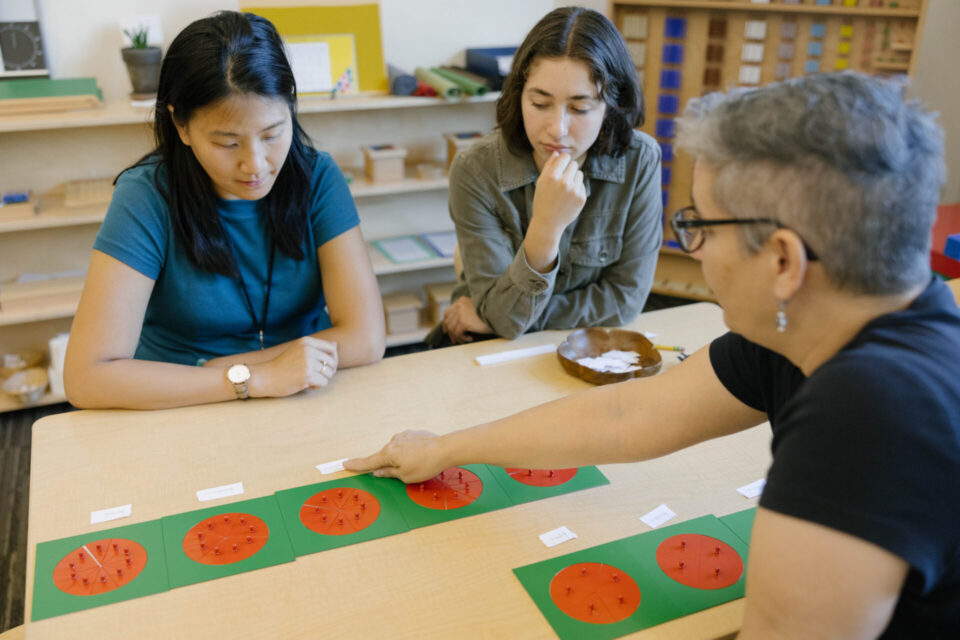
Many of these courses were developed in partnership with the National Center for Montessori in the Public Sector for national alignment. Practicum placements at Spokane Public Montessori provide a public-school experience and direct pathway to employment. The placements support Spokane Public Montessori and other public Montessori programs as well.
Whitworth has also embedded Montessori concepts throughout its teacher education programs, including:
- Intentional integration of Montessori theory and practice into undergraduate teacher preparation coursework
- Incorporation of observation experiences at Spokane Public Montessori;
- Creation of an Early Childhood Education minor that requires an Introduction to Montessori course
- State approved teacher certification tracks at the Early Childhood (P-3) and Elementary (K-8) in which Montessori diploma course training is recognized as the methods coursework
- A permanent model classroom set up for instructors and students to access as needed for courses. This classroom can also be utilized by the Physical Therapy and Occupational Therapy programs on campus.
The Early Childhood Education minor and endorsement is the largest minor program in the undergraduate teacher preparation program at the university today. The intentional inclusion of Montessori into initial and advanced learning experiences ensures it is a natural part of the discussion on effective instructional models and professional pathways for consideration for students.
Community partnerships
University partnerships alone are not enough. Community organizations play a vital role in raising public awareness, supporting professional development, and creating new pathways into the profession. Key collaborators include the Spokane Montessori Collective and the Alliance for Innovative Educational Redesign (AIER).
The Spokane Montessori Collective fosters networking among regional Montessori schools and provides professional learning opportunities for school personnel and community members to participate in. The Collective will pilot a substitute aid and assistant pool this year that allows university students to work in local Montessori programs. This opportunity is intended to introduce pre-service educators to the profession while helping schools meet staffing needs.
AIER has consistently facilitated Learning Journeys at Spokane Public Montessori. Learning Journeys are designed to promote community understanding of innovative educational practices and alternative school models. The experiences bring pre-service teachers and community members into Spokane Public Montessori to observe classrooms and learn about Montessori education firsthand.
Successful results
These partnerships have had a significant impact on Montessori education in the Spokane region. Twelve of the fifteen lead guides at Spokane Public Montessori received their training through Whitworth University and Montessori Northwest’s program.
Undergraduate students often seek practicum placements at Spokane Public Montessori and employment as classroom assistants in Montessori schools. Many plan to pursue training after graduation. Across the graduate programs, more than 100 students have completed their training, with approximately 20% choosing to add state certification in either early childhood or elementary education. Montessori students consistently perform exceptionally well on state-required licensure exams, achieving a 98% first-time pass rate on the National Evaluation Series (NES) content examinations for their level and frequently score near the top of the assessment range.
Collectively, these program options and partnerships prepare highly qualified Montessori guides for both public and private school classrooms while fostering interest among future educators who wish to pursue Montessori education. The partnerships have had a positive and growing impact on the Spokane community and beyond, strengthening Montessori education and training opportunities over time.
Creating a university partnership
P-12 schools that are interested in building similar partnerships can begin with a few strategic actions.
Prepare your talking points and data: University leaders respond to evidence of need. Be prepared to share information and resources about what Montessori is, why it works, connections between Montessori practices and public education standards, and community demand for Montessori trained educators. Helpful data to share includes the number of Montessori schools in your region, current employment opportunities, teacher shortages and workforce trends, and ways your school can help place graduates in professional positions. The National Center for Montessori in the Public Sector has helpful resources that can support these conversations.
Start with community connections: Look within your school community for parents, alumni, or supporters who work at local universities. These connections can provide introductions and help identify opportunities for collaboration.
Request a meeting: Contact department chairs or program coordinators and request a conversation about potential partnerships. Reaching out directly can open doors even without a personal connection.
Offer value: Universities are always seeking meaningful community partnerships. Consider offering a guest lecture on Montessori education, classroom observation opportunities for pre-service teachers, practicum placements, research partnerships, and/or service-learning opportunities as a starting point.
A natural fit
Education departments may not have a strong understanding of Montessori education. Rather than proposing a large-scale program immediately, consider a more gradual integration. Montessori concepts and pedagogy fits naturally into courses such as Educational Psychology, Child Development, Introduction to Early Childhood Education, Introduction to Education, and Exceptional Learners and Inclusion. Guest lectures, observation experiences, and practicum placements can serve as effective starting points.
Once faculty and students gain familiarity with Montessori education these opportunities can evolve into elective or required courses and potentially full program pathways.
Lessons learned
Important lessons have emerged from the partnerships.
First, higher education institutions genuinely want to meet community needs and workforce shortages. However, they face many similar challenges as P-12 schools, including bureaucracy and accreditation requirements, limited staffing, and competing priorities.
When you are able to approach a partnership demonstrating how both parties’ needs and goals will be met, it helps address these challenges in a collaborative way that will facilitate future partnerships.
Second, smaller institutions often have greater flexibility and less bureaucracy involved in developing innovative programs and pathways.
Finally, successful partnerships require patience and persistence. Meaningful change rarely happens quickly. Strong relationships, shared goals, strategic planning, and incremental progress create the foundation for pivotal results.
The Whitworth University, Spokane Public Montessori, and community organization partnerships demonstrate how a more sustainable teacher pipeline can be developed through collaboration and offer a model for growing the workforce. Through a shared vision and commitment to innovation, communities can ensure that future generations of students can continue to benefit from authentic Montessori education led by well-trained guides.

Kathryn Picanco
Kathryn Picanco, M.Ed, Ed.D, is an Assistant Professor and Director of the Center for Gifted Education and Professional Development at Whitworth University in Spokane, Washington.

Rhonda Turnipseed
Rhonda Turnipseed is the Assistant Director of Teaching and Learning at Cheney Public School district.
You may also like