

Montessori classroom culture supports behavior
Classroom culture is a current focus of conversation in conventional education about student behavior. Effective classroom conditions for learning are defined in terms of teacher expectations, relationship building, and instructional practices—all cultural elements rather than structural features of the learning environment.
The distinction between culture and structure was first crystallized for me while reading Loonshots by Safi Bachall during my doctoral studies in Montessori education at the University of Wisconsin-River Falls. My main takeaway was that structure actually plays a more decisive role than culture in shaping outcomes. I came to see culture as an emergent property of structure. This book put words to what I have observed in Montessori classrooms: Montessori education’s brilliance is in the structural design of the learning environment.
I was a conventional, single grade level educator for a decade before I took Montessori training and moved into a Montessori classroom in a traditional K-5 classroom. I immediately loved how Montessori philosophy suggests looking at the environment first when there is an issue with student behavior. Over the years, it has pained me to watch my single grade level colleagues continue to implement student behavior plans and use tack-on behavior programs to deal with negative student behavior instead of using the powerful tool of adjusting the learning environment itself.
Since COVID, behavior challenges such as impulsivity and anxiety have become one of the most urgent issues documented in conventional U.S. elementary schools. As negative student behavior intensifies, so do teacher stress and burnout, resulting in a growing wave of educators leaving the field. Seeing how the structure of Montessori classrooms supports student regulation and behavior, I began to wonder which specific structural supports were responsible and whether they could be identified and replicated in conventional K-5 classrooms.
I started to think about conditions during remote learning. Children spent long periods of time at home with much more physical freedom than they typically experienced in conventional, single grade level classrooms at school. They could move around, take breaks when they wanted to, choose where to sit, and adjust their pacing, and they had more opportunities to manage their own regulation throughout the day. In many ways, remote learning reflected the kind of physical freedom students experience in Montessori classrooms.
Returning to classrooms meant stepping back into spaces that were more physically restrictive than what many children had experienced at home. This shift was compounded by the fact that students’ academic readiness levels had widened dramatically as a result of the pandemic, a challenge made even more acute in single grade level settings where teachers work with only one grade level of curriculum materials. Rising student dysregulation is often attributed to screentime or socialization gaps, but I began to wonder whether a loss of physical freedom, and the abrupt return to more restrictive classroom environments, might also be playing a significant role.
In my Montessori classroom, when students display signs of dysregulation, purposeful academic engagement can act as a regulatory anchor and students can find emotional steadiness through concentrated work. Research shows that certain conditions of freedom within Montessori environments may help mitigate the effects of trauma by restoring a sense of control and offering the calming, regulatory benefits of sustained concentration.
Teachers in conventional classrooms often do not have the freedom or training to make real-time adjustments to students’ work or to the learning environment. Instead, as behavior concerns have increased post-COVID, districts are doubling down on pacing guides in an attempt to standardize instruction across classrooms in order to raise student achievement. Teachers are expected to maintain tight whole-group schedules even as student needs become more variable and ability spans continue to widen dramatically due to learning interruptions caused by behavior issues. I began to wonder if this creates a cycle in which tightened control contributes to the rising dysregulation.
In conventional education settings, social-emotional learning and academic learning are often treated as separate domains. Academic work is viewed as a cognitive task, something students are expected to do once they are calm, compliant, and ready to learn. In Montessori classrooms, academic work is not something students do after they are regulated; it is a primary way they become regulated. Freedom is not something children earn after demonstrating compliance, but a necessary precondition for the development and expression of their agency. Within this freedom, sustained and purposeful work becomes possible and it is through this work that children develop self-regulation, social responsibility, moral awareness, and a growing sense of solidarity with others.
I decided to begin to investigate the structural features of Montessori classrooms. Drawing from Montessori’s writings and interviews with twelve experienced Montessori teachers, I developed a preliminary list of autonomy-supportive, structurally embedded environmental features to guide my instrument design. A panel of Montessori experts offered feedback on item clarity and relevance, helping to streamline the list, remove redundancies, and ensured the core elements of the prepared environment were represented.
The list included:
- freedom of movement from classroom to outside
- freedom of movement within the classroom
- access to materials
- materials with a control of error
- flexible seating
- use of checklists
- self-pacing of work
- uninterrupted time
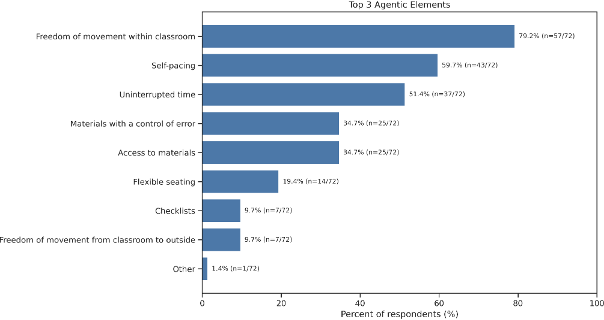
The survey was distributed nationally through Montessori networks, professional associations, school leaders, and social media. Teachers were asked to select the three environmental features they believed most strongly support student autonomy and the development of agency. The survey took less than ten minutes to complete and reached a wide range of teachers across public, charter, magnet, and private Montessori schools. 72 Montessori elementary teachers, most holding Montessori credentials, took part.
Responses converged on three environmental features which best support student agency. Freedom of movement was most frequently selected, followed by self-pacing and uninterrupted time. Nearly all teachers chose at least one freedom of movement option, suggesting that mobility is a powerful structural feature in Montessori environments. 93% of respondents reported intentionally modifying the classroom environment to influence student behavior. Teachers described rearranging furniture, adjusting material placement, facilitating movement pathways, and reducing visual or auditory distractions as common strategies for supporting concentration, independence, peer collaboration, conflict resolution, and the preservation of uninterrupted time through decreased distractions.
Research supports the conditions Montessori teachers identified as most essential for student agency. Studies show that self-pacing strengthens academic performance and supports the development of self-regulation, a key predictor of both achievement and emotional well-being. Freedom of movement is consistently linked with improved executive functioning, emotional regulation, and overall psychological health, with neuroscientific research suggesting that voluntary movement activates the neural systems associated with autonomy and agency. Uninterrupted time is tied strongly to concentration, cognitive endurance, and reduced stress, with interruptions shown to impair working memory, increase cognitive load, and elevate stress responses.
Liberty is also a structural condition in Montessori classrooms. Freedom is not granted after students behave well; rather, it is embedded into the environment so the child can practice and develop regulation. As a Montessori practitioner, I feel the tension between freedom and control every day. When a student is dysregulated, my first instinct is often to tighten expectations or narrow choices. Yet, after reflecting on this study’s findings, I see even more clearly that the path back to stability usually begins with restoring the very freedoms that support agency in the first place: the freedom to move, the freedom to self-pace, and the freedom to work without interruption.
It can be difficult to navigate the balance between the academic work I think is essential for long-term achievement, and the student-chosen work that often serves as an entry point back into concentration and regulation. Yet when I honor these freedoms rather than restrict them, I consistently see children return to regulated, pro-social behavior more quickly and authentically.
Although Montessori environments are distinct, the underlying principles of structural autonomy are broadly applicable. The next phase of my doctoral research will investigate whether there is a measurable correlation between negative student behavior and the presence or absence of the key freedoms Montessori teachers identified as most essential. I am deeply grateful to the Montessori teachers who contributed their insights to this preliminary study. Their collective wisdom is guiding the direction of my ongoing research as I work to understand how these structural conditions function outside Montessori settings.

Katy Wright
Katy Wright is an E1 Montessori teacher with Helena Public Schools in Montana, and a doctoral candidate in Montessori studies at University of Wisconsin-River Falls.
You may also like