

Montessori aligned with Universal Design for Learning
Across the country, programs are expanding. Families are seeking child-centered alternatives. District leaders are exploring models that support the whole child while meeting accountability demands. There is both growing interest and growing opportunity.
At the same time, there is a growing expectation: schools must demonstrate that what they do is grounded in research, aligned to evidence-based frameworks, and designed for all learners.
And this is where Montessori sometimes finds itself at a crossroads. Because while Montessori education is deeply research-aligned in practice, it is not always expressed in the language that dominates today’s educational systems.
Frameworks like Universal Design for Learning (UDL), Multi-Tiered Systems of Support (MTSS), and culturally responsive teaching shape how schools talk about quality, equity, and access. They influence funding, policy decisions, and program sustainability. Montessori aligns beautifully with many of these ideas. But alignment alone is not enough if we cannot name it. If Montessori is to continue growing in public systems while maintaining its integrity, we must be able to do two things at once:
- Clearly translate Montessori practice into the language of modern research and policy.
- Continue learning from evolving frameworks that deepen and strengthen our work.
This is not about changing Montessori. It is about making Montessori visible, understood, and sustainable in the systems we are part of.
So Where Does UDL Fit?
Universal Design for Learning (UDL) is one of the most widely used frameworks in public education today. Developed by the Center for Applied Special Technology (CAST), it is grounded in neuroscience and built on a simple idea: learner variability is the norm, not the exception.
Rather than waiting for students to struggle and then adding supports, UDL encourages educators to design learning environments from the start that offer multiple ways to:
- engage with learning
- access information
- show understanding
- practice learning
At UDL’s heart is a powerful shift. When a child struggles, we first look at the design of the environment—not the child. For Montessori educators, this should feel familiar.
Follow the Child
“Follow the child” is one of the most recognizable phrases in Montessori education—and one of the most misunderstood. Following the child is not simply allowing freedom. It is a disciplined, intentional act grounded in observation. It asks us to study the child carefully and then respond by adjusting the environment, the materials, and the learning conditions.
“To assist a child we must provide him with an environment which will enable him to develop freely,” Montessori wrote. In other words, the work of the adult is design. This is where UDL offers a powerful complement. It gives us a shared, research-based language to describe what Montessorians have long practiced. We do not change the child to fit the system—we design the system to support the child. When we bring these two together, “following the child” becomes even more precise, more intentional, and more visible to those outside our classrooms.
Rethinking Choice
Choice is often one of the first things people notice in a Montessori classroom. Students choose their work, move with purpose, and engage independently. It is a visible marker of Montessori practice. But choice, on its own, is not enough. Research tells us that choice increases motivation, engagement, and persistence—but only when it is meaningful and accessible. For some learners, too many options can be overwhelming. For others, the available choices may not feel reachable at all.
UDL helps us refine how we think about choice. Instead of asking, “Do students have choice?,” UDL asks:
- Can all students connect to the learning in meaningful ways? (Engagement)
- Can all students access the content being presented?(Representation)
- Can all students practice and interact with the learning in supportive ways? (Practice / Action)
- Can all students show what they know in different ways? (Expression)
This expands Montessori’s idea of choice into something more intentional. It pushes us to consider not just whether choice exists, but whether it works—for every child.
What does this look like in practice? Montessori gives us a powerful tool for answering that question: observation. Through observation, we begin to see patterns that might otherwise be missed.
Take Leo, a 10-year-old student in an upper elementary classroom. When working with Montessori math materials, he is confident and engaged. He explains his thinking clearly, persists through challenges, and demonstrates a strong understanding. But when asked to record his thinking or move into abstract notation, something shifts. He hesitates. He avoids the work. He says, “My brain forgets unless I see it.”
Without observation, it would be easy to misinterpret this as a lack of effort or readiness. With observation, we see something different. Leo understands the concept. The barrier is in how the learning is being represented and how he is being asked to express it. That distinction changes everything.
Instead of trying to “fix” Leo, the guide reflects on the design of the experience:
- Are there enough visual bridges between the materials and abstract symbols?
- Are there intermediate steps to support the transition?
- Does Leo have more than one way to show what they know?
Small shifts follow:
- Visual supports are added.
- Verbal explanations are encouraged before writing.
- Flexible recording options are introduced.
- Materials remain available as long as needed.
And just like that, Leo’s understanding becomes visible again.This is not remediation.This is design. It is Montessori observation in action, strengthened by a UDL lens. It is also a powerful reminder: when we change the environment, we often change the outcome.
A Simple Way to See It
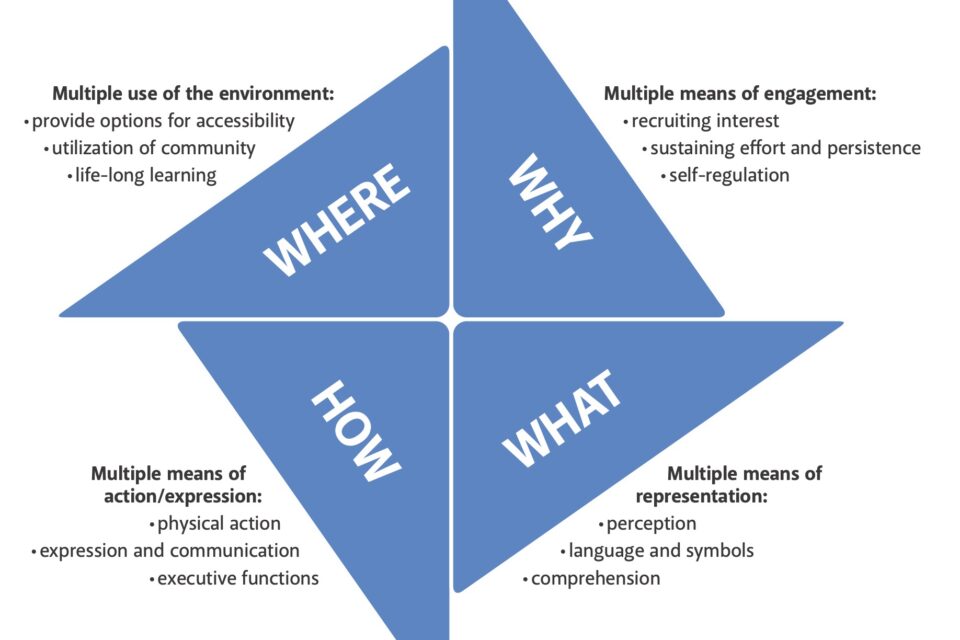
For educators looking to make this connection more visible, we often use a simple framework: the Four Lights of Learning.
- Engagement (Why): How are students connecting to the work?
- Representation (What): How are students accessing the content?
- Action & Expression (How): How are students showing what they know?
- Environment (Where): How is the space supporting—or limiting—learning?
Montessori classrooms already hold these elements. Naming them helps us refine them and helps others understand them.
Why This Matters
As Montessori continues to grow in public systems, this work becomes essential.
Schools are being asked to demonstrate alignment with research-based practices, inclusive design, and measurable outcomes. Montessori can meet these expectations, but we must be able to clearly communicate how.
This is advocacy. It happens when:
- A guide explains a lesson using both Montessori language and research-based terms
- A school leader connects Montessori practice to frameworks like UDL
- A program demonstrates that it is both authentic and accessible to all learners
When we do this well, Montessori is no longer seen as separate from “high-quality instruction.” It is recognized as a powerful example of it.
Holding On While in Motion
There is sometimes a concern that engaging with frameworks like UDL will dilute Montessori.
But Montessori itself was never static. It was built on observation, reflection, and a willingness to evolve in response to what children need. Engaging with research is not a departure from Montessori; it is a continuation of it. UDL does not replace Montessori. It helps us live it more fully, especially in diverse, inclusive, public settings.
Lighting the Way
Montessori education has always asked us to see the child differently; to recognize potential, to trust development, and to design environments that support independence and growth. Today, we are being asked to do something more: to make that work visible in the language of modern education, and to continue strengthening it through research and reflection.
The Four Lights—Engagement, Representation, Action & Expression, and Environment—offer one way forward. They help us connect what we know with what others need to understand. And ultimately, they help us do what Montessori has always called us to do: follow the child; not just with intention, but with clarity, purpose, and a commitment to designing environments where every child can thrive.

Katey Dodd
Katey Dodd, PhD (ABD) is the Director of Montessori Implementation for the California Montessori Project.

Melanie Brown
Melanie Brown, EdD, is the Director of Montessori Curriculum for the California Montessori Project.
You may also like