

Informing cosmic education with Ethnic Studies
“Para todos los niños,” read a sign displayed at the entrance of the exhibit at the Museum of Tolerance. “For all children.”
Something about this exhibit caught my eye: Mendez vs. Westminster Board of Education, 1947. Was this Westminster in Orange County, Calif.? This moment, in a Southern Californian museum at the age of 35, was when I first learned about the truth-telling of Sylvia Mendez. At age eight, Mendez was the center of a civil rights case that set a precedent for the end of school segregation in America—eight years before Brown v. Board of Education. Why did I not learn about this particular local California history in school? Why was this story silenced?
Almost two decades after Mendez v. Westminster, a multi-racial coalition of student-activists called the Third World Liberation Front demanded that UC Berkeley respond to the lack of professors of color and the lack of academic programs now known as Ethnic Studies. This discipline would come to focus on the histories and issues of marginalized communities: Black, Chicano, Asian, and Indigenous. Also during this period, Montessori education had a revival in the United States. Nancy McCormick Rambush, first as Mario Montessori’s representative for the Association Montessori International (AMI) and then as founder of the American Montessori Society (AMS), was an early and influential leader in the movement to open new Montessori schools and teacher training centers across the United States under the directorship of Mario Montessori.
This period of Montessori revitalization aligned with the broader social change of the Civil Rights Movement: independence, liberation, respect for the child, and peace education. The rapidly growing Montessori education movement was shaped by social change, education reform, and the increased demand for child-centered learning.
Ethnic studies and Montessori
So where does Ethnic Studies fit into the Montessori canon?
Cosmic Education offers a powerful lens for social studies by teaching that everything in the universe is interconnected and that each human has a purpose in contributing to the harmony of the global community. Introduced through the “Great Lessons,” these stories about the universe, Earth, life, humans, and communication integrate science, social studies, reading, and writing to foster responsibility, empathy, and a deeper understanding of one’s place in the world.
Students begin to see themselves as active participants in a complex world, capable of applying their knowledge to real-world contexts as thoughtful, engaged citizens.
But, within Cosmic Education, how do students see their identities, cultures, and families reflected with dignity and complexity in the classroom? What opportunities do students have to explore who they are and who they are becoming?
Asking myself these reflective questions ensures that I am cultivating a beloved, peaceful community—a space where students are physically, psychologically and emotionally safe, so they can take safe risks and grow and develop to their fullest potential. “The Great Lessons” embody these values as they inspire curiosity and capture the vastness of the universe. Children can understand that they are specks of star dust interconnected with everything around them.
The Five Great Lessons are:
- Coming of the Universe and the Earth
- Coming of Life
- Coming of Human Beings
- Communications in Signs
- The Story of Number
Third Great lesson, Coming of Human Beings, pertains the most to Ethnic Studies. This lesson is also known as the “The Story of Humans,” and includes the four disciplines of social studies: civics and government, economics, geography and history. The lesson tells the story of how early humans and ancient civilizations began to shape the world through culture. Humans are storytelling, thinking beings with gifts of reason and imagination, hands for creation, language to share culture, and cooperation to work together in harmony to meet their needs and build communities.
These gifts allowed humans not just to survive, but to thrive and build for future generations. This lesson opens the door to studies in early human societies and cultures, the fundamental needs of humans, the historical development of tools, inventions, and problem-solving; and how humans began to come together and form societies through the use of writing, storytelling and cultural expression.
Overall the lesson is not about humans being the strongest or the fastest species alive, but about how, with intelligence, creativity, and cooperation, humans can come together to contribute to the harmony of the greater world.
From conception to practice
So what lessons in my album can I adapt with Ethnic Studies in mind? The sequence of the Third Great Lesson moves through “who are humans?,” “what do humans need?,” and “how do humans meet these needs across time and place?”
This structure helps students see both the humanity and diversity of every human. Christine E. Sleeter and Miguel Zavala, in their book Transformative Ethnic Studies in Schools: Curriculum, Pedagogy, and Research, identify six Hallmarks of Ethnic Studies, including Curriculum as Counter-Narrative and Reclaiming Cultural Identities. I focused on these two concepts as I presented The Story of Humans and the Fundamental Needs of Humans.
Reclaiming cultural identities
I begin every school year with the thematic unit, “All About Me.” This unit covers character traits and physical traits, but goes deeper than that. It begins with the study of the mind. Students learn about the parts of the brain and its functions. They also identify ways to practice mindfulness by developing emotional regulation skills, stress management, self-control, and self-motivation in setting and achieving goals. In addition, students will learn about the benefits of having a growth mindset versus a fixed mindset.
Students then learn about their bodies. In addition to learning the anatomy and physiology of the body and its systems, they will also learn what their body needs as it relates to health and hygiene, and safety. They will begin to identify their physical character traits, interests, and racial/cultural identity so that they know and appreciate who they are and can talk about themselves positively. They will also begin to identify some of their group identities.
The last part of the unit focuses on the heart. Here, students learn about how to develop their relationship skills by building relationships with diverse individuals and groups, communicating clearly, working cooperatively, resolving conflicts, and seeking help. Students will be able to discuss and embrace sameness and differences.
Students will apply a growth mindset to understand and ask questions about differences, including interests, abilities, race, language, gender, and family traditions. Through these diverse perspective experiences, they develop social awareness, perspective-taking, empathy, respecting diversity, understanding social and ethical norms of behavior, and recognizing family, school, and community support.
Beginning with students’ cultural wealth by centering students’ cultural identities is vital in Ethnic Studies. Honoring the names, languages, and communities that the students come with humanizes each student. This approach challenges the dominant, Eurocentric narratives of who are considered “Americans” or “immigrants.” In addition, learning about the history and contributions of their ancestors creates space for critical hope that the entry point of student learning begins with their family and community histories.
Counter-narratives
By the end of the first trimester or quarter, I expand the “All About Me” unit to “All About Us.” In this unit, students delve into the Fundamental Needs of Humans chart.
Going beyond Maslow’s Hierarchy of Needs, which is limited to individual or personal needs, the Fundamental Needs of Humans chart includes material needs, such as shelter, food, clothing, transportation, safety, and communication. It also includes the spiritual needs of love, spirituality or religion, culture, and beauty.
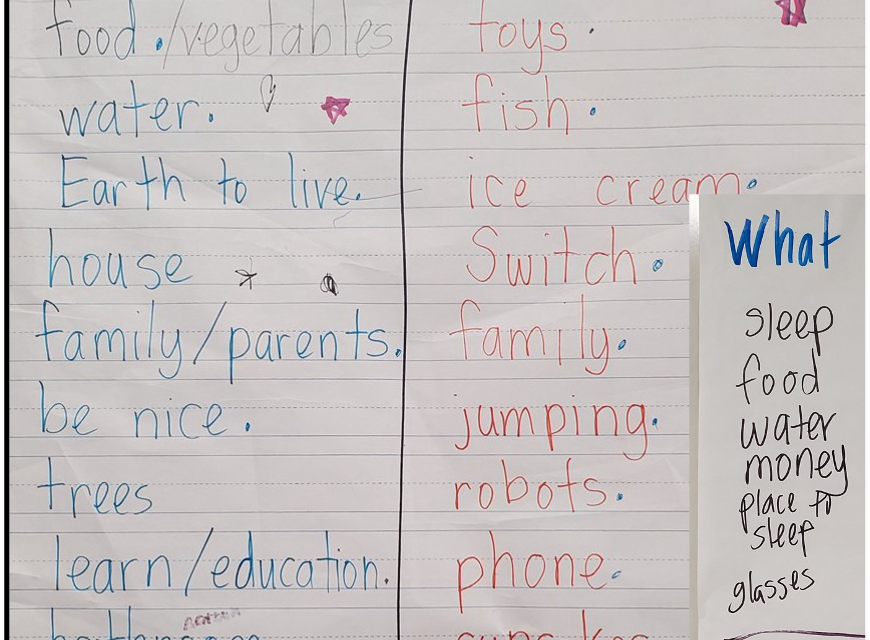
The Fundamental Needs of Human chart also goes beyond material needs and includes what a community needs to be culturally sustaining. The chart reflects the collective thinking of the students in my class. For example, when asked what they all need, my students’ initial response included the need to follow the rules and follow directions. This falls under the need for safety and governance.
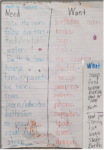
Some students then go further and say that they need to have no poverty and equal rights. Using a T-Chart to document children’s thinking about what is considered wants or needs is a way to spotlight the fact that students bring in a wealth of knowledge to the classroom community space.
In this unit, students begin to define themselves within the greater communities that they inhabit, develop criticality of local history from the perspective of people of color, and begin to rewrite their collective narrative that has been oppressed and suppressed by racism or colonialism.
Counter-narratives are narratives opposed to the dominant, Eurocentric narratives. They are stories of people of color who have been oppressed by racism and/or colonization that provide historical perspectives, interpretations, and criticality. This criticality, through counter-narratives in epistemology, in indigenous knowledge, and through traditions before European colonization, is a way to liberate and reclaim cultural and racial identity from oppression.
Liberatory education
Storytelling is a way to shine a light on issues and experiences some people might not be aware of. Truth telling is a way to share injustices and start to work towards rectifying those injustices. Liberatory education is a way to position students as intellectuals and leaders of their own learning by guiding them to increase their ability to actively increase their funds of knowledge.
As Maria Montessori stated in The Discovery of the Child, “The concept of liberty which should inspire teaching is, on the other hand, universal: it is the liberation of a life repressed by an infinite number of obstacles which oppose harmonious development, both physical and spiritual.”
With this in mind, I must ensure a space within my classroom so that my students can develop to their fullest human potential by combating exoticism, tokenism, or other means of coloniality. Cultural food, flags, and festivals are all great places to begin to appreciate and validate communities of color, as it is a culturally responsive practice. However, delving more deeply into social justice issues of race, food, power, access, environment, and climate provide students with the opportunity to develop critical hope and a more just future.
Our fundamental human needs unite us. Our collective stories began with our human origins and extend to the present time.

Sovandara Chhin
Sovandara Chhin, M.Ed., M.A.T., is a social justice early childhood educator at Dixon Montessori Charter School in Dixon, California.
You may also like