

Preparing Montessori teachers for children with learning differences
Educator Elizabeth Stone once wrote that having a child is “to decide forever to have your heart go walking around outside your body.”
When children are hurt, there is a visible call to action—a scraped knee, a fever, a fall from the monkey bars. But what if the hurt is invisible? What if the struggle lives quietly beneath the surface, only revealing itself over time through frustration, avoidance, or a slow fading of confidence?
This is the path of a child with a learning difference.
A constitutional learning difference is not about intelligence, motivation, or effort. These are children with average to above-average ability whose brains process information differently. When exposed to traditional methods of instruction, they are at risk—not because they won’t learn, but because, in key moments, they truly can’t access learning in the expected way.
And that distinction changes everything.
Seeing the invisible
Learning differences affect approximately one in five individuals. Dyslexia, ADHD, dysgraphia, dyscalculia, and oral language disorders are among the most common. Yet unlike a visible injury, these differences require a trained eye to detect. They live in the subtle, often misunderstood spaces of development—what we call the “soft signs.”
Dr. Sylvia Richardson, a pioneer in the field of learning differences, gave us a simple and powerful framework for early identification. She urged educators and parents to observe five critical areas of development:
- Coordination
- Language
- Attention
- Perception
- Social-Emotional
These areas are not arbitrary. They reflect the underlying neurological systems responsible for learning. When there are delays or inefficiencies in any one of them, a child may begin to struggle long before formal academics even begin.
The good news? These signs are observable early. The better news? When we act early, we can change everything.
Let’s move beyond awareness and into understanding. What does it actually look like when a child is struggling in one of these domains?
Coordination
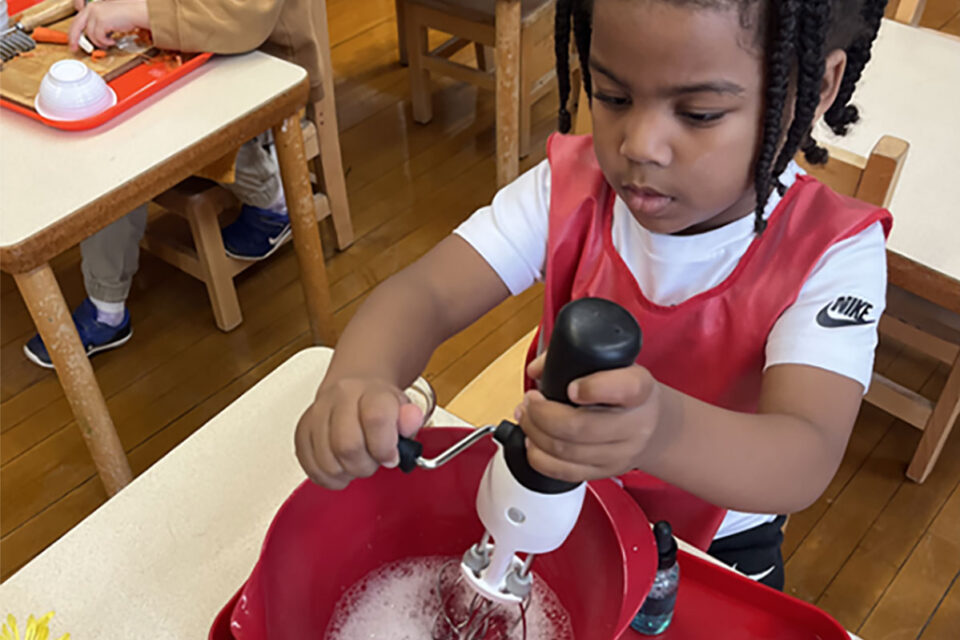
A child with coordination challenges may appear clumsy, avoid physical tasks, or struggle with balance and spatial awareness. You might notice difficulty with tasks that require core strength or bilateral coordination—pouring, buttoning, or carrying materials with control.
In a Montessori environment, this shows up in Practical Life. A child who avoids these foundational activities is not simply disinterested—they may be telling us something about how their body is organizing movement.
Language (oral and written)
Language is layered. Some children struggle with articulation or word retrieval—they know what they want to say but cannot access it efficiently. Others may have difficulty understanding language, following multi-step directions, or expressing themselves clearly.
As written language emerges, additional signs may appear: weak phonological awareness, difficulty matching sounds to symbols, inconsistent memory for letter-sound relationships, and painfully slow progress.
But slow progress is not a pacing issue, it’s a processing issue.
Attention
Attention is not simply about sitting still. It is deeply connected to executive functioning—the brain’s ability to plan, initiate, sustain, and complete tasks. Some children are inattentive. Others are hyperactive. Many are both. You may notice a stark contrast between preferred and non-preferred tasks, or a child who appears capable one moment and completely shut down the next. This is not inconsistency. It is neurochemistry at work—dopamine and serotonin influencing engagement, motivation, and regulation.
Perception
Perception is how the brain interprets what it sees and hears. A child may have intact vision and hearing, yet struggle to make sense of that input. In Montessori classrooms, perception is revealed beautifully through Sensorial work. Difficulties may appear in visual discrimination, auditory processing, or spatial relationships. Fine motor and gross motor integration may also be impacted. If the brain cannot accurately process input, output will always be compromised.
Social-emotional
Perhaps the most misunderstood area, social-emotional development includes the ability to read nonverbal cues, engage in reciprocal interactions, label emotions, and form secure attachments. A child may seem withdrawn, overly reactive, or socially out of sync. These are not character flaws. They are developmental signals. And they matter, because a child’s emotional experience is deeply tied to their ability to learn.
Observation: the beginning of everything
Here’s the shift: recognizing these signs is not about labeling children. It is about understanding them. Observation is not passive. It is a trained, intentional act. In Montessori education, we often say the teacher is a scientist of the child. This is where that becomes real. Through careful observation, we begin to see patterns:
- Where does the child struggle?
- When do they disengage?
- What tasks do they avoid or over-rely on?
- How do they respond to challenges?
Observation allows us to move from assumption to insight. It also allows us to do something even more powerful: match the lesson to the child.
The mindset shift: From won’t to can’t to can
This is the heart of the work. Too often, children with learning differences are misunderstood. Their struggles are labeled as laziness, defiance, or lack of motivation.
- “He just won’t do it.”
- “She’s not trying.”
- “They could if they wanted to.”
But what if we paused and asked a different question? What if it’s not won’t? What if it’s can’t? This is not semantics. This is neuroscience.
When we shift from “won’t” to “can’t,” we move from judgment to curiosity. We begin to ask:
- What is getting in the way?
- What skill is missing?
- What support is needed?
And from there, we build toward the most important word of all: can. With the right intervention, the right instruction, and the right mindset, children can access learning. They can build skills. They can experience success.
But they cannot do it alone — and they cannot do it if we misread the problem.
The Montessori advantage
Montessori education offers a unique and powerful framework for supporting children with learning differences. Why? Because it is built on observation. On individualized instruction. On meeting the child where they are—not where we expect them to be.
The prepared environment allows for:
- Movement and hands-on learning
- Repetition without stigma
- Multi-sensory engagement
- Self-paced progression
But here’s the truth: the environment alone is not enough. The adult matters. Our clarion call is to support teachers. Teachers need access to knowledge and therapeutic strategies. When the teacher becomes the “prepared adult,” they can recognize when a child needs more than exposure—they need intervention. They step in with intention, offering direct teaching of underlying skills while preserving the dignity and independence of the child. They do not wait for failure. They respond to early signs.
What intervention really looks like
Intervention is not a separate event that happens outside the classroom. It is woven into the fabric of daily learning.
It looks like:
- Breaking skills into smaller, teachable components
- Providing explicit, direct instruction where needed
- Using multi-sensory strategies to reinforce learning
- Increasing teacher presence during moments of challenge
- Adjusting expectations without lowering standards
It also looks like a partnership. Parents, teachers, & school administration working together. Sharing observations. Using checklists. Communicating openly about what is being seen and what is being tried. Intervention is not about fixing a child. It is about removing barriers.
The time is now
We have known for over a century that early identification changes outcomes. The research is clear. The tools are available. The path is visible.
And yet, too often, we wait. We wait for a child to “catch up.” We wait for clearer signs. We wait for failure to make the need undeniable.
But children cannot afford for us to wait. The developmental window from birth to age six is a period of extraordinary brain growth. It is also the time when intervention is most effective. We are not powerless in this process. We are stewards of it. The path is clear: Prepare. Observe. Intervene.
The child can
When we begin to see differently, we begin to act differently. When we act differently, children experience something they may not have felt before: Success. Not the kind that comes easily — but the kind that is built, step by step, through understanding, effort, and support. A child who once avoided work begins to engage. A child who struggled to express themselves finds their voice. A child who felt “less than” begins to feel capable.
This is the shift from can’t to can. And it is not a small shift. It is life-changing. We are not just teaching reading, writing, or math. We are shaping how children see themselves as learners. So the next time a child hesitates, resists, or struggles, pause. Look closer. Listen differently. Because beneath that moment may be something invisible — and incredibly important. And when we see it, truly see it, we hold the power to change not just a lesson, but a life trajectory.
The child can.
And it begins with us.

Amy Cushner
Amy Cushner is the President and Founder at AC Education Services.

Joyce Pickering
Joyce Pickering is the Executive Director, Emerita of the June Shelton School and Evaluation Center and the co-author with Sylvia O. Richardson of Montessori Strategies for Children with Learning Differences, from Parent Child Press.
You may also like