

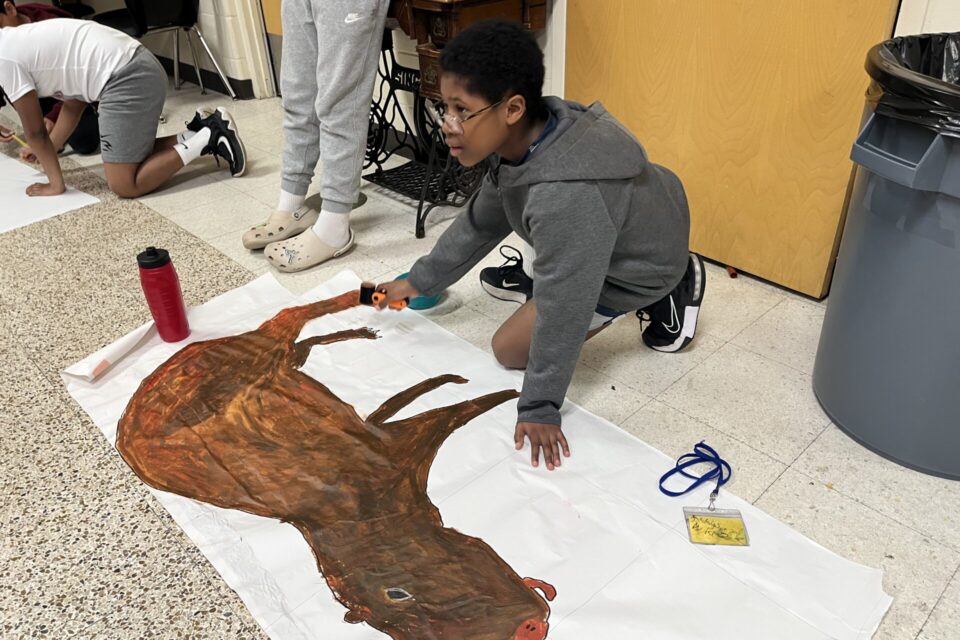

Creativity and culture at the core of the Black Montessori experience
Kuumba! This article delves into the intersection of Montessori, the Black child, and culture. Many points here will relate to children of other ethnicities given that culture encompass human development components. As a Black father I am speaking authentically to my own lived experiences. I open with the word “Kuumba!” because this concept gets to some core aspects of Black culture. Here, we ask how culture relates to Montessori pedagogy in service of #TheBlackChild’s learning as well as learning for other children?
“Kuumba” is a Kiswahili concept translated as “creativity.” It is the 6th principle of the Nguzo Saba—the 7 principles of the African American cultural holiday, Kwanzaa. For me this concept gets to some core aspects of the Black culture. Creativity can be seen in how many Black people operate in key life areas. For example, dance (my mind goes to Michael Jackson’s Motown 25 performance of Billie Jean); dress (remember Serena Williams’ Wakanda or Tutu tennis match outfits); literature (Nikki Giovanni’s Ego Tripping or James Baldwin’s The Fire Next Time); and inventions (Garrett Morgan’s traffic signal or Marie Van Brittan Brown’s home surveillance device) are just a few of Black people’s creative expressions.
In an earlier article (Montessori and the Black child: “Certainly, we must go”, AMI-USA Journal Fall 2022), I presented a “back of the napkin” reflection on three aspects of Montessori pedagogy which align with the learning disposition of many Black children.
I wrote about three concepts (self-initiative, independence, and spirituality) at the intersection of Montessori pedagogy and the learning style of many Black children. However, not only did I leave out kuumba, I also did not touch on culture. To talk further on that subject, I turn to renowned Black thinker and “father of Afrocentricity” Dr. Molefi Kete Asante.
Dr. Asante’s perspective: culture in the Montessori school classroom
A Montessori outsider can see that the Montessori method is grounded in the principles of engaging all the child’s senses. It uses the entire environment of the classroom, deep concentration on practical activities, self-discipline, and teacher facilitation in the making of independent and responsible adults.
The Montessori experience allows schools to adapt their methods to a variety of regions and cultures. In the Montessori method, culture can be a way to use children’s customs, traditions, social institutions, achievements, and histories as curricular components. Everything in the classroom and everything in the students’ minds are parts of the total experience of cultural learning.
Teachers of African and African-American children should have some understanding of the broad outlines of Black culture. We asked a teacher in an urban school where the student population was 80 percent African-Americans, “do you know Langston Hughes?” The teacher looked puzzled, and said, “I think he is the fellow who works as a valet at the local restaurant.” It was not the answer we were looking for—Langston Hughes one of the greatest names in African American literature! What prepares a teacher who is limited in information about African-American culture to teach African-American students, regardless of their numbers? The teacher as facilitator must also be a person of empathy, affect and respect for all cultures.
There are three basic assumptions about schools and culture:
- Education is fundamentally a social phenomenon. This means it has a socializing effect.
- Schools prepare students to live in society. This means it is preparatory for adulthood.
- Societies develop schools suitable to their cultures. This means schools are training spaces for self-discipline.
Why is culture important?
Culture is like a digital clock and GPS; it will let you know what time it is, where you are located, and where you can go. Students should always feel centered, that is, comfortable in the cultural zone closest to them and their families. Should they go outside their culture, there must be sufficient appreciation for cultural differences. Without this understanding students may be unwittingly submerged in cultures that do not like them, distort their histories, and show them as inferior to others.
Students relate to lessons that include cultural content from their histories. They are interested in the lessons because the lessons are interested in them. Students can re-live experiences they have learned from their families when culture is respected in the classroom. Odd things told and learned in families become a part of the environment in the classroom. Students appreciate the value of other students’ cultures when they recognize that all people have some cultural origin, values, customs, and traditions. A mutual understanding of other cultures is the platform for convergence of ideas, values, and meanings.
Why must the teacher facilitate respect for culture?
The teacher must learn as much as possible about the cultures of students to fill in gaps through information intervention, asking questions to students and other facilitators about specific cultures, and allowing students to bring cultural examples to class, if possible.
Why is cultural education important to a child’s development?
First, it provides the child with a natural response to information, concepts, and ideas. Second, it builds trust between the teacher and the child. Third, culture is the source of confidence and independence, where a child can exhibit habits of leadership and accountability. Finally, for those that say they “don’t see race” they often fall into the pitfall of attempting to be non-cultural. Being non-cultural in a western-culture-based world really means being Eurocentric. So, to “not see color” or “not see culture” is to capitulate to the surrounding White domination and Eurocentricity of the surrounding society. Dr. Beverly Tatum uses the analogy of a moving walkway—just standing still is not neutral.
Dr. Montessori described culture as the sum total of accumulated human knowledge and important to one’s growth. In To Educate the Human Potential, she says ”If during this [developmental] period of social interest and mental acuteness all possibilities of culture are offered to the child, to widen his outlook and ideas of the world, this organization will be … used for purposes of social organization at a later stage.
Therefore, in working with Black children, as well as with children in general, I would suggest that we celebrate their culture as opposed to attempt to “not see it.” Consider incorporating symbols, images and artifacts from their culture in the environment. Avoid “minoritizing” children in how we think and talk about them. Montessori for Social Justice has urged us to shift to “people of the global majority” as opposed to “minority.” Instead of “othering” children of the global majority, we can help them to feel a sense of belonging, that they are valued community members and to understand that we are all members of one human race, as Dr. Dove points out, with more in common than different.
Dr. Sabater responds:
This discussion of culture, and how Montessori pedagogy, used in service of #TheBlackChild’s learning, as well as the learning of children from other cultures, is a conversation that is occurring more and more frequently. As visionary efforts like #MontessoriForSocialJustice, #BlackWildflowers and #BlackMontessoriEducationFund become more and more successful. With their success, more and more Black people, and people of the global majority, will be #TouchedByMontessori. And if #BlackMontessori is to succeed then it will have to effectively lean into much of what Dr. Asante has just discussed as important components of culture.
Efforts like Poinciana, where Drs. Dove and Asante visited, are self-professed “Afrocentric Montessori” programs. Poinciana, for example, prominently portrays images reflective of the majority of Black children’s culture. Their library curates books that specialize in Black history, and they offer specifically relevant learning materials.
We hope this brief discussion of “how culture relates to Montessori pedagogy in service of #TheBlackChild’s learning” sparks further investigation into this fascinating arena. Particularly, as increasing numbers of Black families seek Montessori education for their children, it warrants rigorous exploration around how Black children perform there, and how their respective Montessori programs engage the children’s culture. Maybe the world will see more “Kuumba” as more Montessori programs engage with the culture of their respective Black students.

Dr. Ayize Sabater
Dr. Ayize Sabater is a co-founder of Nsroma Montessori Consulting, co-founder of Shining Stars Montessori Public Charter School, a co-founding board member of Montessori for Social Justice, a Washington Montessori Institute (WMI) Board member, and Head of School at Willow Oak Montessori.

Molefi Kete Asante
Molefi Kete Asante, PhD, known as the “Father of Afrocentricity,” is the President of the MKA Institute and a professor in the Department of Africology and African American studies at Temple University.

Nah Dove
Nah Dove, PhD, is a Temple University Africology professor, scholar and co-author of Being Human Being.
You may also like