


Teacher evaluation and professional growth
As Montessorians, we constantly weave together theory and practice, integrating the vision – the “why” – with the reality – the “what” and “how.” As a public Montessori administrator and doctoral student, I have encountered a professional growth point doubling as a research inquiry. As an administrator, in my first year evaluating and supervising Montessori teachers, I wondered: how can we work within our existing teacher evaluation framework to support Montessori-aligned, collaborative growth? How can we infuse the process of teacher evaluation with Montessori values of growth, friendliness with error, and choice? How can we support developmental principles beyond the fourth plane of development, to nurture human flourishing throughout adulthood? As a doctoral student, I looked at existing research and found a gap relating to how teacher evaluation may shape the professional growth of public Montessori teachers.
School districts in the U.S. are increasingly adopting the Montessori approach with hopes of boosting student achievement, diversifying student populations, and attracting families. As the number of public Montessori schools in the U.S. increases, so does the number of Montessori teachers who are assessed in mandated teacher evaluation systems. As both a practitioner and scholar, I wondered: how can we use teacher evaluation in a way that aligns with Montessori values? What is working well? And what might be better?
Through my studies with the Whole School Leadership Institute, I became familiar with the work of Robert Kegan and Lisa Lahey, who have explored “Deliberately Developmental Organizations” and the qualities that support meaningful professional growth. This theory provided a foundation for me as I began to develop feedback skills, and so did my district’s training on effective feedback conversations. However, I wanted to go deeper and hear directly from teachers about their experiences with professional growth and helpful aspects of teacher appraisal. So, I asked teachers: what would it take to make teacher evaluation more Montessori-friendly?
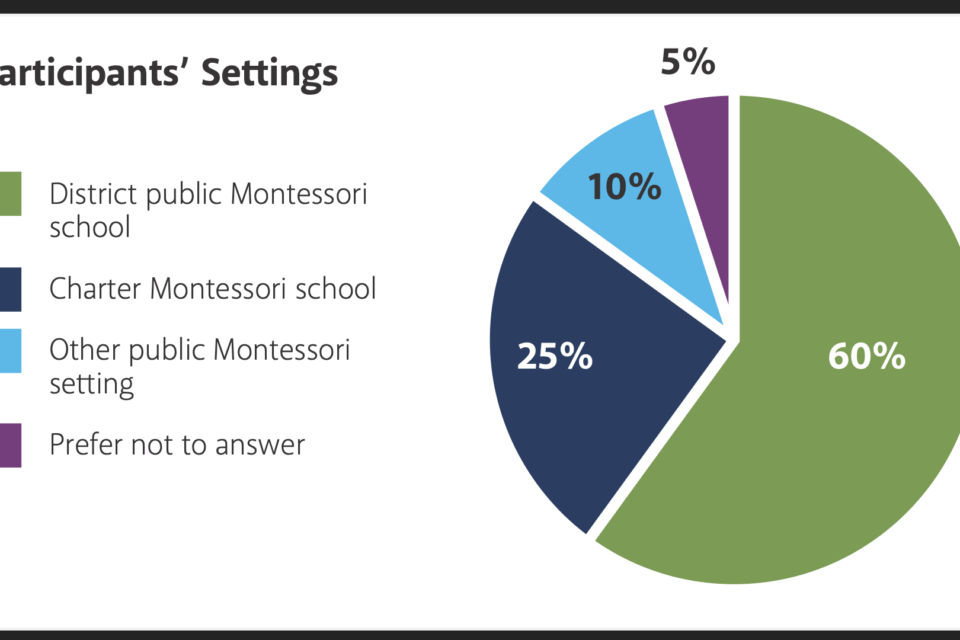
Last year, I conducted a pilot study, a qualitative survey of current public Montessori teachers from across the U.S. Participants were currently employed in public Montessori settings, including both district and charter schools, and they represented a range across grades K3-12, or Primary through Secondary. This pilot has represented an initial exploration, Phase One for my upcoming dissertation research, but it uncovered some interesting findings on its own. In this study, I inquired how Montessori schools can facilitate professional growth in a holistic, collaborative, and growth-oriented way. At the onset of this pilot study, I pursued the following questions:
- What are the experiences of public Montessori educators in the U.S. with their teacher evaluation systems?
- How do teacher evaluation systems influence or impact public Montessori educators’ professional growth?
Findings
Study participants described a wide range of experiences relating to their teacher evaluation and opportunities for professional growth. From the study, it became clear that districts and schools are varying greatly in the degree to which their teacher evaluation measures are infused with Montessori values such as collaboration and choice. Participants’ voices also indicated a wide range in quality of experiences. Participants offered a nuanced view of the potentials and challenges of teacher evaluation structures in a Montessori setting. Some expressed positive experiences with their teacher evaluation systems, noting that the evaluation component of a one-on-one goal-setting session with an administrator “feels Montessori,” or that “My school has allowed me to grow professionally as a leader.” Others expressed more critical opinions, calling their teacher evaluation structures “a punishment” or “gotcha,” and noting, “I have noticed that the past systems have had good intentions, but the amount of staff time needed to fulfill the responsibilities was not sustainable.”
In spite of this range of Montessori-aligned teacher evaluation and variety of teacher perceptions, participants’ responses shared many commonalities. From participants’ words, four main categories emerged, housing thirteen salient themes. I identified the categories as alignment, meaning, support, and choice. Each category included various themes, including cohesion, consistency, growth orientation, relationships, relevance, moving beyond compliance, admin buy-in, time, money, tools, flexibility, autonomy, and self-direction. Overall, these themes seemed to correspond to the needs of public Montessori educators regarding professional growth. The themes also offer three main takeaways that we, as public Montessorians, can weave into our practice to support adult developmental growth.
A first recurring theme in the participants’ comments involved the importance of having administrator buy-in, whether in the form of Montessori training for school leaders, or simply in a Montessori mindset or more holistic view of growth and progress. One participant noted, “[My state’s teacher assessment] can align with Montessori philosophy in the hands of the right administrator. It is mostly a lack of administrative understanding of the role of the Montessorian or how to translate the criteria into Montessori.” This theme speaks to the importance of recruitment of leaders with Montessori backgrounds, and the prioritization of Montessori training, whether pursuing an actual teacher credential, or an administrator course, such as Whole School Leadership Institute.
A second theme involved the importance of Montessori tools to adapt or modify existing teacher evaluation systems. Participants agreed that implementation of tools, such as observation matrices from the NCMPS Assessment Playbook, Public Montessori in Action’s Montessori Educator Self-Reflection Tool, and the MCT-EL Rubric could be helpful adaptations to existing structures. However, they cautioned that these should supplant existing requirements, rather than add more work. As one participant noted, “The district evaluation system is onerous enough that I’ve never asked if I can include extra information.” This theme reminds us of the importance of using tools within the Montessori community.
A third theme from this research involved the tension several participants seemed to feel between autonomy and unity. One participant noted, “I have had to independently seek out opportunities for myself to grow as a public Montessori teacher. It would be wonderful to be a part of a group that supports and gives feedback that improves my teaching.” Several participants noted that, to experience professional growth, they have to take advantage of external opportunities and attend professional development sessions outside of their school or district. Multiple participants also noted that while they appreciate the flexibility and autonomy given them by their schools, they would prefer to have more of a community or network. School leaders can take note of this theme to offer teachers with support, choice, and community in pursuing their individualized professional goals.
Overall, these three takeaways offer possibilities of collaborative growth, in keeping with some Montessorians’ notion of appraisal as continuous reflection and partnership, rather than a top-down, summative grade. To aspire towards this model of collaborative appraisal, we need a mindset shift, so teachers and administrators can work in dialogue towards mutual growth. One way to nurture this dialogue is to ask open-ended questions. My district offers training in Learning-Focused Supervision, a framework for intentionally framing questions to promote the teacher to think more deeply and grow in the process. Learning-Focused Supervision and similar tools also give the administrator or coach flexibility to adopt different stances, depending on a teacher’s needs. However, beyond this, we also need to model inviting, accepting, and learning from feedback, in support of our own and our community’s development.
I designed this pilot study as a precursor to my dissertation, to assess the aptness of interview questions for my upcoming, in-depth research. However, this study presented interesting findings as a stand-alone study, suggesting some of the professional growth needs of public Montessorians – and even, more broadly, Montessorians and educators in general. I will more deeply examine public Montessori educators’ experiences with professional growth this fall, through interviews with teachers and administrators. More research is needed into the use of specific tools, such as teacher appraisal checklists and self-reflection frameworks, to adapt existing teacher evaluation structures.
Just as we, as Montessorians, incorporate the “fundamental needs” of humans into integrated lessons for elementary students, we should consider the “fundamental needs of public Montessorians” regarding professional growth as we navigate Montessori in the public sector. By uniting theory and practice, and weaving existing Montessori tools into existing structures, we can adapt public education policies and structures towards a more holistic and developmental approach for adults.
This fall, I am entering Phases Two and Three of data collection, conducting interviews and focus groups with public Montessori educators in the U.S. for a more in-depth study of their experiences with ways to support meaningful professional growth. If you are a public Montessori teacher, administrator, or coach, I would love for you to participate in this research. Please contact me at [email protected] if you would like to become involved! This study may shape future practice and policy: what schools and districts are doing this well? What could be better, and how can we learn from each other? How can we collaborate to support developmental growth – not just for our young people, but for adults, as well?
References
- Benson, T. A., Salas, S., & Siefert, B. (2021). Irreconcilable differences: Black teachers’ lives and K-12 schools. The Urban Review, 53(4), 659–680.
- Bungay-Stanier, M. (2016). The coaching habit: Say less, ask more, and change the way you lead forever. Page Two.
- Chambers Mack, J., Johnson, A., Jones-Rincon, A., Tsatenawa, V., & Howard, K. (2019). Why do teachers leave? A comprehensive occupational health study evaluating intent-to-quit in public school teachers. Journal of Applied Biobehavioral Research, 24(1), e12160.
- Close, K., Amrein-Beardsley, A., & Collins, C. (2020). Putting teacher evaluation systems on the map: An overview of states’ teacher evaluation systems post-Every Student Succeeds Act. Education Policy Analysis Archives, 28(58).
- Damore, S.J., & Rieckhoff, B.S. (2021). School leader perceptions: Coaching tool and process. Journal of Montessori Research, 3(1).
- Even-Zahav, A., Widder, M., & Hazzan, O. (2022). From teacher professional development to teacher personal-professional growth: The case of expert STEM teachers. Teacher Development, 26(3), 299-316.
- Gerker, H. E. (2023). Making sense of Montessori teacher identity, Montessori pedagogy, and educational policies in public schools. Journal of Montessori Research, 9(1).
- Jor’dan, J.R. (2018). Predominantly Black institutions and public Montessori schools: Reclaiming the ‘genius’ in African American children. Teaching and Learning, 13(1), 1-7.
- Kegan, R., & Lahey, L.L. (2016). An everyone culture: Becoming a deliberately developmental organization. Harvard Business Review Press.
- Kegan, R., & Lahey, L. (2010). From subject to object: A constructivist-developmental approach to reflective practice. In N. Lyons (Ed.), Handbook of reflection and reflective inquiry: Mapping a way of knowing for professional reflective inquiry (pp. 433–449). Springer.
- Lipton, L. (2013). Learning-focused supervision. MiraVia.
- Madigan, D. J., & Kim, L. E. (2021). Towards an understanding of teacher attrition: A meta-analysis of burnout, job satisfaction, and teachers’ intentions to quit. Teaching and Teacher Education, 105, 103425.
- Marx, S., Lavigne, A.L., Braden, S., Hawkman, A., Andersen, J., Gailey, S., Geddes, G., Jones, I., Si, S., & Washburn, K. (2023). “I didn’t quit. The system quit me.” Examining why teachers of color leave teaching. International Journal of Leadership in Education, 1-24.
- Minardi, K., Davidson, P., Pritzker, S., & Covert, T. (2022). Module 1, Transforming self, community & society: Principles of effective educational leadership. Whole School Leadership Institute.
- Murphy, T. R. N., Masterson, M., Mannix-McNamara, P., Tally, P., & McLaughlin, E. (2020). The being of a teacher: Teacher pedagogical well-being and teacher self-care. Teachers and Teaching, 26(7–8), 588–601.
- Murray, A.K., Daoust, C.J., Mallet, J., & Damore, S. (2021). Designing the Montessori Coaching Tool Elementary Rubric for early-career professional development. Journal of Montessori Research, 21(7), 25-61.
- National Center for Montessori in the Public Sector (2019). Assessment playbook. National Center for Montessori in the Public Sector Press.
- Pallas, A.M. (2023). The rhetoric of teacher evaluation: New York City teachers’ responses to performance labels. Educational Policy, 37(3), 769-799.
- Public Montessori in Action (n.d.) Montessori Educator Self-Reflection Tool.
- Saylor, L. L., McKenzie, G., & Sacco, C. C. (2018). Teacher-centered mentorship as meaningful professional development. Journal of Montessori Research, 4(2), 10–32.
- Schein, E.H., & Schein, P.A. (2021). Humble inquiry: The gentle art of asking instead of telling (2nd ed.). Berrett-Koehler.
- Shuls, J. V., & Flores, J. M. (2020). Improving Teacher Retention through Support and Development. 4(1).
- Slade, E.G. (2021). Montessori in action: Building resilient schools. Jossey-Bass.
- Sutcher, L., Darling-Hammond, L., & Carver-Thomas, D. (2019). Understanding teacher shortages: An analysis of teacher supply and demand in the United States. Education Policy Analysis Archives, 27(35).
- Tanner, S., McCloskey, A., & Miller, E. (2021). Destructive domains: Rethinking teacher evaluation in the age of Charlotte Danielson. International Journal of Qualitative Studies in Education, 36(9), 1876–1890.
- Taylor, P. (2020). The complexity of teacher professional growth: Unravelling threads of purpose, opportunity and response. Professional Development in Education, 49(1), 16-29.
- Vagi, R., Pivovarova, M., & Miedel Barnard, W. (2019). Keeping our best? A survival analysis examining a measure of preservice teacher quality and teacher attrition. Journal of Teacher Education, 70(2), 115–127.
- Visone, J. D., Mongillo, M. B., & Liu, Y. (2022). Teachers’ perceptions of collaboration within an evolving teacher evaluation context. Journal of Educational Change, 23(4), 421–450.

Caroline Robbins
Caroline Robbins is a public Montessori school administrator in Milwaukee Public Schools and a doctoral student in Montessori Studies at the University of Wisconsin-River Falls.
You may also like