

This article is in the
Spring 2018 print issue
of MontessoriPublic

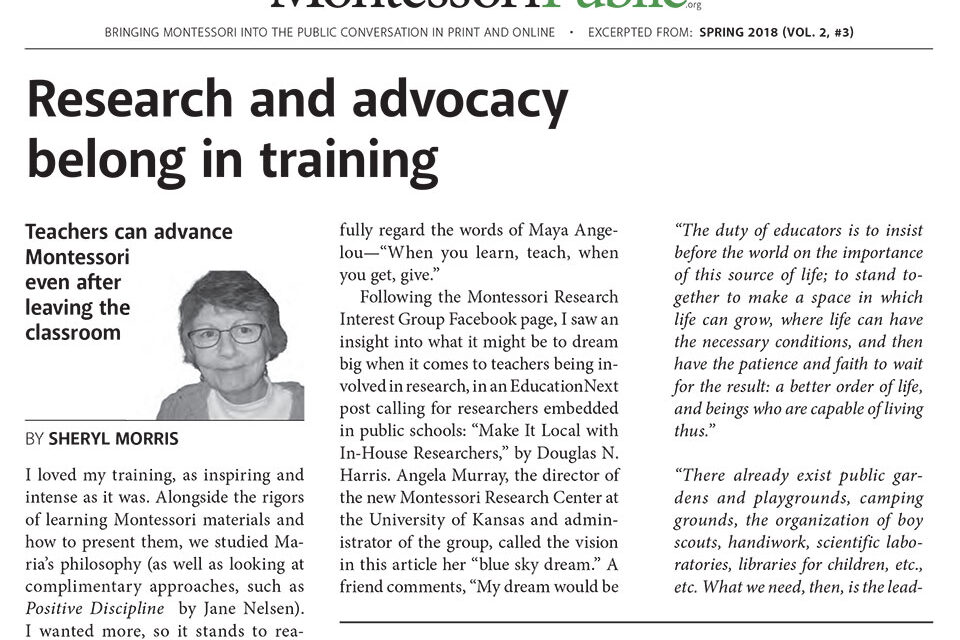
Teachers can advance Montessori even after leaving the classroom

by Sheryl Morris
I loved my training, as inspiring and intense as it was. Alongside the rigors of learning Montessori materials and how to present them, we studied Maria’s philosophy (as well as looking at complimentary approaches, such as Positive Discipline by Jane Nelsen). I wanted more, so it stands to reason I would continue to seek out resources, especially online, once away from training, and then away from the classroom. Montessorians are among all of those that continue to make me a better, smarter person.
In this issue of MontessoriPublic, we were invited to share how we feel about our training and what may have been missing. Two areas I wish had been covered, even if only with an introduction, would be research and advocacy. Given the passion I saw in fellow teachers-in-training and many teachers themselves, I would like trainers and administrators to encourage and support those that have the inclination to facilitate research and broadly advocate, when possible, both while a part of the classroom and away.
To teacher trainers and administrators I would say this: Nurture trainees’ aspirations as they nurture those of children; help them be all they can be inside the classroom and out, and more fully regard the words of Maya Angelou—“When you learn, teach, when you get, give.”
Following the Montessori Research Interest Group Facebook page, I saw an insight into what it might be to dream big when it comes to teachers being involved in research, in an EducationNext post calling for researchers embedded in public schools: “Make It Local with In-House Researchers,” by Douglas N. Harris. Angela Murray, the director of the new Montessori Research Center at the University of Kansas and administrator of the group, called the vision in this article her “blue sky dream.” A friend comments, “My dream would be to study and research half the day, and be in the classroom the other half.” I hope your dreams come true!
In training, I and many of my cohort felt, as many of us have, “This should be for all children!” Or at least, all children should have Montessori as an option. But it wasn’t until later that I realized how large a role advocacy should really play in being a teacher, and especially a Montesssorian. It wasn’t until later that I discovered Maria’s own words about advocacy.
The duty of educators is to insist before the world on the importance of this source of life; to stand together to make a space in which life can grow, where life can have the necessary conditions, and then have the patience and faith to wait for the result: a better order of life, and beings who are capable of living thus.”
There already exist public gardens and playgrounds, camping grounds, the organization of boy scouts, handiwork, scientific laboratories, libraries for children, etc., etc. What we need, then, is the leading idea which is to combine these things into one organic whole: the conception by which they will all tend towards the formation of man.
So what’s stopping us?
Nine Reasons Teachers are Unwilling to Stand Up for Their Profession, a 2015 EducationWeek blog post by Michigan teacher and writer Nancy Flanagan, is a place to begin understanding why teachers do not engage in advocacy. The reason that carried the most weight for me was that teachers “are too busy.” This is where administrative support is needed. Other reasons, such as “lack of information” and “inexperience,” can be changed with training. Given needed coaching, encouragement, and support, teachers and teachers-in-training can even be persuaded to advocate local legislators.
Within school communities, among fellow teachers and parents whose children are enrolled in the school, and at Montessori conferences, there is enthusiastic promotion and championing of Montessori. But if we are rise to Maria’s vision of advocacy, we need to involve ourselves even more. Wherever there are parents and grandparents, caregivers, and other educators, Montessori can be revealed. Two places that come to mind are local libraries and school board meetings. Where else might Montessori be shared? Montessorians are not always visible at family events and conferences arranged by other organizations looking to all possible “best practices” for educating and nurturing children. Two such organizations are the Alternative Education Resource Organization (AERO) and the National Association for the Education of Young Children (NAEYC). NAEYC, which has individual chapters in each state, is engaged right now in reviewing its standards for teacher preparation and needs to hear from Montessorians about how well our training prepares teachers.
It is not always easy to know exactly what you might do to further Montessori programs and philosophy once you are no longer in the classroom. Are you, in fact, still a Montessorian if you are no longer in the classroom? Thank you, Zoe for setting me straight on that! “You are no less a Montessorian because you are not in the classroom or managing a school.” The best training would include more and more knowledge of ways to engage with the rest of the world, bringing light as only Montessorians know how.
Once the general public realizes the sacredness of the task of teaching, and once the standard of assistance given to the children is such that the results in the lives of the adults produced by it is fine and great, then the teachers will be regarded as benefactors to humanity and their advice and assistance will be sought.

Sheryl Morris
Sheryl Morris moved from book publishing to AMS 3-6 training and now enjoys assisting early-education programs at the public library and conducting independent studies in math education, holistic educations, and social justice.
You may also like