

Montessori-inspired life skills for developmentally disabled adolescents
Independence holds a privileged place in Montessori education. We prepare environments and organize our own actions so children can do things for themselves. Through environmental preparation, skilled observation, and disciplined stepping aside, we invite students to grow in competence, confidence, and the ability to be self-directed. For years, I understood independence as a self-evident educational goal.
When I began my doctoral work, independence was central to my thinking about education for students with disabilities. I believed that Montessori offered the field of special education a time-tested roadmap for fostering independence in all children. Then, in my second year, I began working with middle school students with intellectual and developmental disabilities and extensive support needs and, as I got to know these students, I began thinking about independence differently.
These students will likely need substantial support throughout their lives. Many communicate primarily without speech and rely on familiar others to interpret and elevate their voices. Many need physical assistance with mobility and daily living tasks. The traditional understanding of independence, i.e., doing things by yourself, simply does not fit within their lives.
Instead, their lives are characterized by dependence and interdependence. At the same time, the students I came to know regularly expressed strong preferences and desires. They clearly wanted to make choices and direct their own activity, but this would look different than what I had come to expect as a Montessori teacher.
Working with these students led me to this question: “If Montessori is for everyone, can independence truly be our goal? And, if independence is not the goal, what is?”
When I looked beyond traditional notions of independence in research literature, I found the concept of autonomy. Within Self-Determination Theory, autonomy refers to a person’s ability to act in accordance with their own preferences, values, interests, and beliefs. An autonomous act is intentional, chosen, and free from compulsion.
Unlike independence, the concept of autonomy leaves room for support. A person can make a choice rooted in their own desires, interests, and values while relying on another person to help carry it out. For example, to prepare a meal, a person may require support to gather ingredients or use kitchen tools. The presence of support to complete these tasks does not diminish the autonomy of the person preparing the meal, so long as the meal reflects the person’s preferences and the process is guided by the person’s expressed desires.
This means that a person can cultivate autonomy within a life that necessarily involves dependence on others. This distinction between independence and autonomy has become central to how I understand inclusive Montessori education. Our goal can be bigger than independence; instead, we can foster autonomy within community.
The Apartment
I have had the opportunity to explore these ideas through a program called the Apartment: a Montessori-inspired life skills classroom at UCP Bailes Community Academy, an inclusive K–8 public charter school in Central Florida. The school itself is not a Montessori school, but the Apartment serves a group of middle school students with intellectual and developmental disabilities and extensive support needs in a distinctly Montessori way.
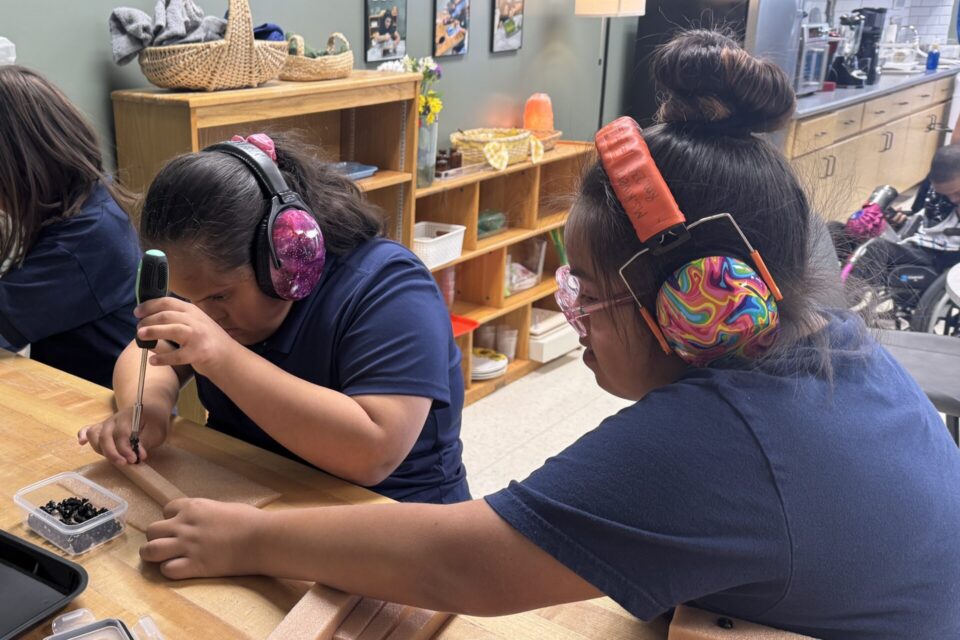
The classroom looks like a small studio apartment. It includes a kitchen, living area, bedroom area, dining table, laundry space, and accessible shelves stocked with materials prepared according to Montessori principles. Students cook, wash dishes, sweep, mop, arrange flowers, do laundry, care for plants, sew, paint, work with tools, and practice other activities connected to everyday life. In keeping with Montessori philosophy, the materials are real. The dishes can break, the washing machine washes actual clothes, and students use ordinary kitchen tools, cleaning supplies, linens, and flowers.
Our weekly sessions begin with a brief group lesson, usually a demonstration of a daily living activity. The students then move into an extended period of self-directed work. Just as in a typical Montessori classroom, students choose activities, return to familiar work, try something new, collaborate with peers, rest, observe, and seek assistance when needed. Adults give lessons and provide support, but try to avoid unnecessary help or directives.
Within the first few weeks of the program, we were already seeing big changes. One student often had difficulty entering her regular classroom and participating in adult-directed work. One morning when I arrived for our Apartment session, I found her sitting in the hallway with the school’s behavior team.
Instead of telling her to go into the room or presenting her with an assigned activity, I mentioned that we had a lot of clean laundry in the Apartment that needed to be folded. She immediately stood up and followed me in. After she folded the laundry and the rest of the class joined us, she moved from one activity to another, worked alongside peers, and naturally assumed a leadership role within the group.
This student who was often resistant to participation in a traditional classroom environment became energetic and industrious in the Apartment. In our Montessori environment, she could choose how she spent her time, her work had an intelligible purpose, and she could contribute to a shared community as a helper, not only as one who receives help.
This student’s experience illustrates how often something we perceive as a problem within a student is actually a mismatch with the environment.
Montessori educators understand this. When a child struggles, we look carefully at the environment. Is the material accessible? Is the sequence clear? Is something interfering with concentration? Have we given too much help? Too little? For students with disabilities, these questions can become especially consequential.
Research on autonomy among individuals with disabilities has documented limited opportunities for choice and self-direction across the lifespan. Students with significant support needs typically spend their entire school days in highly adult-directed environments. Adults choose where to go, what to work on, how to complete the task, when to stop, and what counts as success. Many of these supports arise from legitimate needs; nevertheless, intensive support can easily become intensive control.
Autonomy-supportive classrooms offer an alternative: meaningful choice, flexible structure, and adults who support action without trying to control it. Montessori educators will recognize this model immediately. Research shows these kinds of environments can work for students with disabilities.
Because of what I have read, seen, and experienced, I believe Montessori education offers a powerful model for imagining autonomy-supportive education for students with significant support needs. To serve these students well, however, we must reconsider some of our goals and expectations, especially when it comes to independence. We need to ask: What would it look like to shift our focus from fostering independence to creating conditions for autonomous action?
Meaningful choice
Choice is one of the clearest ways people exercise autonomy. We often talk about choice as if it rests entirely on an adult providing options, but meaningful choice requires more. A student needs the opportunity to choose, but the student also needs to perceive options as truly available to them. With students who communicate differently, adults also need to recognize the student’s communication as meaningful and work to understand.
I find the Montessori triad—environment, adult, and child— especially useful when thinking about choice. The environment creates opportunities for choice. The adult helps make those opportunities visible and accessible and ensures the child’s choice is consequential. The child chooses. All three work together.
I saw this clearly during a woodworking activity in the Apartment. A student had chosen to work with a bolt board, but he was having difficulty turning the manual screwdriver. An adult could easily have interpreted his difficulty as evidence that he could not do the activity and returned it to the shelf, but our classroom assistant saw it differently. She watched him for a few moments then exclaimed, “Oh wait! He needs an electric drill!”
Her response left a deep impression on me, because it was so clear that it grew from her deeply held belief that the student could accomplish what he wanted to accomplish. With this mindset, the problem at hand shifted from “He can’t do it” to “We haven’t found the right tool yet.” We immediately ordered a drill.
During our next session, the student chose to continue his work using his new tool. Even with the drill, he still could not complete his chosen work entirely on his own; he still needed physical support. But he completed his chosen task with immense satisfaction. His joy was evident on his face and in his movements. I think this is a striking example of the power of shifting from independence-as-the-goal to autonomy-as-the-goal. This student’s need for assistance did not diminish the meaningfulness of his choice. He chose what he wanted to do, and we helped make it possible.
This renewed my belief in the importance of the prepared adult. When adults work with students with extensive support needs, we are constantly interpreting. Attending to sounds, gestures, movements, and words, we interpret what students understand, what they want, what they can do, whether a behavior is intentional, and when they need help. These interpretations shape what becomes possible for the student.
If I assume a student cannot do something, I am less likely to offer the opportunity. If I presume competence, when faced with a challenge, I ask: What does this student need to complete this task? Presuming competence does not mean assuming a student can do everything, much less that a student can do everything independently. It means believing in each student’s capacities, erring on the side of “yes, they can,” and treating their desires, preferences, and intentions as worth knowing and making consequential within classroom life.
“We shall walk together on this path of life, for all things are part of the universe and are connected with each other to form one whole unity.”
Maria Montessori
Students with disabilities and high support needs are often educated in settings where adults have understandable reasons for providing extensive structure and control. But everyone deserves opportunities to make choices, contribute to a community, and experience themselves as capable.
The Apartment shows that support does not have to come at the expense of autonomy. When families visit the Apartment or see photographs and videos, I often hear a version of the same response: “I didn’t know he could do that.”
Parents begin imagining new possibilities for their children. Teachers also see students who have spent much of their school day working with iPads, worksheets, or highly structured adult-directed tasks make their own choices and become absorbed in freely chosen, hands-on activity.
The Apartment is unusual because we are using Montessori principles within a traditional public school to serve students with extensive support needs, a population rarely centered in conversations about Montessori education. The ideas behind the Apartment, however, should feel very familiar to Montessori educators. As Montessorians, we know how to prepare environments where support makes meaningful participation possible.
We know how to give students opportunities to direct their activity and contribute to their communities. Perhaps we can also make greater room for interdependence as part of classroom life. People become themselves in relationship with other people. We contribute to others, and we depend upon them. We give help, and we receive it.
Shifting our focus from independence to autonomy is critical if we want to offer Montessori education to students with extensive support needs, but I think this shift can also enrich how we understand all Montessori communities. Maybe if we do so, we will see that it is interdependence that is actually at the heart of the Montessori Method.

Rachel Barker
Rachel Barker is a Ph.D. Student in Exceptional Student Education at the University of Central Florida
You may also like