

Helping middle school students make the leap to the next level
We spend years in the Montessori environment cultivating a profound respect for the rights of the child. We champion their right to independence, to self-paced exploration, and to a learning ecosystem driven by intrinsic curiosity. Within our carefully prepared micro-societies, these rights are not just philosophical ideals; they are the daily, lived reality of our students.
But a critical question emerges as these students mature: What happens when our adolescents take the leap into a system that operates on a completely different set of rules?
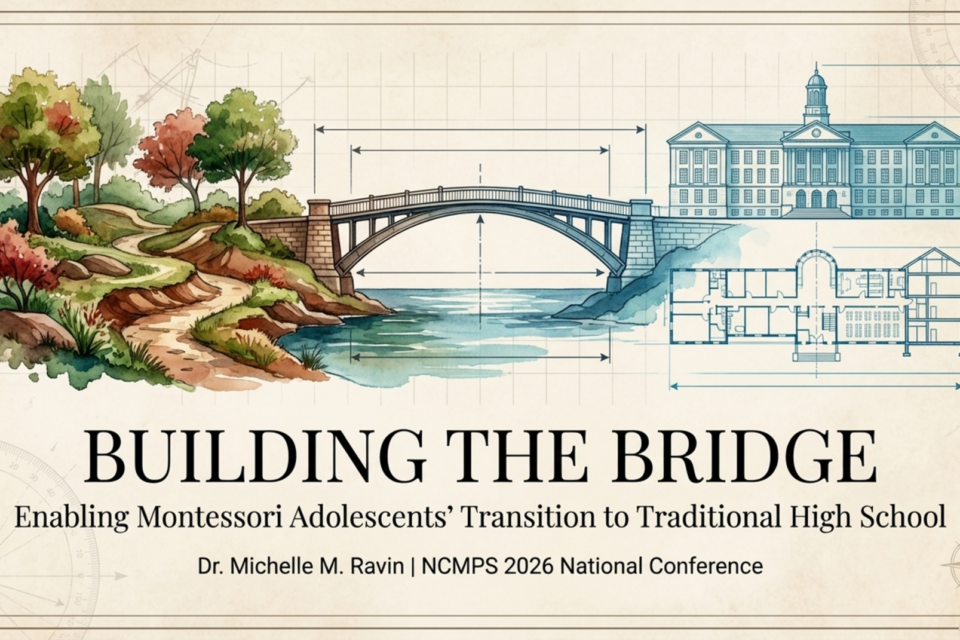
As an educator, a phenomenological researcher, and a mother who has personally navigated these stages with my own children, I have spent years observing the crossing between the “Montessori Shore” and the “High School Shore.” Moving from a small, individualized, process-driven community to a large, anonymous, product-driven institution is not merely a change of buildings; it is a profound philosophical and structural discontinuity.
If we truly believe in the rights of the child, our responsibility does not end at our classroom doors. We must advocate for their right to a supported, humanized transition.
When strength becomes friction
Through listening closely to the lived experiences of students and families navigating this crossing, it becomes clear that adolescents face three distinct areas of “shock”:
- Academic Shock (The Loss of Autonomy): Students experience a jarring shift from self-paced mastery to rigid deadlines, lecture-based learning, and grade-driven assessment.
- Social Shock (The Anonymous Institution): Adolescents leave a close-knit micro-society where every student is known, entering a complex macro-school governed by rigid new social hierarchies.
- Philosophical Shock (The Clash of Motivations): Montessori-honed superpowers—intrinsic motivation, deep questioning, and self-pacing—can act as a double-edged sword in a system not designed to accommodate them.
In a traditional system not designed to accommodate them, the very superpowers our students have honed—independence, self-advocacy, and deep questioning—often act as a double-edged sword. As one adolescent participant in my research powerfully articulated, “I used to ask questions all the time. Then I learned when not to.”
Another noted, “It felt like school stopped being about learning and started being about proving.”
These voices highlight a critical vulnerability. Without deliberate support, the transition threatens their right to authentic intellectual engagement, forcing them to assimilate rather than integrate.
Transition theory in action
To safeguard the rights of the transitioning adolescent, we must build a bridge that honors their strengths rather than asking them to simply assimilate. Educator and author Nancy Schlossberg developed her Transition Theory model to understand how individuals experience and cope with change and transition. We can scaffold this leap from middle school to high school using the four foundational pillars (the “4 S’s”) of the model:
- Navigating the “Situation”: We cannot change the structural realities of the receiving high school. However, we can help adolescents reclaim their agency by finding small areas of choice—whether through electives or independent research—to maintain their “Inner Pilot”.
- Protecting the “Self”: We must explicitly teach students that their Montessori “Self”—their curiosity and independence—is their greatest asset, even if it is not immediately graded. Reminding them that grades often reflect procedural fluency, not actual intelligence, ensures their self-esteem remains intact.
- Building Robust “Support”: A successful transition requires humanizing systems. We must implement advisory models so every transfer has at least one “human lighthouse” who knows their name, and help students find “Social Sanctuaries” (like clubs or sports teams) that replicate the scale of their Montessori roots.
- Explicit “Strategies”: We must actively teach the skills required to navigate the hidden curriculum. This means providing explicit instruction on traditional survival mechanisms: navigating grading portals, adopting traditional note-taking formats, and studying for standardized tests.
Equipping the builders
A blueprint requires skilled builders. To support this leap, the adults in the microsystem must evolve their roles from Directors—managing schedules and controlling the Montessori ecosystem—to Consultants. As consultants, we empower self-advocacy, provide emotional scaffolding, and proactively mesh the family, the sending guide, and the receiving school before a crisis hits.
Honoring the rights of the child means recognizing that we are not merely preparing students to survive within our own walls. We are equipping them with the resilience, the self-advocacy, and the intrinsic fire to cross into any environment—and flourish. Ensuring our students can bridge this gap with their curiosity and confidence intact is at the very heart of our mission.

Michelle M. Ravin
Dr. Michelle M. Ravin is the Assistant Principal of MacDowell Montessori School in Milwaukee, Wisconsin and author of Building the Bridge: Enabling Montessori Adolescents’ Transition to Traditional High School.
You may also like