

Seward Montessori has persisted through the decades
Starting in the early 1980s, Montessori advocates in Minneapolis leveraged the magnet school movement to establish one Lower Elementary classroom in a shared school. That led to more classrooms, and between 1995 and 2015 public Montessori in Minneapolis peaked with two district schools, and one charter school, including one that provided Montessori middle school up to the 8th grade.
That school is Seward Montessori school. Following recent turmoil and a longer-term decline in public Montessori options in the city, it is the only one still operating today.
Obstacles to overcome
While all schools face hurdles, some of Seward’s challenges have been unique.
In recent years, Seward Montessori has not only had to contend with district wide restructuring, general declines in enrollment across the city and the COVID-19 pandemic, but also with the well-publicized killing of George Floyd and subsequent riots that started within blocks of the school, as well as the most recent federal immigration enforcement efforts that have disrupted schools throughout the Twin Cities area and beyond.
The school is located within one mile of the third precinct police station that was destroyed during the 2020 civil unrest, three miles from where George Floyd was killed and less than three miles from where Renee Good and Alex Pretti were killed by federal law enforcement this winter.
“We stand up for the safety and integrity of our Seward families and community in several ways,” said Kelly Dean, Montessori Coordinator at Seward, when asked about how they are handling the recent increased federal immigration enforcement activities.
The school has established safe routines for arrival and dismissal, practiced safety actions for responding to ICE activity in our area and helped supply basic needs like food and safe transport to families.
They have also had dozens of parents and neighbors patrolling the perimeter of their campus at every arrival and dismissal, and, according to Dean, all their guides have “chosen to keep their children who moved to online learning within their classroom community, rather than dividing and shuffling them into new ones with new teachers.”
“All of these responses required a lot of behind-the-scenes thinking, enormous amounts of extra effort and work, and a deep commitment to each other as a united front rising to the challenge,” added Dean.
The school also suffered a setback in 2021 due to a district-wide restructuring effort inspired, in large part, by district-wide loss of revenue. Called the Minneapolis Public Schools Comprehensive District Design, it was approved in 2020 and implemented in the 2021-22 academic year to address racial disparities, budget deficits, and declining enrollment.
The plan included reducing the number of magnet schools, eliminating most k-8 schools and organizing them into K-5 (elementary), 6-9 (middle) and 10-12 (high) schools.
This resulted in the closure of the other magnet Montessori school, Armitage, located in southwest Minneapolis, and required Seward to dramatically reduce enrollment and eliminate services to any students beyond the fifth-grade level, despite a major addition of nine classrooms completed in 2016 to accommodate a growing middle-school program.
“Losing our middle school hurt us a lot,” said Dean.
Prior to the change, and the loss of third-year Upper Elementary students, more 12 year-old students stayed in upper elementary classes and through middle school. Elementary classrooms were “always at full capacity,” Dean said. “Now we’re down to 20 kids in our upper elementary rooms even though technically we could go up higher.”
This year, however, the school has been allowed to keep its third-year Upper Elementary students, although, without the seventh and eighth-grade levels, some students still choose to move before sixth grade to avoid entering a new middle school a year later than most others.
Still, enrollment is growing, and there is a waiting list of those who want to enroll at the school overall.
Keys to success
Despite the challenges it has brought, Dean sees the school’s location as something that has also contributed to its survival and success.
Being in one of the city’s more densely populated and economically, culturally and racially diverse neighborhoods also helped it meet district integration goals. And being centrally located helped keep transportation costs down.
“We are often treated as a neighborhood school,” said Dean. “We have had a lot of immigrant populations coming to our school and that immigrant population has changed over the decades as the population of the neighborhood changed.”
The neighborhood has seen waves of immigrants and refugees with a Hmong population in the 1990, followed by many families coming from Ethiopian, Oromo and Somali. “Right now,” she added “I feel like we’re in a transition with a lot of different Spanish-speaking countries.”
According to a 2023 report from Minnesota Compass, the neighborhood is made up of 52% people of color, 48% white and 26% foreign born.
When asked directly what she thinks has helped keep the school going these years, Dean is quick to offer a one word answer.
“Montessori,” she said.
When asked to expand, she credits the Montessori method itself, and how popular it is with parents.
“We have a lot of people attracted to Montessori because they think that it’s going to be a better fit for their children,” she elaborated. For some, she said, “they don’t like the idea of their kids having to sit in seats.”
The multi-age classes are also appealing to many.
“I know our Somali families often wanted to keep their children here because they love having that relationship with the teacher for three years and then they have another relationship for three years.”
The extra mile
The extra efforts of teachers and administrators are also a major part of the school’s success, according to Dean.
“Because we do so much outreach with families, and we’re so inclusive to our families and our community … they tend to stay longer,” Dean said. “But it starts with Montessori. With the reputation of whatever somebody thinks of is Montessori. Which often, as I’ve come to learn, they think means more freedom for their children and more freedom to express themselves, like there’s less processing and more embracing of who kids are.”
Tammy Goetz, for example, was a former Montessori guide who served as principal at Seward from 2013 to 2020 when enrollment reached nearly 900 students, with 80 staff working at the school. She helped ensure multi-ages in the Children’s House and oversaw a large addition in 2016.
Parents advocates have also made a huge difference according to Dean. She shared the story of one parent who led the efforts to get a much-needed expansion for the middle school that included a connected new building.
Dean recalls how “People were teaching in hallways and under stairs. We had corners that they put temporary partitions like they do for offices, just to block off a corner to try to give a little bit of privacy space in the hallway. One parent actually went around and she literally measured the square footage per pupil ratio in the different middle schools and then presented that to the school board. She was a key, critical piece at making it so that we got this massive expansion.”
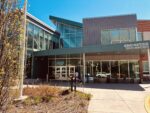
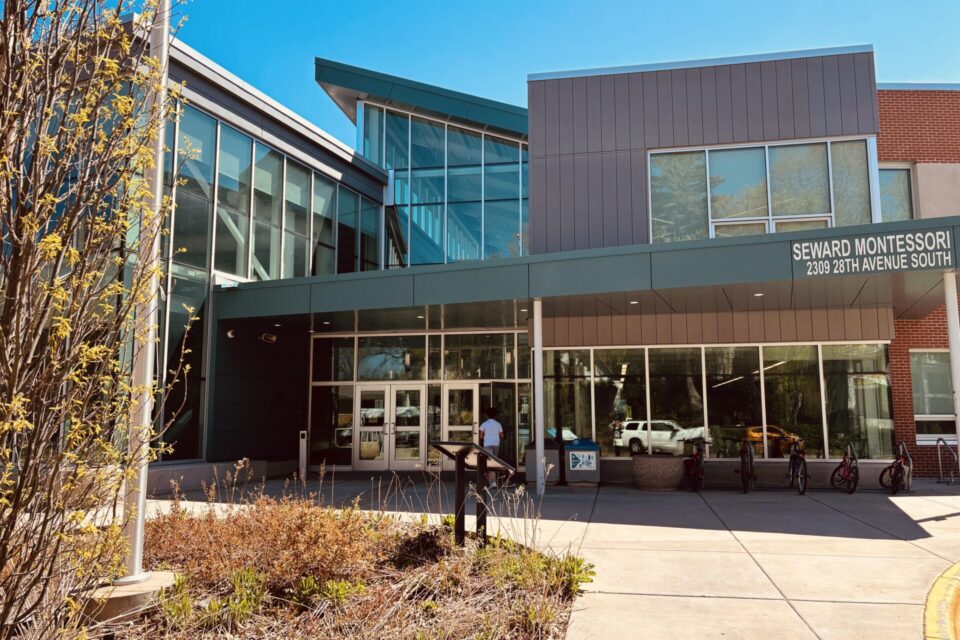
That 2016 expansion included a new media center, lunchroom, offices, a larger main entrance and the addition of a new third floor. The district reported that between 2014 and 2023, the district has invested $22,070,024 in capital expenditures for the building that is now 126,726 square feet in size, and has a design that can handle up to 900 students.
The district has also made significant investments in the school’s outdoor learning environment. It features an inner courtyard, community garden, rain garden, and other planting areas where students actively participate in gardening projects.
There are currently ten Lower and seven Upper Elementary classrooms, and four Primary, or Children’s House, classrooms, with enrollment of around 700 students.
“Now the school is as strong as ever,” Dean said with pride, while also noting that their neighboring St. Paul district has five public Montessori schools.
“I really feel strongly,” she said, “that a public education for Montessori is super necessary right now in Minneapolis.”

Cam Gordon
Cam Gordon is a former Montessori teacher/guide and administrator, and the author of "Together with Montessori."
You may also like