


Looking back and looking forward
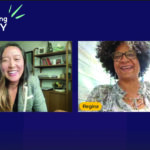
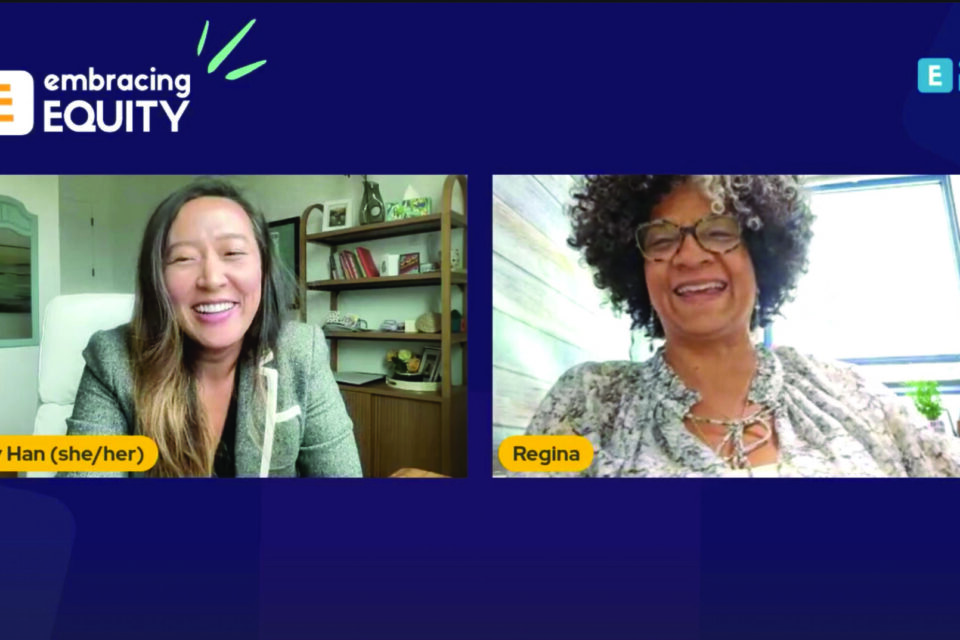
Last fall, as part of their Real Talk, Real Action webinar series, social justice nonprofit Embracing Equity hosted a conversation between Daisy Han, Embracing Equity’s Executive Director and Regina Dyson, Board Chair of Montessori for Social Justice.
MontessoriPublic listened in on that webinar and is happy to share some highlights here.
Daisy Han: For me, Montessori for Social Justice (MSJ) is deeply personal. Social justice isn’t just a concept—it’s a life mission. My journey into this work started with the realization that education holds immense power—not only to impart knowledge, but to shape a just and equitable society. I believe there is so much potential in Montessori as a pathway toward a more equitable world.
Regina, can you share what brought you to MSJ?
Regina Dyson: My connection began on the periphery. I had colleagues and friends involved since its
genesis. But at the 2023 conference in Chicago I became engaged. I attended with a high school student
—who also happens to be my own child—and it was everything MSJ always has been: grounded in
community, mission, and vision.
Shortly after, I was invited to join the board, and then to serve as chair. It’s been a whirlwind—about
nine months now—and full of growth and energy.
DH: Let’s look back at the roots of MSJ, reflect on where we are today, and envision where this movement could go.
Maria Montessori was a revolutionary figure—an advocate for social reform, women’s rights, and the
rights of children. She famously said that “children are both the hope and the promise of mankind.” She
understood the importance of education as a force for social change. Her work, over 100 years ago, laid
the foundation for what we are doing today.
At the same time, it’s important to ask: right now, in this lived reality— How do you approach social
justice in education today? What is MSJ doing today that’s relevant, applicable, and productive in our
current context?
RD: MSJ is a community—always has been. From its beginnings, it has operated through the vision and
mission of its community. And that includes anyone who is Montessori: practitioners, parents, students,
advocates, and activists working in the Montessori context.
Some things are the same, and some are different from when MSJ started. As we talk now in 2024, the
board is actively discussing how to focus our efforts, how to recalibrate, and how to stage our next
chapter.
We’re in a unique position, unlike a lot of Montessori organizations. We can truly collaborate, partner,
and attend to the fundamental needs and aspirations of the Montessori community—without being bound by external obligations or restrictions. That flexibility is incredibly valuable. It means we don’t have to do things a particular way. We’re not constrained by a rigid set of ideals or practices. So we’ve focused our energy on a few key areas:
- Access for adults: We want to improve access to training, support, and resources for adults in Montessori—particularly resources centered on social justice.
- Adolescent leadership: We want to engage more deeply with adolescent curriculum and leadership development. We believe that young people are going to change the paradigm. Our role is to be prepared adults—with the right materials, resources, and environments to support and respond to their leadership.
- Workplace support: We’re looking at how to support practitioners in their workplaces—whether through HR support, program development rooted in social justice, or guidance specific to their regional and policy contexts.
In all of this, we’re thinking in terms of collaboration. We’re interested in doing this work with others—
not in isolation. MSJ actually preceded—and in many ways set the stage for—a lot of the anti-bias, anti-racism, and social justice work now happening in Montessori spaces. MSJ, and the people who made it what it is, helped catalyze this movement.
I have a deep respect for beginnings and for the people who launch a movement. And that includes a
whole group of folks. If it weren’t for MSJ, I believe this work would still have come forward eventually—
but MSJ was the vehicle that brought Montessorians together and put them to task. It gave people a way
to engage meaningfully, powerfully, and necessarily in social justice work. Because let’s be honest—it can feel incredibly lonely when you’re doing this work alone in your school or classroom. Being part of
something larger, knowing you’re not alone, gives you a sense of solidarity. You know someone is in your
corner.
DH: Let’s talk about the journey that brought us here. It started with a group of energetic Montessori
parents, educators, and trainers—including Mira Debs, who at the time was doing her dissertation work.
She noticed that everywhere she went, people were passionate about accessible Montessori education.
They wanted to connect.
In 2013, after the International Montessori Congress in Portland, Oregon, Mira started a listserv. Then in
June 2014, the first public Montessori “unconference” was held at City Garden Montessori Charter School in St. Louis, Missouri. That was the beginning of this beautiful, growing community. Walk us through what happened next.
RD: Various projects were taking shape in different places—especially by 2017 and 2018, and certainly into 2019.
- 2014: After the unconference in St. Louis, we held a second conference in Salt Lake City. That’s when the name Montessori for Social Justice (MSJ) and its mission were formally determined by the launch group.
- 2016: The third conference was in Cambridge, at the Tobin Montessori School, with a focus on building the public Montessori movement and advancing educational equity.
- 2017: The MSJ board was elected by the attending MSJ community—everyone who was part of the community could vote.
- 2018: The fourth MSJ conference was held in Houston, along with the first official board meeting. Another conference followed in St. Paul, Minnesota.
- 2019: A conference was hosted by Harmony Montessori School in Portland, Oregon, including a two-day pre-conference Decentering Whiteness event, and a full-day retreat for Montessorians of Color and people of the global majority. So many powerful things came out of that experience.
- 2020-2023: COVID—a significant pause.
- 2023: Our first post-COVID conference was at Near North Montessori in Chicago. This was a wonderful event—reaffirming and re-energizing.
Now, we’re working on expanding our board and growing our working committees, and we’re actively
planning for the 2025 conference. MSJ has touched so many people.
DH: Why do you think this organization resonates with so many people?
RD: People see MSJ as a nexus organization: A place where the community can come together around
these issues with transparency, lived experience, and an immense pool of knowledge and expertise.
When folks attend an MSJ conference or engage in this community, they feel seen, heard, and valued
—in ways they often aren’t in their own environments. And to be frank, in some cases, they’re not even
allowed to be fully themselves where they live, work, sweat, cry, and experience joy. MSJ provides a
space where they can show up whole.
It’s been healing. Revitalizing. Empowering. Deeply connecting. In my 30–35 years as an educator, I’ve
never experienced what MSJ has offered and continues to offer—this kind of space that draws people
together with a shared mission around equity, healing, wholeness, and justice. It’s real, meaningful, lived
work. I go to many conferences and engage with many people, but MSJ provides something singular—
something rare.
DH: I think the transparency and vulnerability are key. That’s something that stood out to me as well—both as an attendee and as a board member. The environment is prepared for us to show up in our full
humanity, and to be affirmed in community as people who are passionate about providing that for children.
Since MSJ started in 2013, we’ve seen incredible connection and passion, and there have also been
real obstacles: gaps in organizational infrastructure, limited staffing, and confusion around what’s happening behind the scenes. There’s been a halt in progress at times.
Can you speak to some of the challenges that have hindered MSJ’s mission, growth, and stability?
RD: Like any emerging entity, especially one rooted in passion and ideals, MSJ faced growing pains. That
includes differences in vision, conflicting priorities, or even differing beliefs about what the work should
look like, how it should be done, and who should be doing it.
There’s a very human element to that. These kinds of tensions can hinder clarity, stability, and progress.
COVID, of course, threw a massive curveball. The board and working committees had been doing great
work prior—strategic planning, framing the mission, building community—but the pandemic forced
everyone to shift focus. People had to prioritize survival, both personally and professionally.
On the other side of COVID, I want to give a huge shoutout to Dr. Lindsey Pollock, who remains on the
board. She held things together on a fundamental level—maintaining continuity and structure so that when the time came to reemerge, we had a foundation to build on.
And then came the conference in Chicago, where Lindsey, Mercedes, LaToya, George, and others
stepped in to help get us back together and resume this important work.
Now, in terms of organizational development—and this isn’t just MSJ, this applies to many nonprofits—
one of the biggest challenges is that we often don’t give enough time and attention to the nuts and bolts:
logistics, infrastructure, clear role definitions, and solid foundations.
That’s when things become chaotic. We lose clarity, we can’t assign responsibilities effectively, and
we’re trying to move forward without structure.
At the same time, life is still life. We’re living through turbulent political, economic, and social times. That
deeply affects people—both as individuals and as professionals. It limits capacity and energy.
So yes, we’ve had lots of challenges. But now we’re at a point where we’re putting our legs back under
us. We’re functioning as a working board again. So, while it’s not like we’re starting over, there are internal things we need to attend to. There’s the business of being a 501(c)(3)—the infrastructure, the logistics. That’s where we’re directing our time and attention now: to find our groove, to be productive, progressive, engaging, clear, and to build solid footing.
DH: It’s as if MSJ is in its adolescent stage of development. For adolescent practitioners out there, you’ll
recognize this. It’s a stage filled with potential and knowledge, but also a time of coaching, honing,
refining, and making mistakes. A time to learn how we relate to each other as we engage in this cosmic
task together.
RD: Absolutely. That’s exactly how I understand where we are. There’s so much possibility, and there’s
also a lot of real-time learning as we figure out how to do this work together meaningfully.
DH: That’s such a graceful view of your current reality. You have a unrelenting belief in what’s possible for the future of MSJ.
What motivated you to say yes to the role of board chair and president? And what are your reflections
and goals in this season of reemergence?
RD: I don’t believe in timing being coincidental. Attending the 2023 conference was pivotal. I brought my
child who also attended and graduated from a Montessori high school. Watching them engage, listening to their reflections, and seeing the impact the conference had on them—that was clarifying. It was a call to action for me, as an educator, as a Montessorian, as a parent, and as a Black woman moving through
spaces that don’t always embrace my full humanity. It made me ask: What’s next for me? What’s my role
in this season of life?
I work with other high schoolers too, and they have made it even clearer that my role in this moment is
to be as prepared, available, and supportive as I can be for their cosmic task. I truly believe their
generation—and those that come after—will be the shift. They will be the ones who transform the world.
Montessori education emboldens them. It recognizes their innate potential, their genius. And we—
adults—need to do the work of ensuring they can show up confidently, courageously, and safely. They
need to be seen, heard, and activated. That’s my work.
MSJ is committed to that. That’s part of its mission. When we talk about diversity, equity, and inclusion,
it’s not just about race or ethnicity. It’s also about gender, age, identity—all of it. Young people are at the
forefront of what’s next. And it’s an honor to be working with the people I get to work with, in this time, in
this place, and in this way.
DH: That’s what energizes me about your leadership as board chair—your clarity. You’re not doing this for your own career. You’re doing it as a pathway for our youth. You’re asking: How do we amplify young
people to become the leaders of a world we can’t yet imagine?
And young people like your child are already embodying intersectionality in such powerful ways. Their
mindset is different. It’s valuable. And it’s often missed or dismissed in traditional Montessori spaces.
There’s still too much deference to “the way it’s always been.” To models from 100 years ago. But we
need to make Montessori relevant to the world we live in now—and the world that’s coming.
We have to collectively envision what’s possible for MSJ. Otherwise, as Montessori said, we risk
becoming like an unused organ—shriveling up and dying. If we don’t do this visioning work together, we’ll
just keep spinning on the same hamster wheel.
RD: Yes, young people should be centered. And I also deeply believe that Montessori is the most powerful path to liberation. Whether we’re talking about teachers, heads of schools, board members, parents, or students—Montessori offers a common space where we can truly live liberated lives. That belief is what undergirds why I show up the way I do—and why I persist.
DH: So how do you imagine that future? Right now, Montessori is still very inaccessible—less than 3% of
schools in the U.S. The training is rigid. The credentialing is bottlenecked. There are all these restrictions
in the name of keeping it “authentic.”
But if you carry a deep knowing of what Montessori truly is, in its most liberatory form—what could that
look like?
RD: We need to grow adolescent programs. Whether that’s programs embedded within existing schools,
stand-alone adolescent schools, or something else entirely. We need the full adolescent window—from 12 through 18. And beyond that, I have dreams for the 18–23 window too. That age group is so often overlooked and unsupported. It’s an untouched space that needs our attention.
We should be exploring every model available: lab schools, hybrid models, mentorship, apprenticeships. And crucially, young people need to be in the room, invited to conferences. They need to be shaping these experiences alongside us—not as an afterthought. Their experiences, voices, and leadership should be central—not left out while the adults make decisions for them. We can’t keep doing things for young people without with them. They need to be at the table. They are part of the formulation.
I also have a deep respect for our ancestors and our elders—with a capital E. There’s so much wisdom
that only time and experience can give. I believe we need some healing, some recovery, and some
intentional reconnection with that wisdom. Knowing where we come from helps us understand where
we’re going. And that’s not just a cliché. That’s a core belief.
There must be intentionality and demonstrated commitment in Montessori organizations—training
centers, certifying bodies, leadership development programs—to collaboration. Every Montessori
organization should be making equity commitments publicly. Every one of them should be conducting
equity audits, just like 501(c)(3)s conduct financial audits. Equity audits are not optional—they are integral to doing this work with integrity. I believe that without pause or apology.
DH: MSJ is currently in a year-long equity audit partnership with Embracing Equity, right?
RD: Yes. Whether it’s been Chambers of Commerce, schools, or nonprofits, I’ve always been committed
to some form of audit to help clarify what’s actually happening in our programs, our engagement, and our impact. It’s a tool of accountability and reflection. It asks: Are we doing what we say we’re doing? Where are the gaps? How can we enhance, enrich, or correct course?
So with Embracing Equity, our MSJ board started with the anti-racist leadership cohort. At the time, we
had six board members, and I invited four additional practitioners—folks in different roles and on different
timelines—who were deeply interested in MSJ’s future. That work was powerful. It gave us tools, it fortified us, and it deepened our shared language and understanding. It was a diverse group—many perspectives, many walks of life—and it helped us build trust and connection. This work is complex, layered, and tender. And that doesn’t change whether we’re in a cohort or not. If you’re walking this walk, you’re doing it every day.
The experience brought us together in meaningful ways. Especially in moments of broader cultural or
political tension, it gave us a foundation for responding from a place of care and accountability.
We’re now in a year-long leadership program. It includes coaching, development, tools, and resources
to support us as leaders. And let me tell you: no matter how much you think you know—there is always
more to learn. Our bandwidth gets pulled in so many directions. This work keeps us grounded and
focused.
Even as someone who walks through the world in brown skin, with that lived experience, I know there
are still things within me that need work. We all have things to work on—places where we need to grow.
DH:As Montessorians, we know the spiritual preparation of the adult is paramount. If you’re not doing that work—intentionally, as a way of life—you’re not really doing Montessori.
RD: Exactly. Say it how you want, but I’ll just say it: if you’re not spiritually preparing yourself, you’re not
doing Montessori. And this is not a “read a book and move on” kind of thing. It’s ongoing. We all fall off sometimes—but that’s why we come back to the work.
DH: Right. And the inequities that exist within Montessori education don’t just exist on the surface. They
go deep. Classism, gender identity, sexual orientation—these systems of oppression are intentional and
structural. And they’re also internalized.
DH: What would you love to hear from folks today?
RD: I’d love to know: What are the challenges you face in doing social justice work—whether you’re in the
classroom, on staff, in leadership, or elsewhere? What supports you? What depletes you? What fortifies you? What harms? Those are the questions I ask in every space I’m in.
Let me know your interests—whether that’s adolescent programming, intergenerational work, LGBTQIA+ advocacy, conference planning, or organizing around equity at other Montessori events like ICC, MPPI, or AMS. Folks can email me at [email protected]
We’d love to build with you.
DH: Thank you, Regina. I’m so deeply grateful for your leadership, your clarity, and your heart. You have
all of us in your corner—we’re with you.
RD: Thank you. It’s good to be here together. This work would be meaningless without all of us showing
up together.

Regina Dyson
Regina Dyson is the Board President of Montessori for Social Justice.

Daisy Han
Daisy Han was the founding CEO of Embracing Equity.
You may also like