


The sensorial materials keep their magic
“You are the only one who can do it,” my principal said when I arrived at her office. I silently hoped my face wouldn’t betray me when I found out just what she was asking of me. I had been deeply rooted in
Montessori education for nearly thirty years, training as a Children’s House teacher (where I fell in love with the materials), and working at that level for the entirety of my career in both private and public programs, and then as a Montessori instructional coach in a public school in my home state of Michigan.
Becoming a Montessori coach was like a dream come true. When my principal asked me to take the lead in an upper elementary classroom that day, I reflected on the experiences interspersed throughout my years in the classroom. There were many opportunities to act as a mentor and Montessori trainer. I
valued each and every one. I had always believed that the philosophy and materials have a powerful
effect on children of all levels. I have observed firsthand the brilliance of Dr. Montessori’s method for much of my career with our very youngest students. Sharing ideas, demonstrating materials, and helping others to learn and grow in their practice is like letting someone in on a wonderful secret. The feeling of
satisfaction cannot be duplicated. “Follow me and I’ll show you the magic of Montessori!” I was soon to
find out how true that was!
I realized that being asked to become the lead teacher in an upper elementary classroom due to
staffing changes presented its challenges. Wanting to guide the students to success but also feeling
apprehensive about the experience, I wondered about working with students in the second plane. My
experience with this level amounted to only a handful of days as a substitute teacher.
Despite my initial excitement, I didn’t fully understand the reality of guiding upper elementary. After all, I
had grand plans for this class! “I can come in and sprinkle my knowledge of all things Montessori like
magic and the students will immediately normalize and grow!”
The students knew me, as I had coached in their classroom and visited about once a week. I had
observed peaceful work. Despite that, I noticed immediately upon my entry that this was a class that had
experienced great change due to unforeseen staffing shifts. By the time I arrived in late February, I sensed distrust. Simple directions became a cause for outrage. Motivating them to complete work was a daunting task. They appeared to be rather reliant on technology. Many had become disorganized and began falling into less-than-optimal work habits. At the suggestion of a fellow teacher, we had a “problem/solution” class community meeting with the support of the school social worker in order to restore some functionality to the class. Despite these efforts, there still seemed tobe many students who were resistant to the idea of me being their teacher.
I was a kindergarten teacher lost in an upper elementary wilderness. I realized on that first day that I did, however, have a fallback option: the Montessori materials themselves! Completely improvising at the end of a very challenging first day, I grabbed the geometric solids off the shelf in an act of pure desperation and asked the students to join me. They did so reluctantly. I presented them with little language and a focus on the hands. Channeling my inner kindergarten teacher, I noticed that the students were surprisingly silent and engaged.
Encouraged by this win, I continued to demonstrate extensions with the solids in the coming days. I
asked the students to put their hands behind their backs. I put a shape in their hands and they had to
guess which one they had without looking, working on the stereognostic sense. I asked them to close
their eyes and guess which one was missing, working on visual memory. They immersed themselves in
these early activities with glee, and, more importantly, purpose. Like the proverbial light bulb going off, I
thought “Is the hand as important to upper elementary as it is to early childhood?” I believe the answer is
yes.
Montessori wrote about the connection between intelligence and hand in her book The Absorbent Mind.
She wrote that the hand begins to do purposeful work in infancy. Further, she shared that ”Children who
have been able to work with their hands make headway in their development, and reach a strength of character which is conspicuous”. Indeed, “The hands are the instrument of man’s intelligence.” Through
my Montessori training, I had learned that the sensory-motor exercises in the practical life and sensorial
sequences are crucial to the three-to-six-year-old child, but what of children in the second plane of
development?
Kay Baker, a long-time Montessorian affiliated with the Association Montessori International, wrote that,
“The child in the elementary years has an inner dictate to seek the reasons for things and exploring how
things work with their hands satisfies this need to know.” She also stated that, “The cosmic education plan exposes the child to knowledge, and most importantly, then allows the child to explore this knowledge through the work of the hand.”
I set out to work, equipped with this profound new observation. One afternoon, when we had an
uninterrupted work period, I decided to set up Montessori centers with a variety of materials. I brought out the metal insets, coloring a continent map, an “animals on the continents” activity, and making the
geometric solids out of clay. Everything involved use of the hands. It was fascinating to see the quality of their work. Beautiful metal inset designs, drawings of animals, and clay sculpted shapes. This was not the silent work of early childhood; their voices were engaging and insightful, and their enthusiasm was undeniable.
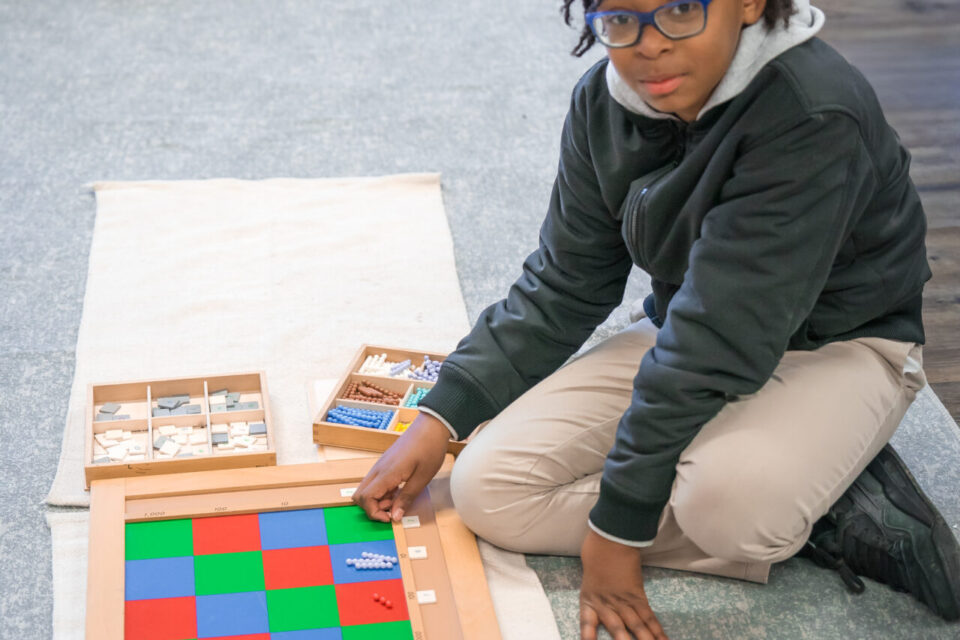
Another time, I asked a few volunteer teachers to come and work with the students on re-introducing the checkerboard in small groups. I noticed that some students who tended to gravitate to Chromebooks were excited to explore this material and teach it to others. The enthusiasm was palpable. When given the chance to create their own paper checkerboard as an extension, one student actually clapped! Another student asked “Are you showing us Montessori materials to get us off of Chromebooks?” Inwardly, I smiled.
Perhaps introducing and re-examining the exercises of early childhood and lower elementary is
beneficial to the upper elementary child. We are a public school after all, and not every child has had the
chance to experience the full spectrum of Montessori education. Some enroll in preschool, while others do not enroll until 5th grade or later. Is creating or recreating experiences with early childhood materials
useful to the 9-12 year-old child? Through my observations over the days and weeks, the students demonstrated an ability to concentrate on the materials in a way that they hadn’t when it came to pencil and paper tasks. After presenting the triangle box, for example, one of the more vocal students exclaimed “That was impressive!” after an extended period of silence.
I continued to present materials in the classical Montessori way, with a clear focus on the hands,
precision of movement, and little verbalization for the remainder of my time in the classroom. An assistant with aspirations to become a teacher graciously offered to take the lead, allowing me to return to my coaching position.
This experience was one of the most challenging of my career, forcing me to stretch in ways I couldn’t
even imagine at the time. Luckily, this was not a job that I had to do alone; I had several wonderful
teachers offer their assistance and expertise to the students and me. I also remembered that there can be no growth without discomfort for both teachers and students, a lesson well learned, even in my advancing years.
The words of my Montessori mentor ring in my ears to this day; that we must always go by what the
children teach us. While there were many tears behind the scenes that my kind and supportive colleagues can attest to, I would not trade my experience with this class for the world, as the world does indeed belong to them.

Kelly Kieselbach
Kelly Kieselbach is an instructional coach and sometime Upper Elementary sub at Creative Montessori
Academy in Southgate, MI.
You may also like